


Re-Employed Officers Form Distinct Class, Cannot Demand Parity In Pay Scales: SC
 Copy Link
 Share
 Save
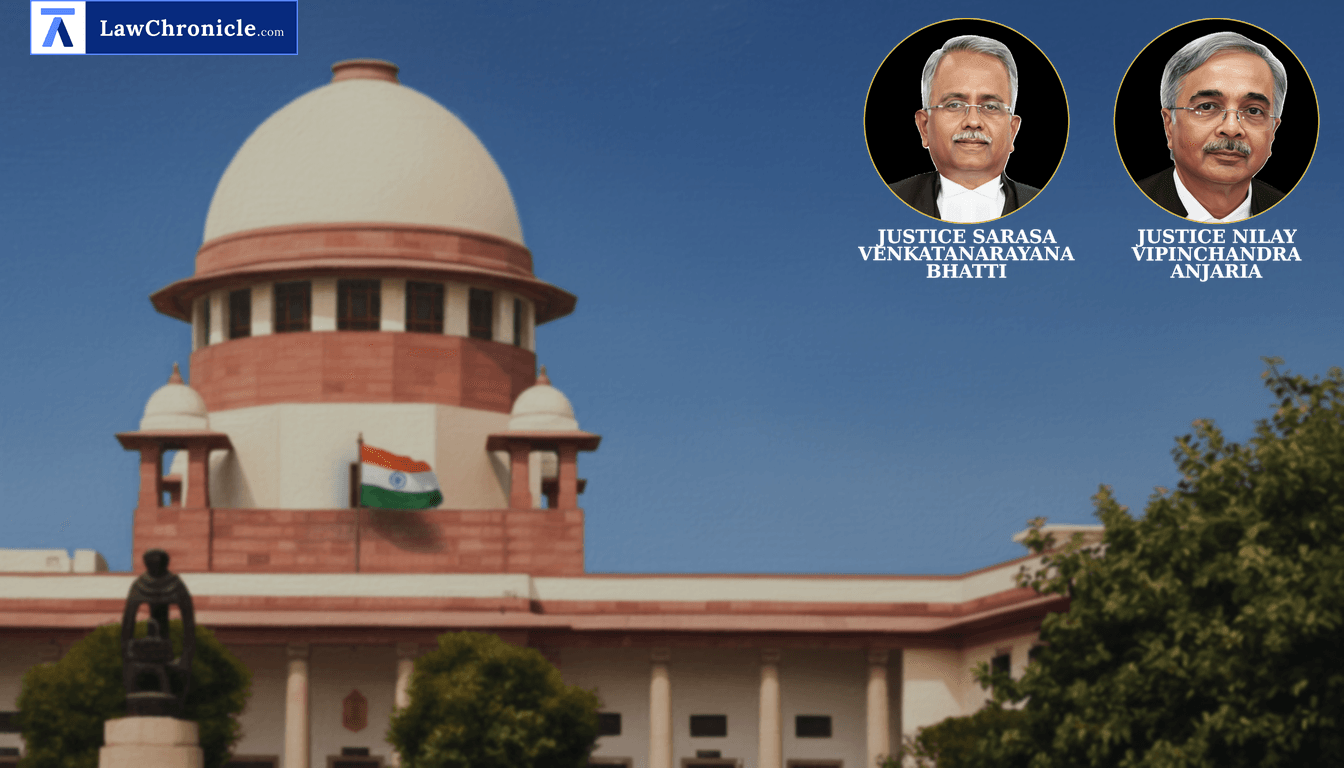
Re-employed government officers who are appointed post-superannuation constitute a separate and distinct class, disentitling them from demanding pay scale parity with regular employees under the 6th Pay Commission. Reinforcing the doctrine of reasonable classification, the Supreme Court affirmed that pay fixation remains an exclusive executive domain immune to judicial interference absent proven arbitrariness or mala fides.
A bench comprising Justice S.V.N. Bhatti and Justice N.V. Anjaria dismissed a writ petition filed under Article 32 of the Constitution of India, 1950 by former Presiding Officers of Central Government Industrial Tribunals-cum-Labour Courts (CGIT-cum-LCs). The petitioners sought directions to implement the 6th Central Pay Commission recommendations at par with other tribunals, challenging the Government's action of equating their pay scales with the District Judiciary pursuant to the Justice E. Padmanabhan Committee recommendations.
Key Takeaways
Executive Prerogative Reinforced: Determination of pay structures and classification of posts fall within the exclusive domain of the executive and expert pay bodies.
Re-Employed Pensioners as Separate Class: Post-retirement re-employed personnel do not form a homogeneous group with regular government employees for claiming equal pay scales.
Validity of Judicial Equivalence: Equating Presiding Officers of CGIT-cum-LCs with the District Judiciary based on expert commission recommendations does not violate Article 14 of the Constitution of India, 1950.
Scope of Judicial Review: Courts must exercise restraint and refrain from altering pay structures unless an explicit, admitted anomaly is established.
Court's Observations and Legal Principles
Analyzing the constitutional validity of separate pay rules for re-employed officers, the Court held that Article 14 permits reasonable classification based on an intelligible differentia. Re-employed pensioners are governed by a specific scheme, namely the Central Civil Services (Fixation of Pay of Re-employed Pensioners) Orders, 1986, and cannot assert fundamental rights to claim identical pay scales extended to regular employees.
The Court, in its reasoning, observed: "The category of re-employed officers/persons like the petitioners stand with substantial distinction against the regular officers in the employment of the government. The re-employed class could be reasonably and rationally classified separately for the purpose of applying pay scales which may not be equivalent to and on the same pedestal with the other classes. Upon re-employment, the reemployed officers/persons would cease to be homogeneous vis-a-vis class of regular officers in employment of the government."
Addressing the judicial restraint required in pay determination, the Court reiterated that pay fixation is an executive function best left to expert bodies. In State of U.P. and Others vs. J.P. Chaurasia and Others, it was established that courts are ill-equipped to evaluate pay scale differentiation unless mala fides are demonstrated. Although Union of India vs. Dineshan K.K. ( "(2008) 1 SCC 586": 2008 CaseBase(SC) 353) acknowledged judicial review in cases of apparent anomalies, the Court reaffirmed the binding precedent in Union of India vs. Indian Navy Civilian Design Officers Association and Another ( "(2023) 19 SCC 482": 2023 CaseBase(SC) 299) and Union of India vs. T.V.L.N. Mallikarjuna Rao ( "(2015) 3 SCC 653": 2014 CaseBase(SC) 656), which held that tribunals and courts cannot sit in appeal over the wisdom of the executive in structuring pay grades. Applying the principles governing Article 14 laid down in Charanjit Lal Chowdhury vs. Union of India ( "1950 SCC 833": 1950 CaseBase(SC) 21), the Court ruled that distinct conditions of service justify differential pay structures.
Ratio
Re-employed post-superannuation pensioners do not share homogeneity with regular employees and constitute a valid separate class for pay fixation. Classification of posts and determination of pay structures fall within the exclusive domain of the executive, and courts will not interfere with pay scale equations recommended by expert committees under Article 14 and Article 16 of the Constitution of India, 1950 absent manifest arbitrariness or statutory violations.
Background
The petitioners were appointed as Presiding Officers of CGIT-cum-LCs at New Delhi and Hyderabad on deputation and subsequently re-employed post-superannuation up to 65 years of age under Section 7 and Section 7A of the Industrial Disputes Act, 1947. They contended that their tribunals shared equal pedestal with other Central tribunals constituted under Articles 247, 323-A, and 323-B of the Constitution of India, 1950, making the denial of 6th Pay Commission pay scales discriminatory.
The Union of India resisted the petition, pointing out that pay scales for Presiding Officers of CGIT-cum-LCs had historically been equated with the District Judiciary based on the First National Judicial Pay Commission (Shetty Commission) and subsequently revised under the Justice E. Padmanabhan Committee report. The Ministry of Finance and Department of Personnel and Training declined to extend 6th Pay Commission scales, relying on the statutory rules governing re-employed pensioners.
Finding no irrationality or constitutional infirmity in placing re-employed Presiding Officers at par with District Judges, the Supreme Court held the petition to be devoid of merit and dismissed it without granting relief.
Case Details:
Case No.: Writ Petition (C) No. 193 of 2012
Neutral Citation: 2026 INSC 848
Case Title: R.K. Yadav & Anr. v. Union of India and Others
Appearances:
For the Petitioner(s): Mr. Nishant Krishan Yadav, Advocate
For the Respondent(s): Ms. Archana Pathak Dave, Additional Solicitor General, with Mr. Amrish Kumar, Advocate-on-Record
Source: 2026 CaseBase(SC) 778
Similar Articles


 Breaking News


