


Supreme Court upholds Validity of Deduction of Pension From Salary of Post-Retirement Appointees
 Copy Link
 Share
 Save
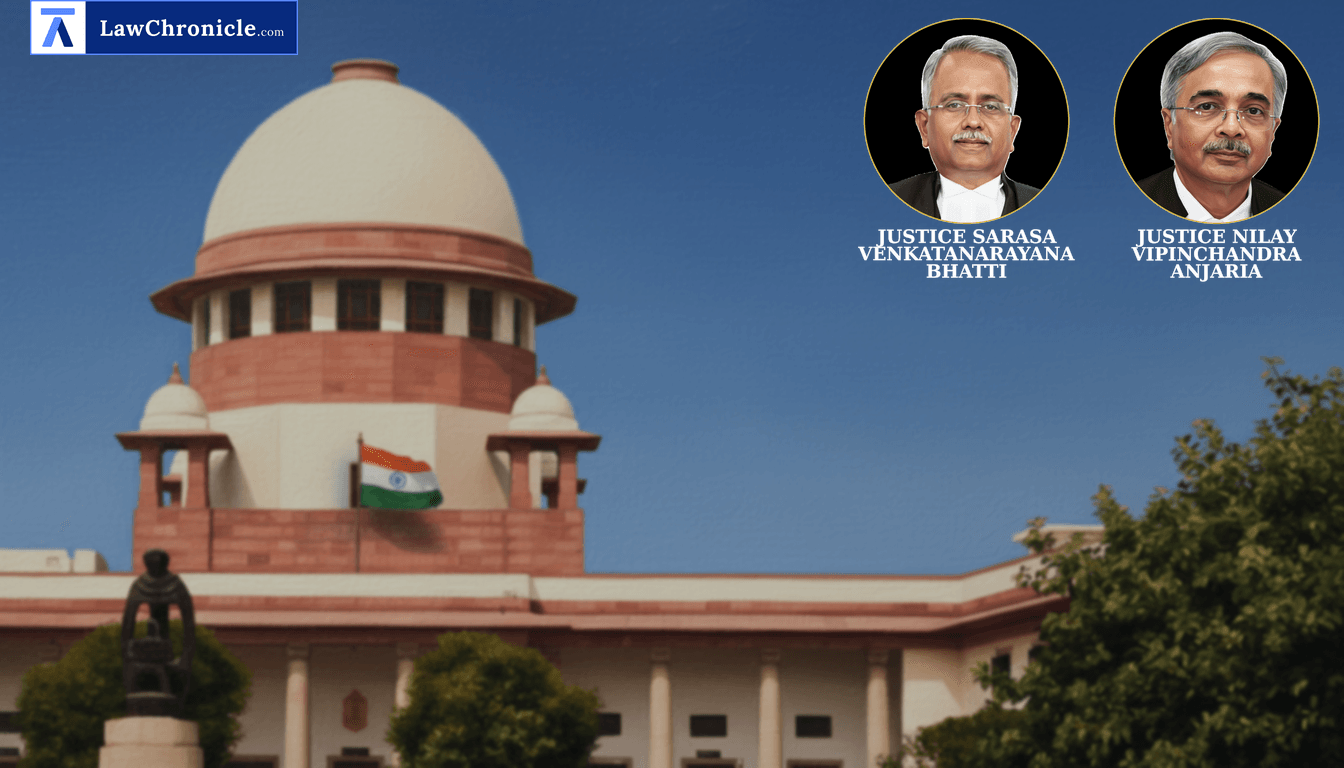
In a major verdict clarifying pay fixation norms for constitutional posts, the Supreme Court has ruled that withholding a retired government servant's pension during their post-superannuation tenure as PSC Chairman or Member does not violate the doctrine of equal pay for equal work.
A Division Bench comprising Justice S.V.N. Bhatti and Justice N.V. Anjaria set aside a High Court judgment that had struck down pay-minus-pension rules, holding that deferring pension payments during post-retirement constitutional appointments is fully permissible in law.
Key Takeaways
1. Pay-Minus-Pension Norm Upheld: Retaining or withholding pension earned from previous service during re-employment on constitutional posts is legally valid and does not constitute an illegal reduction of salary.
2. Equal Pay Doctrine Inapplicable: The principle of 'equal pay for equal work' under Constitution of India, 1950 cannot be invoked to claim full salary in addition to previous service pension.
3. Principle of Estoppel Applies: Appointees who accept constitutional positions with full knowledge of prevailing service conditions cannot subsequently challenge the validity of those rules.
Court Observations and Directions
The Supreme Court observed that keeping pension in abeyance during the tenure on a constitutional post does not amount to a permanent withdrawal of pensionary benefits. The entitlement revives fully once the appointee leaves office. Rejecting the High Court's reasoning on Article 16 of the Constitution of India and Article 39(d) of the Constitution of India, the Apex Court observed that adding pension to admissible salary would lead to absurd outcomes where total compensation exceeds the prescribed basic pay of the post.
The Court, in its reasoning, observed: "At the end of the tenure of the Chairman or, as the case may be, the Member, the entitlement to pension which was kept in abeyance would revive and the petitioners-respondent No.1 herein would get the pension deducted during the tenure of their chairmanship or membership of the Uttarakhand PSC. In other words, there is no withdrawing of the pension, it is only the withholding during the period when the posts of the Chairman or, as the case may be, the Member of the Uttarakhand PSC is held."
Addressing the challenge against Regulation 7(2) of the Uttarakhand Public Service Commission (Conditions of Service) Regulations, 2004, the Apex Court held that the Governor's determination to deduct pension operates retroactively and is fully valid. The Court further placed reliance on Gurmesh Prakash Bishnoi vs. State of Haryana and Others ( "(1998) 5 SCC 260": 1998 CaseBase(SC) 772) to emphasize that temporary suspension of pension during re-employment in a higher constitutional capacity is a recognized legal mechanism.
The Court has following directions:
"The present appeals are allowed. Any interlocutory application, if pending, shall cease to survive in view of the disposal of the appeal."
Ratio
Fixation of salary for retired government servants appointed to constitutional posts on a 'pay-minus-pension' basis under statutory regulations does not violate Constitution of India, 1950 or Article 39(d) of the Constitution of India of the Constitution of India, 1950, as keeping previous pension in abeyance during the tenure does not amount to forfeiture of pension or adverse variation of service conditions.
Background
The dispute arose when retired Lieutenant General M.C. Bhandari and retired PCS Officer Sohan Lal were appointed as Chairman and Member of the Uttarakhand Public Service Commission respectively in 2006. While fixing their salaries under Regulation 7 of the Uttarakhand Public Service Commission (Conditions of Service) Regulations, 2004, the State Government deducted the amount of pension drawn by them for their past services.
The appointees challenged Regulation 7(2) before the High Court of Uttarakhand, arguing that pension was a vested right for past service and had no nexus with their duties at the Commission. The High Court allowed their writ petitions, declaring Regulation 7(2) ultra vires Constitution of India, 1950 read with Article 39(d) of the Constitution of India of the Constitution of India, 1950 on the ground of 'equal pay for equal work'. Aggrieved, the State of Uttarakhand appealed to the Supreme Court.
Reversing the High Court's findings, the Supreme Court held that the respondents were aware of the rules when accepting the appointments and were estopped by the doctrine of acquiescence from challenging the regulations after serving out major portions of their tenures.
Case Details:
Case No.: Civil Appeal No. 1614 of 2011
Neutral Citation: 2026 INSC 1194
Case Title: State of Uttarakhand thr. Chief Secretary and Others v. M.C. Bhandari and Another
Source: 2026 CaseBase(SC) 9531
Similar Articles
 Breaking News


