Reference Courts Must Assess Compensation Adequacy Despite Claimant Absence: Gujarat HC
 Copy Link
 Share
 Save
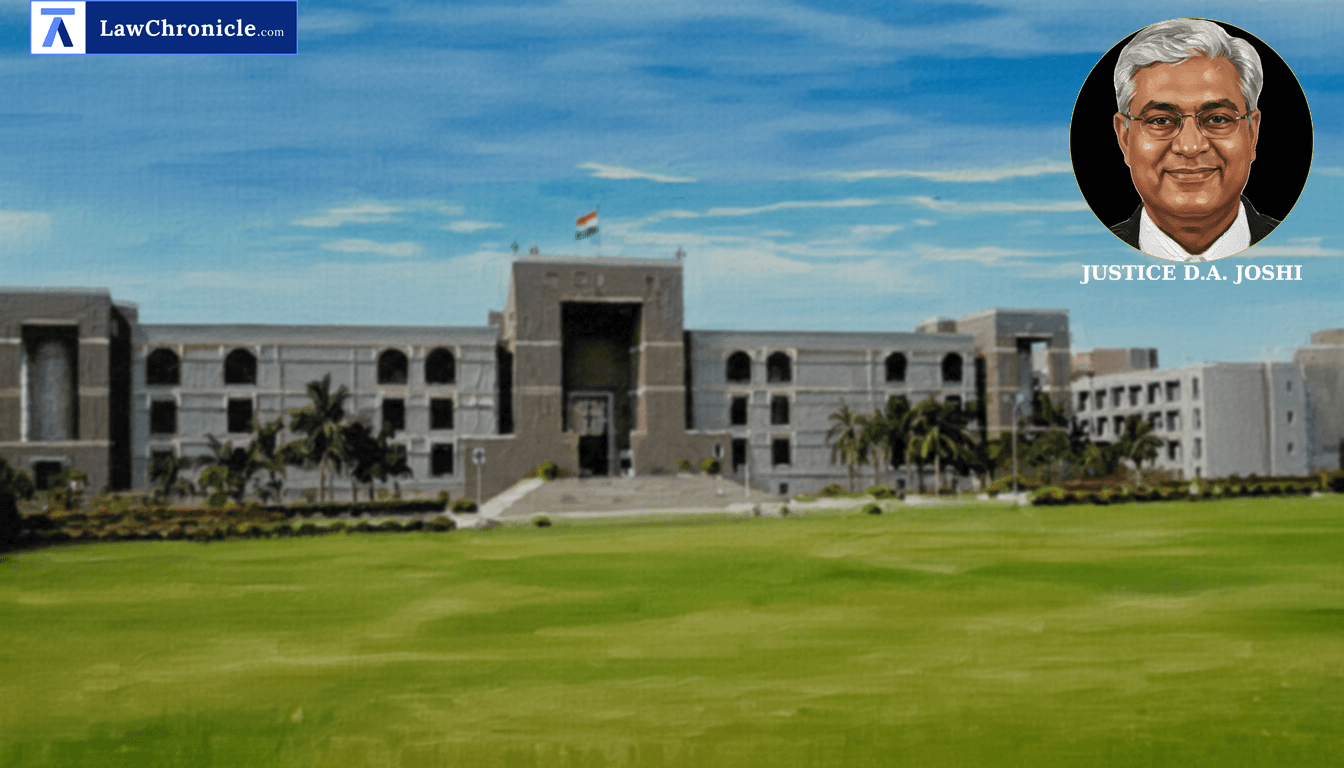
In a decisive move to protect the rights of landowners, the Gujarat High Court has ruled that Reference Courts cannot summarily dismiss compensation claims due to the absence of claimants, emphasizing that land acquisition proceedings are not adversarial in nature. The Court held that the judiciary bears a fundamental duty to ensure 'just and reasonable' compensation whenever citizens are deprived of their property, even if litigants show initial negligence in producing evidence.
Justice Divyesh A. Joshi, presiding over the matter, heard an appeal challenging the dismissal of reference proceedings where claimants had failed to appear and adduce evidence. The Court noted that in such significant matters involving the loss of land, the technicality of non-appearance should not result in a total denial of the right to seek enhanced compensation.
Key Takeaways
Non-Adversarial Character of Reference
Land acquisition reference proceedings are not strictly adversarial; Courts must proactively ensure that compensation is adequate for those who have lost their land.
Duty to Determine Fair Value
Reference Courts are mandated to go into the issue of awarding compensation and assess its adequacy, rather than dismissing cases for default of appearance.
Conditional Restoration
While litigants are granted a second chance to prove their case, they must waive interest for the period of delay to balance the scales of justice and prevent taking advantage of their own negligence.
Court's Rationale on Compensation Adequacy
The Court observed that the primary function of a Reference Court is to act as a guardian of the landowner's right to fair compensation. Relying on a precedent set in First Appeal No. 4258 of 2022, the bench reiterated that the Reference Court must undertake an exercise to assess the adequacy of compensation in the background that the claimants have lost possession of their land.
The Court, in its reasoning, observed: "In the land reference cases, it is the duty of the learned reference Court to go into the issue of awarding compensation and to assess the same for its adequacy in the background that the claimants have lost possession of their land. In the present case, no such exercise has been undertaken by the learned reference Court."
The bench further clarified: "In reference, person who has lost land and seeking enhancement has to be given opportunity since it is not adversarial forum of litigation."
Directions to the Reference Court
The Court has the following directions:
"The impugned order is quashed and set aside. Accordingly, Reference proceedings is restored before the learned Court concerned with direction to decide the same within period of three months from the date of receipt of present order. The appellant-claimants are directed to remain present before the Reference Court on each and every date of hearing of the matter and co-operate learned Trial Court in disposing the matter as early as possible. It is also directed that the appellants-claimants shall not be entitled for any interest for delayed period of 2881 days."
Ratio
In land reference cases, the Reference Court is under a legal obligation to independently assess the adequacy and fairness of the compensation awarded to landowners. Since these proceedings are not purely adversarial, a claim for enhancement cannot be dismissed solely on the ground of the claimant's failure to produce evidence or remain present, and an opportunity must be granted to adduce evidence to ensure the determination of just and reasonable compensation.
Background
The appellants, whose lands were acquired for irrigation purposes, had filed reference proceedings seeking enhancement of the compensation awarded by the Land Acquisition Officer. However, the Reference Court dismissed the proceedings because the claimants were unable to remain present or adduce evidence despite opportunities.
The appellants approached the High Court arguing that they deserved a final opportunity to present their case, even offering to waive interest for the period of delay (2881 days) caused by their negligence. The State, represented by the Assistant Government Pleader, contended that the Reference Court was justified in its dismissal as ample opportunities were already provided.
Following the principles laid down in First Appeal No. 862 of 2022 and First Appeal No. 4258 of 2022, the High Court set aside the dismissal and remanded the matter for fresh consideration on merits, subject to the condition that no interest would be payable to the claimants for the period of delay.
Case Details:
Case No.: R/FIRST APPEAL NO. 4542 of 2026
Neutral Citation: 2026:GUJHC:69710
Case Title: Narshibhai Thakarshibhai Nandasana & Ors. Versus The Deputy Collector Special Land Acquisition Officer And Rehabilitation (Irrigation) & Anr.
Appearances:
For the Petitioner(s): Mr Krushnakant D Patel, Mr Tejas P Satta
For the Respondent(s): Ms. Dixa Pandya, Ld. Asst. Government Pleader
Source: 2026 CaseBase(GUJ) 31975
 Breaking News