


Safeguards under BNSS Section 175(3) Not Empty Formalities: Allahabad HC
 Copy Link
 Share
 Save
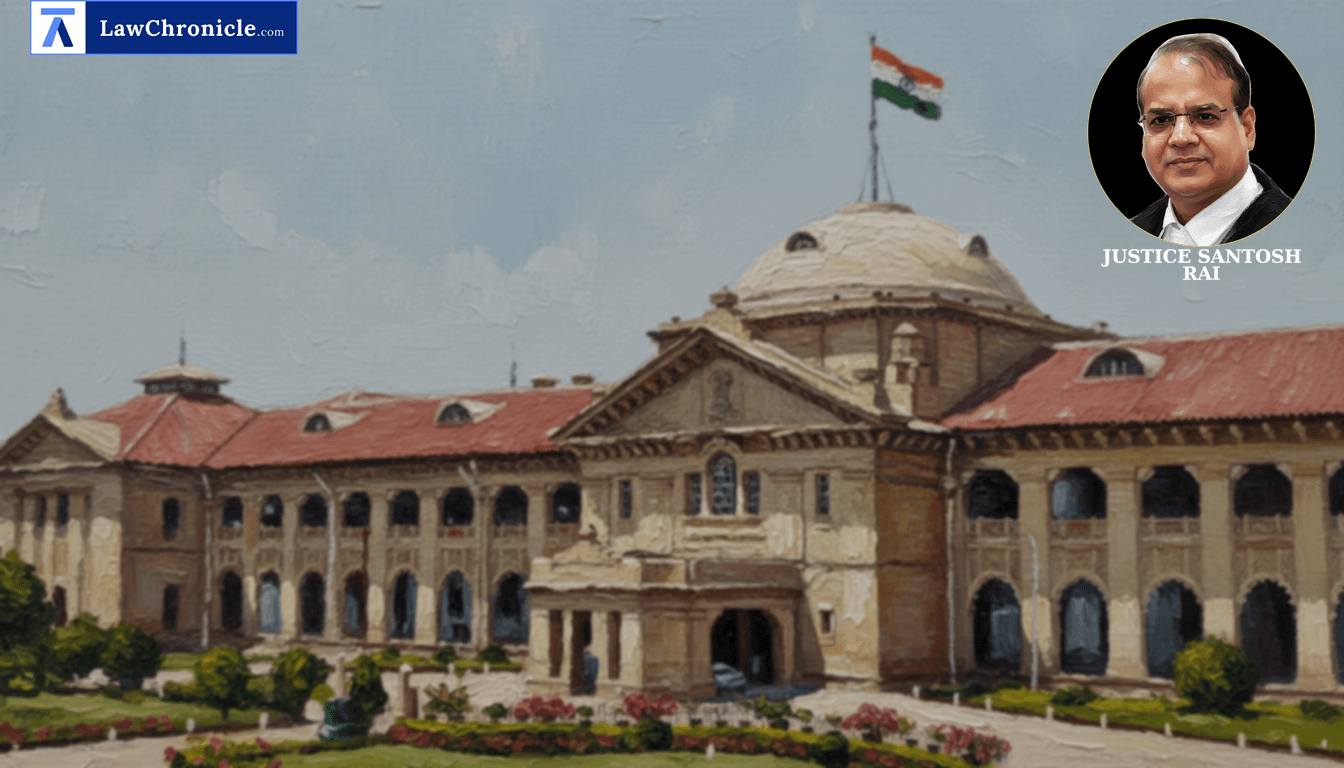
In a decisive check on judicial overreach, the Allahabad High Court has ruled that Magistrates cannot mechanically order FIRs against public servants without conducting the mandatory inquiries and considering police submissions as now necessitated under the Bharatiya Nagarik Suraksha Sanhita, 2023. The Court underscored that the transition from the old Code to the new Sanhita has introduced substantive procedural safeguards designed to prevent the harassment of officials performing their lawful duties.
Justice Santosh Rai heard the criminal appeal challenging an order by a Special Judge who had directed the registration of an FIR against a Sub-Inspector and several police personnel. The case arose from allegations of house trespass and outraging modesty during a police raid, which the appellants contended was a counter-blast to earlier criminal proceedings.
Key Takeaways
Mandatory Judicial Inquiry
Magistrates must now explicitly consider if an inquiry is necessary under Section 175(3) of the Bharatiya Nagarik Suraksha Sanhita, 2023, marking a departure from the simple power under the old Code.
Public Servant Protections
Section 175(4) of the Bharatiya Nagarik Suraksha Sanhita, 2023 acts as a specific shield, requiring a report from superior officers and the version of the accused official before any investigation is ordered.
Curbing Vengeful Litigation
Courts are directed to exercise 'heightened judicial caution' when complainants file cases against police officers who have previously arrested them or their family members.
Speaking Orders Required
Every judicial order directing an investigation must now be a reasoned document addressing compliance with statutory prerequisites and the nexus with official duties.
Enhanced Safeguards Under Section 175(3) BNSS
The Allahabad High Court observed that the Bharatiya Nagarik Suraksha Sanhita, 2023 has introduced significant changes to the mechanism of ordering investigations. Unlike the erstwhile Section 156(3) of the Code of Criminal Procedure, 1973, the new Section 175(3) requires the Magistrate to consider the application supported by an affidavit, conduct an inquiry if necessary, and consider the submissions of the police officer.
The Allahabad High Court observed that "The expression 'such inquiry as he thinks necessary' undoubtedly confers judicial discretion upon the Magistrate regarding the nature, extent and manner of the inquiry warranted by the facts of the particular case. However, such discretion cannot be construed as conferring a power to completely ignore the statutory requirement of applying his/her mind to whether an inquiry is necessary."
Directives to Judicial Officers
The Allahabad High Court noted with 'serious concern' the mechanical approach of the Special Judge and issued a series of mandatory guidelines for all judicial officers in Uttar Pradesh. The Bench issued the following directions:
"(i) All the Judicial Officers exercising jurisdiction under Section 173(4) and 175 of the BNSS shall bear in mind that the words “after making such inquiry as he thinks necessary” occurring in Section 175(3) BNSS are a conscious and substantive statutory departure from the erstwhile Section 156(3) Cr.P.C. The object is not to conduct a ‘mini-trial’ at the stage of Section 175(3) BNSS, but to ensure that the statutory power of directing police investigation is exercised judicially and not mechanically.
(ii) The Judicial Officers shall consider the submission/report of the concerned police officer regarding the refusal or failure to register the FIR before passing an order under Section 173(4) and Section 175(3) BNSS.
(iii) Before exercising jurisdiction under Section 173(4)/175(3) BNSS, the Court shall verify that the applicant has followed the statutory course contemplated by Section 173 BNSS. The power under Section 175(3) BNSS is not intended to permit a complainant to introduce an entirely new factual foundation before the Magistrate after the police have declined to register the original information.
(iv) Section 175(4) BNSS is not an independent or stand-alone mechanism by which the safeguards contained in Section 175(3) BNSS can be bypassed. The sub-sections (3) and (4) must be read harmoniously and that an application against a public servant, where the allegation arises in the course of official duty, must also satisfy the procedural requirements applicable under Section 175(3) BNSS.
(v) Where, on a prima facie consideration of the complaint, the alleged act appears to have arisen in the course of discharge of official duties, the Magistrate and Special Courts shall follow the procedure contemplated by Section 175(4) BNSS.
(vi) Whenever Section 175(4) BNSS is attracted or is specifically relied upon, the judicial order shall contain a brief but clear finding as to whether the alleged act bears a reasonable nexus with the discharge of official duty. Such finding shall be based upon the material available before the Court, including the material gathered in the inquiry under Section 175(3) BNSS, the police report/submission and, where applicable, the report and assertions contemplated under Section 175(4) BNSS.
(vii) The Magistrates and Special Courts ‘shall exercise heightened judicial caution’ where the proposed accused is a public servant or police officer/police personnel...""
Ratio
An order directing the registration of an FIR under Section 175(3) or 175(4) of the Bharatiya Nagarik Suraksha Sanhita, 2023 must be a speaking and reasoned judicial order. It must demonstrate the application of mind to three distinct statutory requirements: consideration of the affidavit-supported application, the necessity of an inquiry, and the consideration of submissions made by the police officer. In cases involving public servants, the additional procedural layer of Section 175(4) must be harmoniously integrated to determine if the alleged act bears a reasonable nexus with official duties.
Background
The dispute originated from a land and money conflict between two families. On the night of June 6, 2026, police personnel, including the appellants, conducted a raid following a clash. The complainants alleged that the officers forced entry without a warrant, committed obscenity, and made caste-based remarks. However, the police record showed that the raid was part of official duties following a PRV/112 call and had resulted in the arrest of the complainants' family members in cross-cases. The Special Judge ordered an FIR against the officers based solely on the complaint.
The Allahabad High Court, relying on precedents like State of Haryana & Ors. Vs. Bhajan Lal & Ors., Anil Kumar & Ors. Vs. M.K. Aiyappa & Anr. ( "(2013) 10 SCC 705": 2013 CaseBase(SC) 485), and Priyanka Srivastava & Anr. Vs. State of U.P. & Ors. ( "(2015) 6 SCC 287": 2015 CaseBase(SC) 248), held that the Special Judge failed to consider the 'counter-blast' nature of the complaint. The Court also cited the recent rulings in Om Prakash Ambadkar Vs. State of Maharashtra & Ors. ( "(2026) 2 SCC 622": 2025 CaseBase(SC) 280) and XXX Vs. State of Kerala & Ors. ( "(2026) 6 SCC 770": 2026 CaseBase(SC) 50) to emphasize the new statutory safeguards. Consequently, the Allahabad High Court set aside the impugned order and quashed all consequential proceedings.
Case Details:
Case No.: CRIMINAL APPEAL No. - 8381 of 2026
Case Title: Rakesh Kumar Yadav Versus State of U.P. and 2 others
Appearances:
For the Petitioner(s): Ram Pravesh Yadav, Shashank Kumar
For the Respondent(s): Pawan Kumar, G.A., Sushil Pandey, AGA
Source: 2026 CaseBase(ALL) 1194
Similar Articles
 Breaking News


