


Sale Deeds Exempt from Attestation Requirements Under Evidence Act: SC
 Copy Link
 Share
 Save
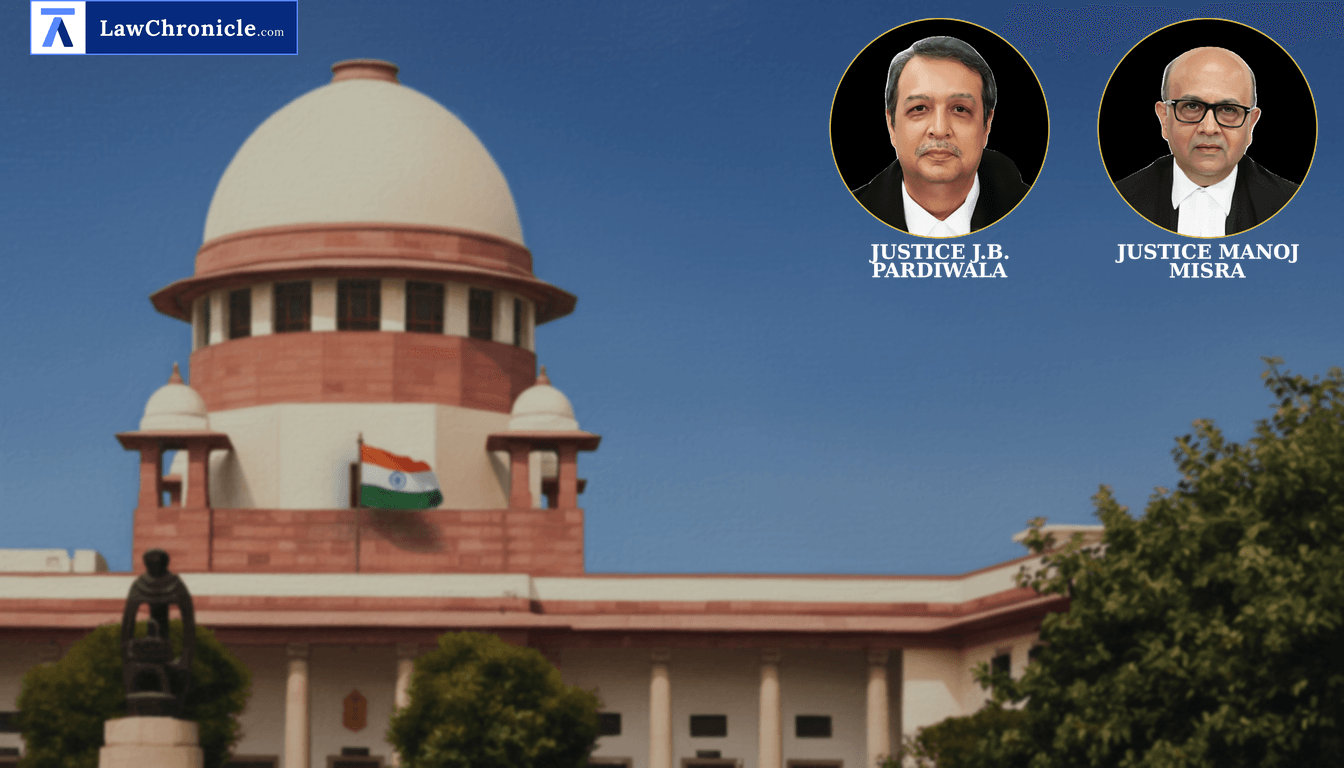
The Supreme Court has delivered a definitive clarification on the interplay between property transfers and evidentiary standards, ruling that Section 68 of the Indian Evidence Act, 1872 does not apply to registered sale deeds as they are not documents mandatorily required by law to be attested. This judgment effectively shields thousands of property transactions from the rigorous attestation-proof standards reserved for Wills and Gift deeds, while simultaneously rebuking High Courts for deciding second appeals without formulating mandatory substantial questions of law.
A bench comprising Justice J.B. Pardiwala and Justice Manoj Misra set aside a Kerala High Court judgment that had erroneously applied the proviso to Section 68 to a 1978 sale deed dispute. The apex court emphasized that judicial discipline requires strict adherence to procedural mandates under the Code of Civil Procedure, 1908 when entertaining second appeals.
Misapplication of Evidence Act to Sale Deeds
The controversy arose from a suit for declaration of title and recovery of possession. The High Court had reversed the first appellate court's findings by relying on the proviso to Section 68 of the Indian Evidence Act, 1872. However, the Supreme Court noted that this was a fundamental legal error. The Court clarified that unlike a Will or a Gift deed, a sale deed under Section 54 of the Transfer Of Property Act, 1882 only requires a registered instrument and not attestation.
In its reasoning, the Court observed: "Section 68 of the Indian Evidence Act provides how a document, required to be attested by law, is to be proved. It provides that such a document is to be proved by examining at least one attesting witness... A sale deed being not required by law to be attested, the provisions of Section 68 of the Indian Evidence Act on the face of it is not applicable."
The Jurisdictional Mandate of Section 100 CPC
The Supreme Court further criticized the High Court for allowing the second appeal without formulating any substantial question of law, a step deemed mandatory by the Code of Civil Procedure, 1908. Referring to Nazir Mohamed v. J. Kamala and Others ( "(2020) 19 SCC 57": 2020 CaseBase(SC) 1332) and Government of Kerala v. Joseph ( "2023 INSC 693": 2023 CaseBase(SC) 53), the Court reiterated that formulation of such questions is a condition precedent for exercising jurisdiction under Section 100.
Court Directions
The Court issued the following directions: "The appeal stands allowed in the above terms. We request the High Court to ensure that the Second Appeal is heard afresh after formulating substantial question(s) of law and the same is disposed of within a period of three months from the date of the receipt of the writ of this order. The High Court shall inform about the disposal of the Second Appeal to this Court. The Registry shall forward one copy each of this judgment to all the High Courts."
Key Takeaways:
Narrow Scope of Section 68 Proviso
Exempts documents not requiring mandatory attestation from the 'specific denial' proof rule, preventing misinterpretation of sale deed validity.
Strict Adherence to Section 100 CPC
High Courts cannot bypass the formulation of substantial questions of law; doing so renders the judgment vitiated and liable to be set aside.
Clarification on Provisos
Reaffirms that a proviso cannot expand the scope of the main enactment but must be construed as a qualifying exception to the principal matter.
Ratio Decidendi:
Section 68 of the Indian Evidence Act, 1872 and its proviso apply exclusively to documents that are mandatorily required by law to be attested (such as Wills, Gift Deeds, or Mortgages). Since a sale deed governed by the Transfer Of Property Act, 1882 does not require compulsory attestation, it falls outside the ambit of Section 68, and its execution need not be proved through an attesting witness even if its execution is specifically denied.
Background:
The appellants (original defendants) challenged a High Court order that restored a trial court decree in favour of the respondents (original plaintiffs). The dispute involved a 6.5-cent plot of land. The plaintiffs claimed title based on a 1978 sale deed (Ext. A3), while the defendants claimed the document was bogus and relied on a 1996 sale deed (Ext. A4). The First Appellate Court had dismissed the suit, finding the attesting witness's testimony for the 1978 deed unreliable. However, the High Court allowed the second appeal by incorrectly interpreting Section 68 of the Indian Evidence Act, 1872 to mean that a denial of execution must be made through a separate suit or counterclaim. The Supreme Court relied on precedents like Hans Raji (Smt.) v. Yosodanand and Bayanabai Kaware v. Rajendra s/o Baburao Dhote to hold that Section 68 does not cover transactions like sale deeds. The matter has been remitted to the Kerala High Court for fresh disposal.
Case Details:
Case No.: CIVIL APPEAL NO. 6526 OF 2024
NeutralCitation: 2026 INSC 703
Case Title: R. Veronica & Anr. V. Rudrayani Devaki(D) Through Lrs. S. Satha Kumar & Ors.
Appearances:
For the Petitioner(s): Mr. Prakash Ranjan Nayak, Advocate
For the Respondent(s): Mr. Ankur S. Kulkarni, Advocate
Source: 2026 CaseBase(SC) 658
Similar Articles
 Breaking News


