


SC Clarifies Order II Rule 2 CPC Requires Evidence; Not Ground for Order VII Rule 11(D) CPC Rejection
 Copy Link
 Share
 Save
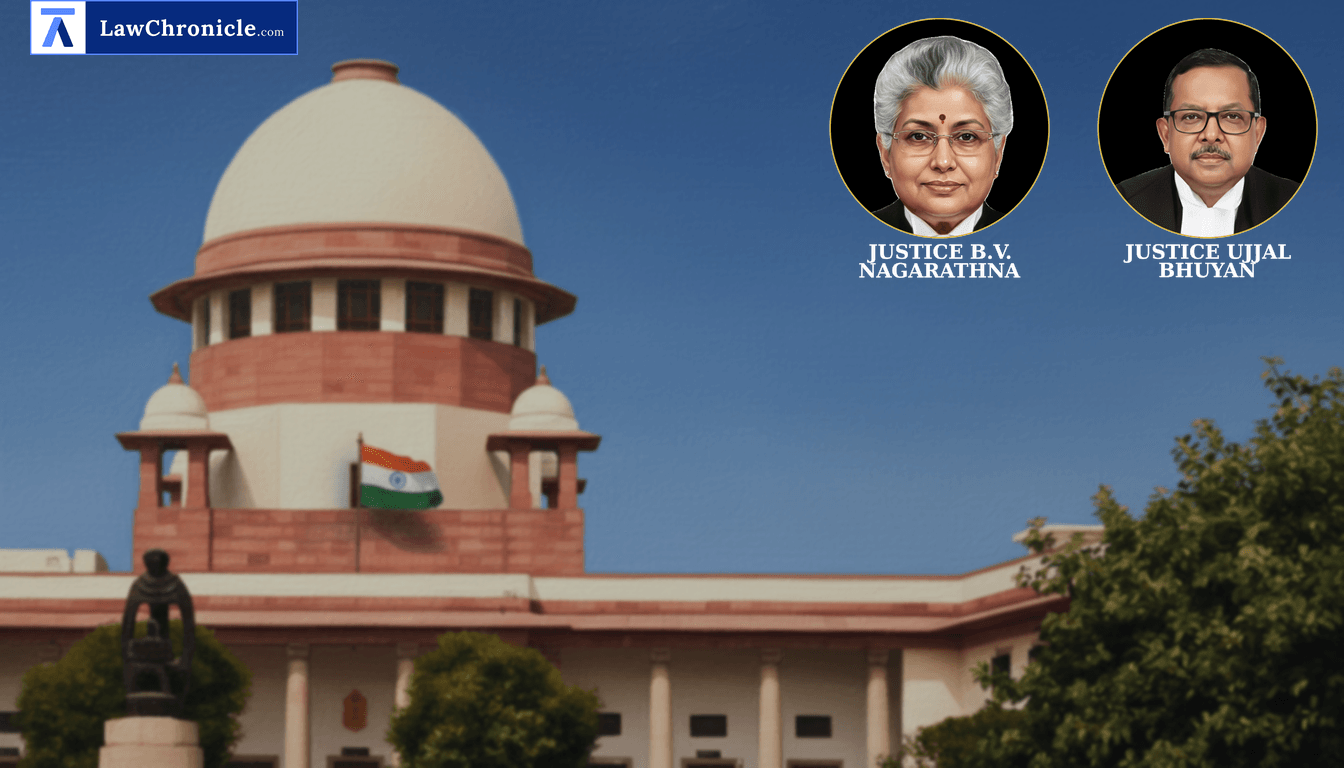
A bench of Justice B.V. Nagarathna and Justice Ujjal Bhuyan heard an appeal challenging the Madras High Court order dated 11.07.2019 which had set aside the trial court order in O.S. No.2320 of 2013 and rejected the plaint on the ground that the second suit was barred by Order II Rule 2 of the Code of Civil Procedure, 1908. The issue before the Court was whether a plea under Order II Rule 2 of the Code of Civil Procedure, 1908 could justify rejection of a plaint under Order VII Rule 11 of the Code of Civil Procedure, 1908 without evidence, and whether the second suit raised a distinct cause of action from the first suit (O.S. No.4722 of 2012).
The Supreme Court allowed the appeal, set aside the High Court order and restored the trial court's order which had retained the plaint in O.S. No.2320 of 2013. The Court held that a plea under Order II Rule 2 of the Code of Civil Procedure, 1908 could not be treated as a ground for rejection of the plaint under Order VII Rule 11(d) of the Code of Civil Procedure, 1908 and that ordinarily the defendant must prove by evidence that the subsequent suit was founded on the same cause of action as the earlier suit. The Court noted important authorities on the scope of rejection of a plaint and on the meaning of "cause of action," and explained that the inquiry under Order VII Rule 11(d) was limited to a meaningful reading of the plaint and the documents annexed thereto.
The Court, in its reasoning, observed: "On a conjoint reading of Order II Rule 2 with Order VII Rule 11(d) of the Code, it emerges that the plea under Order II Rule 2 of the Code cannot be a basis or a ground for rejection of the plaint. In other words, it is for the defendant to establish by way of evidence, the bar of the subsequent suit under Order II Rule 2 of the Code filed by the very same plaintiff. In such an event, on a comparative analysis of the plaint filed in the first suit and the plaint filed in the second suit, if the Court comes to the conclusion that the second suit was filed on an identical cause of action which led to the filing of the first suit and there was an omission to make the claim or to reserve the reliefs to be claimed in the first suit in a subsequent suit, then the bar under Order II Rule 2 of the Code would apply to the subsequent suit or the second suit. Then the claims or reliefs not maintainable would be rejected as the plaintiff could not have sued for those reliefs by filing a second suit, although technically, the filing of such a suit was not barred by any law. On the other hand, if the cause of action for filing the second suit is totally distinct from the cause of action from filing the first suit and the reliefs claimed are distinct, subject-matter of the suits are different and if the parties to the suit are also different then in such a case, the plea under Order II Rule 2 of the Code would not arise at all. The above are, inter alia, the heads of distinction to be analysed while analysing the plaints in the first/former suit and a subsequent suit."
Background
The dispute arose from an alleged oral family settlement of 01.11.2011, a registered Power of Attorney dated 04.11.2011 and subsequent settlement deeds executed in November 2011. The parents (plaintiffs in the first suit) filed O.S. No.4722 of 2012 seeking injunctions concerning a Chennai property and bank accounts, alleging intimidation and undue influence by their son. After the father died, the widow and daughters filed O.S. No.2320 of 2013 seeking a declaration that the Power of Attorney dated 04.11.2011 was illegal and consequential reliefs; they also sought interim relief under Order XXXIX Rules 1 and 2 of the Code of Civil Procedure, 1908. The trial court declined the defendants' application under Order VII Rule 11 of the Code of Civil Procedure, 1908 and granted interim injunction; the High Court reversed that view and treated the second suit as barred under Order II Rule 2 of the Code of Civil Procedure, 1908, rejecting the plaint. The Supreme Court held that the High Court erred in treating averments in the second plaint as if they were evidence and in conflating the bar under Order II Rule 2 with the ground for rejection under Order VII Rule 11(d). The Court restored the trial court order and emphasized that whether Order II Rule 2 applied required evidence demonstrating identity of cause of action; concurrently the Court observed that its appellate remarks were confined to the procedural question and "All observations made in this appeal are only for the purpose of disposal of this appeal and would not have a bearing on the merits of the suit to be tried by the trial court." The appeal was disposed with costs to be borne by the respective parties.
The judgment discussed precedent and statutory interpretation: the Court relied on T. Arivandandam vs. T.V. Satyapal ( "(1977) 4 SCC 467": 1977 CaseBase(SC) 44) to underscore the proper exercise of Order VII Rule 11 review, cited Roop Lal Sathi vs. Nachhattar Singh Gill, Raptakos Brett & Co. Ltd. vs. Ganesh Property and Saleem Bhai vs. State of Maharashtra ( "(2003) 1 SCC 557": 2002 CaseBase(SC) 394) for the proposition that the plaint must be read as a whole, and followed the guidance in R.K. Roja vs. U.S. Rayudu ( "(2016) 14 SCC 275": 2016 CaseBase(SC) 675) and Kuldeep Singh Pathania vs. Bikram Singh Jaryal ( "(2017) 5 SCC 345": 2017 CaseBase(SC) 522) that the court must ordinarily confine itself to the averments in the plaint when deciding rejection. It referred to the 1936 authority Maqsud Ahmad vs. Mathra Datt & Co. and later decisions Sejal Glass Ltd. vs. Navilan Merchants Private Ltd., Madhav Prasad Aggarwal vs. Axis Bank Ltd. ( "(2019) 7 SCC 158": 2019 CaseBase(SC) 1699) and Sri Biswanath Banik vs. Sulanga Bose on the rule that a plaint cannot be rejected in part, and it noted tests articulated in B. Shambumal vs. State Bank of Mysore, State of Uttar Pradesh vs. Mool Chand and the Privy Council decision in Mohammad Khalil Khan vs. Mahbub Ali Mian about the meaning of "cause of action." The Court placed particular reliance on Cuddalore Powergen Corporation Ltd. vs. Chemplast Cuddalore Vinyls Limited, which it said elaborated the tests for applying Order II Rule 2 and explained the burden on the defendant to establish identity of causes of action.
Case Details:
Case No.: Civil Appeal No.3624 of 2024
NeutralCitation: 2026 INSC 372
Case Title: S. VALLIAMMAI & OTHERS v. S. RAMANATHAN & ANOTHER
Source: 2026 CaseBase(SC) 334
Similar Articles




 Breaking News


