


SC: Courts Should Liberally Allow Pleading Amendments to Prevent Multiple Litigation
 Copy Link
 Share
 Save
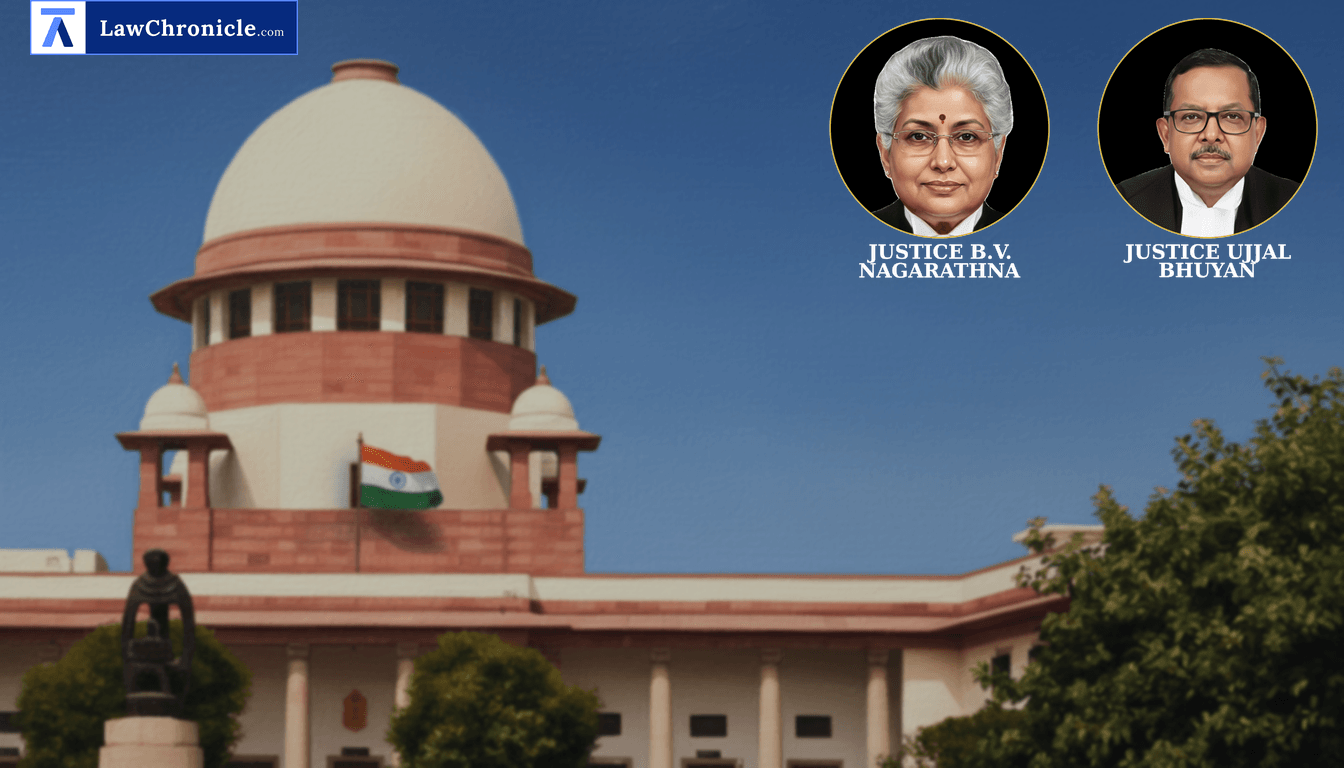
The Supreme Court emphasized that courts should adopt a liberal approach when deciding applications for amendment of pleadings to ensure that the real questions in controversy are determined and to prevent unnecessary multiple litigations.
A bench comprising Justice B.V. Nagarathna and Justice Ujjal Bhuyan heard the challenge against a High Court order that had set aside a trial court's permission to amend a plaint schedule. The apex court set aside the High Court's findings, noting that procedural technicalities should not impede the delivery of justice, especially when no prejudice is caused to the opposing party.
Criteria for Allowing Amendment of Pleadings
The Court examined the scope of Order VI Rule 17 of the Code of Civil Procedure, 1908, which governs the amendment of pleadings. The bench reiterated the two fundamental points of consideration for deciding such applications: whether the amendment is necessary for determining the real question in controversy and whether it can be allowed without causing injustice to the other side.
The Court, in its reasoning, observed: "It is a settled position of law that while deciding an application seeking amendment of pleadings, courts should not delve into the technicalities of law; rather, a liberal approach should be followed, inasmuch as the object and purpose of allowing amendment in the pleadings is to avoid multiplicity of litigation."
Trial Court's Discretion vs. High Court's Intervention
The Supreme Court found that the trial court had rightly exercised its discretion. Since the application for amendment was filed before the commencement of the trial and the respondent was granted the opportunity to file an additional written statement, there was no cause for the High Court to intervene on grounds of lack of bona fides or change in the nature of the suit.
The Court has the following directions:
"The amendment sought for by the appellants herein is consequently allowed. It is needless to observe that the suit shall be adjudicated and disposed of in accordance with law."
Background:
The appellants, owners of agricultural land, filed a suit for permanent injunction (O.S. No.52/2016) against the respondent to prevent interference with their possession. During the proceedings, the appellants realized that due to an inadvertent error, the boundaries for one of the survey numbers (Sy No. 18/5) were not mentioned in the plaint. Consequently, they filed an application under Order VI Rule 17 of the Code of Civil Procedure, 1908 to correct the schedule boundaries.
The Principal Junior Civil Judge at Kodad allowed the amendment, noting that it was necessary to resolve the dispute and would not prejudice the respondent. However, the High Court of Telangana reversed this decision, holding that the amendment would change the nature of the property and introduce a new cause of action. The Supreme Court disagreed with the High Court, restored the trial court's orders, and allowed the appeals.
Case Details:
Case No.: Civil Appeal Nos. of 2026 (@ SLP(C) Nos.17491-17492/2023)
NeutralCitation: 2026 INSC 428
Case Title: AKKIRAJU PANDURANGA RAO & ANR. VERSUS GUNDLAPALLY RANGA RAO
Source: 2026 CaseBase(SC) 552
Similar Articles

 Breaking News


