


Typographical Errors in Plaint Do Not Bar Amendments at Final Argument Stage: Karnataka HC
 Copy Link
 Share
 Save
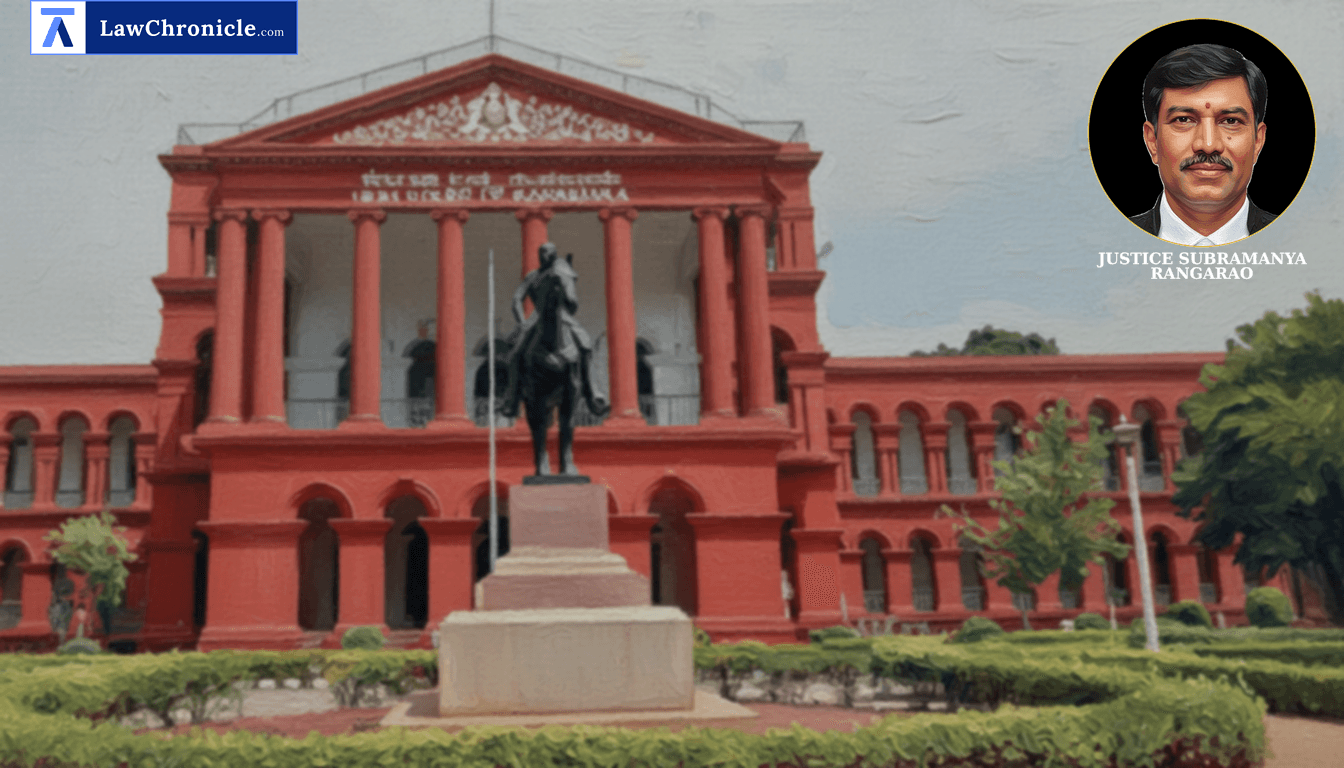
The High Court of Karnataka has reinforced the principle that procedural rules must serve the ends of justice, ruling that a mere typographical error in property boundaries can be corrected even at the stage of reply arguments to prevent a multiplicity of proceedings. The Court emphasized that a party cannot be denied just relief due to inadvertent mistakes or negligence unless the amendment is shown to be mala fide or causes irreparable injury to the opponent.
A Single Judge Bench of Justice Subramanya Rangarao dismissed a writ petition challenging a Trial Court's order that allowed a plaintiff to correct a plot number in the suit schedule property. The Court noted that such amendments are descriptive in nature and do not alter the fundamental character of the suit or the cause of action.
Key Takeaways
Substance Over Form
Procedural lapses or inadvertent mistakes in pleadings should not be used to deny substantive justice if the error is clearly a typographical oversight.
Liberal Approach to Amendments
Courts should adopt a liberal stance toward Code of Civil Procedure, 1908 applications, even at belated stages, provided they are necessary to determine the real controversy.
Prevention of Multiple Suits
Allowing the correction of mis-described boundaries at the trial stage prevents the necessity for future litigation and serves the interest of judicial economy.
No Prejudice Rule
An amendment is generally permissible if it does not introduce a completely new case or withdraw a clear admission that benefits the opposing party.
Court Upholds Correction of Plot Numbers
The dispute centered on a suit for possession of a residential house where the plaintiff had mistakenly identified an adjacent plot as '315A' instead of '34A'. The defendant opposed the amendment, arguing it was filed at the "fag end" of proceedings during reply arguments and would change the nature of the suit. However, the High Court observed that the defendant's own written statement had pointed out the existence of plot '34A', confirming that '315A' was a non-existent entity in that context.
The Court has following directions:
"The Writ Petition is hereby rejected."
The Court, in its reasoning, observed: "It is well settled that rules of procedure are intended to be a handmaid to the administration of justice. A party cannot be refused just relief merely because of some mistake, negligence, inadvertence or even infraction of rules of procedure. The Court always gives relief to amend the pleading of the party, unless it is satisfied that the party applying was acting malafide or that by his blunder he had caused injury to his opponent which cannot be compensated for by an order of cost."
Ratio
Amendments to pleadings under Order 6 Rule 17 of the Code of Civil Procedure, 1908 should be allowed liberally to determine the real question in controversy, provided they do not cause injustice or prejudice to the other side. A hyper-technical approach must be avoided, especially when the amendment is intended to rectify the absence of material particulars or typographical errors, thereby avoiding a multiplicity of litigations.
Background
The respondent-plaintiff originally filed O.S.No.446/2018 seeking possession of a portion of Plot No.51A. During the final stages of the trial, after arguments were heard and the matter was posted for reply, the plaintiff filed an application under Code of Civil Procedure, 1908 to correct the western boundary description. The Petitioner-defendant challenged the Trial Court's approval of this application before the High Court under Articles 227 of the Constitution of India, 1950.
The High Court relied on Mahila Ramkali Devi and Others vs. Nandram (dead) through Legal representatives and Others to reiterate that the power to grant amendments is intended to serve justice and is not bound by narrow technical limitations. Further, referencing Life Insurance Corporation of India vs. Sanjeev Builders Pvt. Ltd., and another ( "2022 SCC OnLine SC 1128": 2022 CaseBase(SC) 652), the Court noted that all amendments necessary for determining the real controversy must be allowed. The Court also cited Ganesh Prasad and Others vs. Rajeshwar Prasad and Others ( "2023 SCC OnLine SC 256": 2023 CaseBase(SC) 301), affirming that even inconsistent alternative pleas can be introduced if no prejudice is caused to the defendant. Finding that the correction was a simple rectification of a typographical error, the High Court upheld the Trial Court's decision.
Case Details:
Case No.: WRIT PETITION NO.200058 OF 2025 (GM-CPC)
Case Title: Govindappa Vs. Gangawwa
Appearances:
For the Petitioner(s): SRI MANVENDRA REDDY, ADVOCATE & SRI NARENDRA M. REDDY, ADVOCATE
For the Respondent(s): SRI B.K. HIREMATH, ADVOCATE
Source: 2026 CaseBase(KAR) 21541
Similar Articles

 Breaking News


