


SC Directs Compensation For Juvenile Wrongfully Detained In Adult Jail
 Copy Link
 Share
 Save
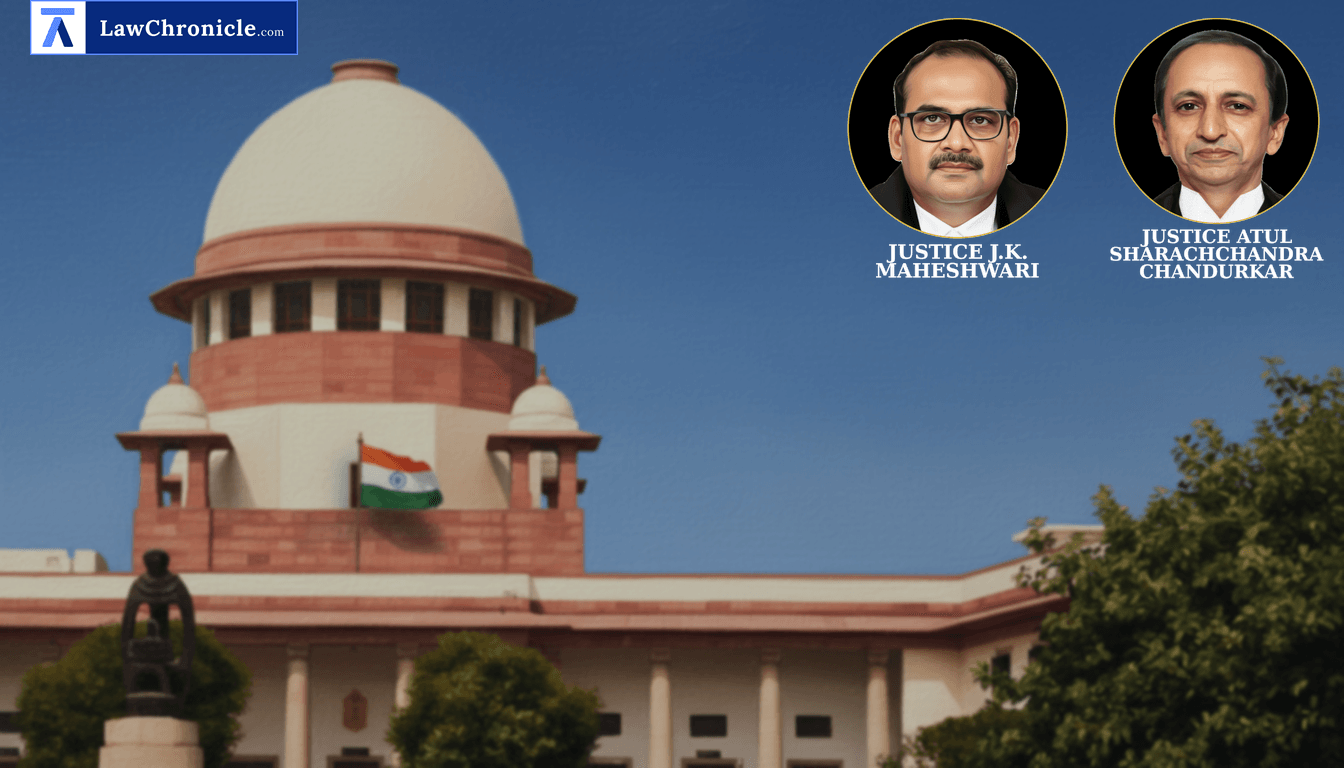
The Supreme Court condemned the "inhumane approach" of authorities who kept a declared juvenile in a regular prison for over two years, awarding him ₹5 lakh in compensation for the "constitutional tort" committed against him.
A Bench comprising Justice J.K. Maheshwari and Justice Atul S. Chandurkar took serious exception to the systemic failure where, despite a judicial declaration of juvenility, the appellant remained lodged in an adult jail due to a purported lack of communication between the Juvenile Justice Board and prison authorities.
The Error of Treating Juveniles as Adults Without Assessment
The Court observed that the lower courts and the High Court erroneously dismissed the appellant's bail plea by over-emphasizing the 'heinous' nature of the offence. The Bench clarified that under Section 15 of the Juvenile Justice (Care and Protection of Children) Act, 2015, a child between 16 and 18 years can only be tried as an adult after a specific two-tiered preliminary assessment.
The Court, in its reasoning, observed: "As evinced from the statutory scheme, where a child above 16 years but below 18 years is alleged to have committed a heinous offence, the determination of whether such child is to be tried as an adult is two-tiered... In absence thereof, the ordinary statutory framework applicable to juveniles must prevail."
Criticism of Judicial Insensitivity
The Bench expressed 'utter dismay' that the High Court and Trial Courts failed to notice the juvenile was in a regular jail during the bail proceedings. It noted that the District Probation Officer’s report actually suggested a reformative environment rather than continued detention.
The Court further noted: "Present is a case where a juvenile has been wrongfully put in regular jail meant for adult prisoners, even after declaring him juvenile, because of lack of communication, insensitivity and inhumane approach on the part of the officials. In this light, and being guided by the mandate of Article 21 of the Constitution of India, 1950, we also sought response from the State vis-a-vis compensation in lieu of the Constitutional Tort committed against the Appellant."
Directions Issued to Statutory Authorities
To prevent such recurrences, the Court issued extensive directions to formalize communication protocols across India. The Court has following directions:
"23. This Court sincerely hopes that the concerned learned Judge of the High Court as well as the Judicial Officers presiding the JJB will exercise extreme care in future while dealing with the matters of juveniles. For purpose of ensuring this, let this order be placed before Hon’ble the Chief Justice of the High Court, and upon approval, be further communicated to the concerned Judge and the Judicial Officers through the Registrar General.
24. Having regard to the seriousness of the issue involved, we deem it appropriate to direct the Registry of this Court that a copy of this order, along with the SOP prepared by the High Court of Judicature at Allahabad, be forwarded to the Chief Justices of all the High Courts for their kind perusal and appropriate action. The Chief Justices of all the High Courts may examine the same and, if no such mechanism has already been implemented in their respective jurisdictions, take suitable measures to ensure effective implementation of the statutory mandate under the JJ Act, particularly with regard to prompt communication of orders declaring a person as juvenile and immediate transfer of juveniles lodged in regular jail to observation homes upon such declaration.
25. Being cognizant of the fact that the implementation of such SOPs ultimately rests with the concerned State Governments, it is also directed that a copy of this order along with the SOP be also transmitted to the Chief Secretaries of all the States and Union Territories of India for appropriate action.
26. The Registry shall also circulate a copy of this order to the Directors of all Judicial Academies across the country, for purpose of sensitizing and apprising the judicial officers in this regard."
Background:
The appellant was accused in a double murder case occurring in July 2022. The Juvenile Justice Board (JJB) declared him a juvenile on June 23, 2023, finding his age to be 16 years and 11 months on the date of the incident. Despite this, he remained in Central Jail, Agra. His bail was rejected by the JJB and subsequently by the Appellate Court and the Allahabad High Court, citing the gravity of the crime and potential danger of re-offending.
The Supreme Court found that the Juvenile Justice (Care and Protection of Children) Act, 2015 mandate was ignored as no order under Section 18(3) was passed to treat him as an adult. Consequently, the Court set aside the High Court's order, acknowledged the ₹5 lakh compensation already deposited by the State of U.P., and allowed the appeal.
Case Details:
Case No.: Criminal Appeal No. of 2026 (SLP (Crl.) No. 16883 OF 2025)
NeutralCitation: 2026 INSC 387
Case Title: Juvenile Delinquent v. State of U.P. and Ors.
Appearances:
For the Petitioner(s): Not Mentioned
For the Respondent(s): Mr. Pradeep Misra, Advocate for State of U.P.; Mr. Ravi Raghnath, Advocate for Registrar General
Source: 2026 CaseBase(SC) 556
Similar Articles
 Breaking News


