


SC Issues Mandatory Guidelines To Curb Black Money In Elections
 Copy Link
 Share
 Save
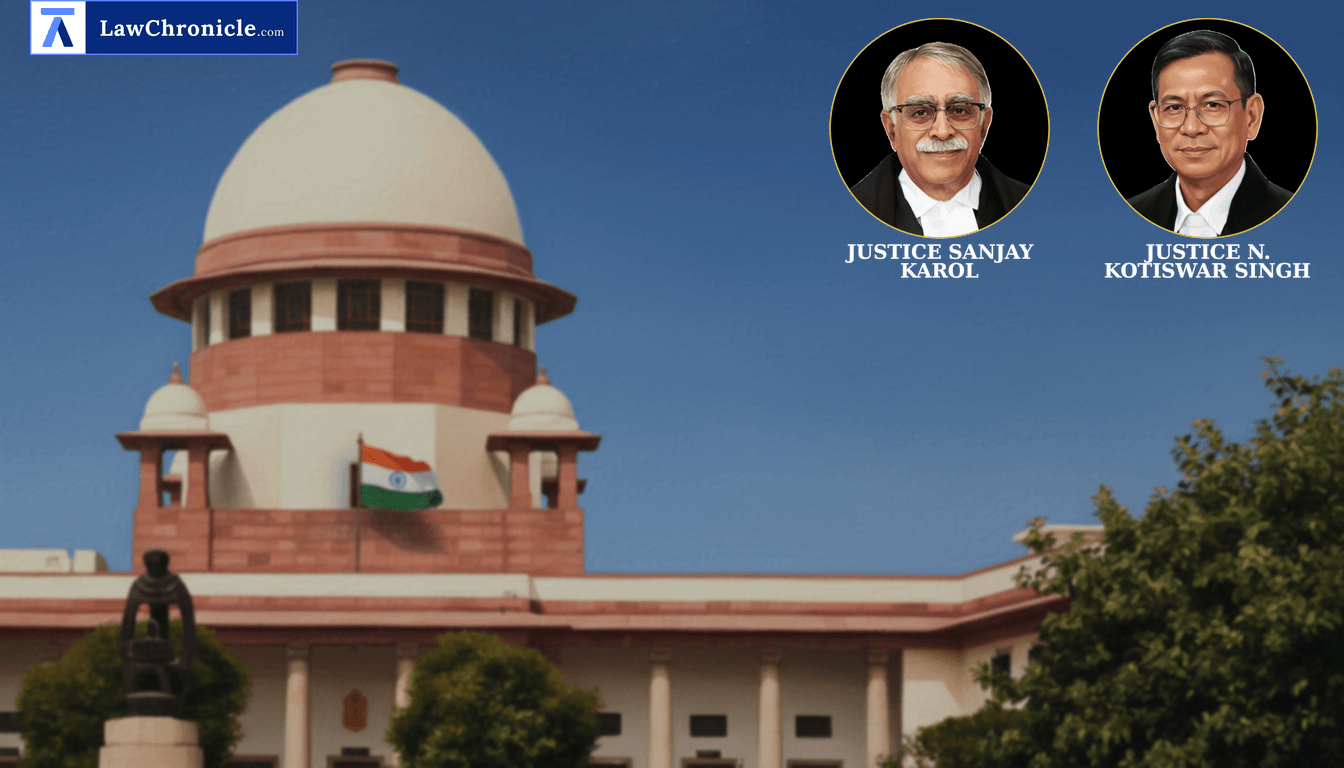
In a decisive blow to the influence of illicit wealth in democratic processes, the Supreme Court has mandated high-level judicial oversight and strict timelines to curb the widespread deployment of black money during elections. The ruling effectively prevents State governments from unilaterally dropping electoral offense prosecutions against political allies without express High Court approval.
An apex court bench comprising Justice Sanjay Karol and Justice Nongmeikapam Kotiswar Singh addressed the systemic threat posed by unchecked financial inducements in democratic elections. Hearing appeals arising from an illicit cash seizure during the 2014 Lok Sabha bye-elections in Bellary, the Court examined the broader procedural failures in prosecuting election-related crimes and enforcing election integrity.
Key Takeaways
• High Court Mandate for Case Withdrawals: States can no longer arbitrarily drop criminal cases registered during elections, as any withdrawal now requires mandatory approval from the concerned High Court.
• Time-Bound Investigations: Investigating officers must endeavor to complete probes into election-related FIRs within one year, ensuring candidates do not face indefinite taint or escape timely accountability.
• Mandatory Judicial Reporting: Authorities making seizures of cash or assets must submit written reasons showing a prima facie nexus to electoral offenses to a competent court within 24 hours.
• Specialized Fast-Track Trials: High Courts are directed to designate special courts for the prompt hearing and trial of electoral cases involving political candidates, sitting MPs, and MLAs.
Court Observations and Directions
The Supreme Court underscored that free and fair elections, the rule of law, and democracy form an inseparable triad under the Constitution of India, 1950. The Court, in its reasoning, observed: "Voting in elections happens generally once every five years... If it is that this one chance at expression is itself tainted, it would not be an understatement to say that the very essence of democracy, which is a rule of the people, by the people and for the people, is compromised. To put it simply, the choice exercised by the people once influenced by external factors is no longer a choice of their own. It is somebody else’s choice being thrust upon them."
The Court issued the following directions:
"a. When a seizure of cash or other assets takes place, the authority affecting the seizure, must, within 24 hours, report the same to the District Magistrate/Additional District Magistrate/Court having competent jurisdiction along with written reasons disclosing the prima facie nexus between the cash or other asset seized and the suspected electoral offence.
b. When FIRs are registered, the Investigation Officer (IO) entrusted with the investigation thereof shall make every possible endeavour to complete investigations thereinto, within a year, from the date of registration. If this timeline is exceeded, reasons therefor shall be recorded and communicated to the Election Commission of India;
c. The investigating officer shall submit a quarterly status report regarding the investigation to the EC through the Nodal Officer, after due approval of the Senior Superintendent of Police/the Deputy Commissioner of Police of the concerned district;
d. When Static Surveillance Teams (SST) during checks find money in excess of Rs. 10 lacs, information about the same shall be forwarded to the income tax authorities.
e. All endeavours ought to be made for expeditious disposal of cases against candidates/sitting MPs/MLAs keeping in view the recurrent nature of elections. For this purpose, it is directed that the High Courts may, by following respective procedures, designate courts for the purposes of prompt hearing and disposal of such cases.
f. For withdrawal of cases against candidates in a particular election cycle, the approval of the concerned High Court is mandatory in view of K.Ajith (supra) and Ashwani Kumar Upadhyay (supra).
g. The affidavit of the EC that details the number of cases pending in connection with the Lok Sabha (2024) and Assembly elections (2019-25), shows quite a large percentage of pendency. The concerned courts should make all efforts to take the cases to the logical conclusion with utmost expedition."
Ratio
Purity of the electoral process is an integral facet of the basic structure of the Constitution. To prevent the subversion of criminal justice by shifting political dispensations, prosecutions initiated for electoral offenses cannot be withdrawn under Section 321 of the Code Of Criminal Procedure, 1973 without prior scrutiny and explicit sanction of the High Court, placing election candidates on par with sitting legislators.
Background
The matter originated from a 2014 flying squad raid on the residence and business premises of a candidate during the Bellary constituency bye-elections, yielding cash and electronic devices. An FIR was registered under Sections 171E and 188 of the Indian Penal Code, 1860. However, the High Court of Judicature at Karnataka quashed the FIR on February 12, 2015, observing a lack of specific averments regarding intended bribe recipients.
Upon appeal by the State of Karnataka, the Supreme Court expanded the scope of proceedings, issuing notice to the Election Commission of India and all State Governments to address the broader systemic failure in prosecuting election-related crimes. While interpreting powers under Article 324 of the Constitution of India, 1950, the Court relied on established precedents, including State of Kerala v. K. Ajith ( "(2021) 17 SCC 318": 2021 CaseBase(SC) 851) and Ashwini Kumar Upadhyay v. Union of India, to emphasize that withdrawal of criminal prosecutions involving political figures must undergo strict judicial scrutiny to uphold public policy and democratic integrity.
Case Details:
Case No.: Criminal Appeal No. ____ of 2026 (Arising out of SLP (Crl.) No. 3549 of 2016)
Neutral Citation: 2026 INSC 868
Case Title: The State of Karnataka & Anr. v. Prathik Parasrampuria
Source: 2026 CaseBase(SC) 794
Similar Articles
 Breaking News


