


High Court Permission Required Before Withdrawing Prosecution Against MPs/MLAs, Supreme Court Upholds
 Copy Link
 Share
 Save
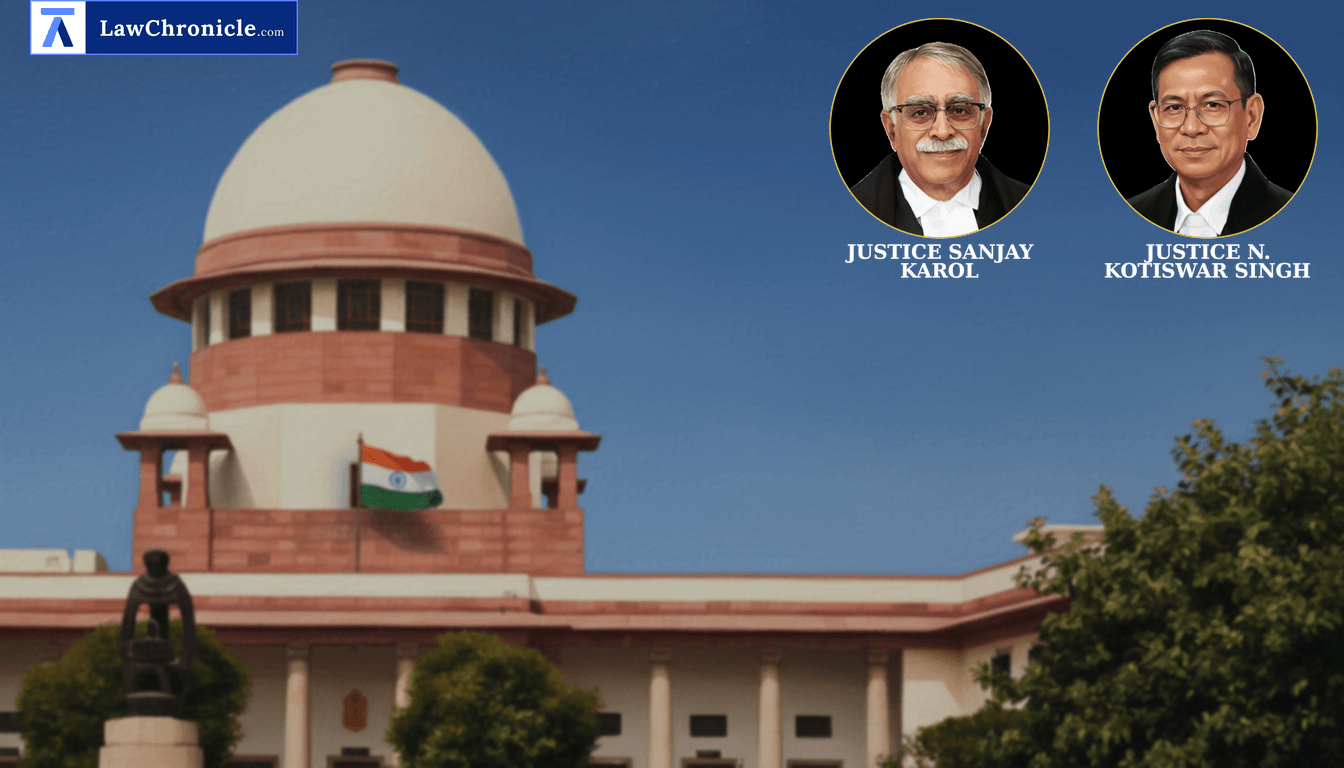
A bench of Justices Sanjay Karol and Nongmeikapam Kotiswar Singh heard appeals by an accused seeking to quash multiple criminal proceedings after the State moved to withdraw certain cases; the appeals challenged orders of the Allahabad High Court which declined to exercise its Section 482 CrPC/Section 528 BNSS jurisdiction to quash prosecutions where the State had not procured High Court leave as contemplated in Ashwini Kumar Upadhyay.
The Court dismissed the appeals and held that the High Court did not err in refusing to quash the prosecutions where the statutory and supervisory permission required in cases involving a sitting or former Member of Parliament or Member of Legislative Assembly was absent. The Court reiterated established principles governing withdrawal of prosecution under Section 321 CrPC, emphasising that a court must ensure the Public Prosecutor did not exercise executive power improperly and that withdrawal must subserve the administration of justice. The Court, in its reasoning, observed: "The true function of the court when an application under Section 321 is filed is to ensure that the executive function of the Public Prosecutor has not been improperly exercised or that it is not an attempt to interfere with the normal course of justice for illegitimate reasons or purposes. The court will grant its consent if it is satisfied that it subserves the administration of justice and the purpose of seeking it is not extraneous to the vindication of the law." The Court also noted that the permission required under Ashwini Kumar Upadhyay was absent in the present matter and that the High Court had therefore rightly dismissed the quashing petitions; it left all contentions on merits open for consideration at the appropriate stage of trial or discharge.
Background
The appellant faced a common FIR dated 12 June 2007 arising from allegations that he, though a holder of a valid arms licence, had acted contrary to provisions of the Arms Act, 1959. Chargesheets were filed in July 2007 and cognizance followed. By Government Order dated 6 August 2014 the State communicated a decision to withdraw Cases Crime Nos. 654/2007, 655/2007 and 656/2007 "in public interest as well as in the interest of justice" and authorised the Public Prosecutor to move for withdrawal under Section 321 CrPC. The Public Prosecutor filed an application for withdrawal before the trial court on 27 August 2014. The trial court observed on 8 October 2021 that the State had not sought the High Court's permission as mandated by the law laid down in Ashwini Kumar Upadhyay and granted the State thirty days to obtain such permission; it warned that, absent permission, prosecution would proceed.
The State did not seek High Court leave. The appellant then filed petitions under Section 482 CrPC and Section 528 BNSS before the High Court to quash the proceedings; the High Court dismissed those petitions. The present appeals arose from that dismissal. The Supreme Court reviewed settled precedents including State of Kerala v. K. Ajith and Ashwini Kumar Upadhyay, reiterating the tests set out for withdrawal: the Public Prosecutor must form an independent, fairly-considered view and the court must satisfy itself that the withdrawal is not an attempt to stifle the process of law or to serve extraneous purposes. The Court emphasised that where Ashwini Kumar Upadhyay required High Court leave for withdrawals in cases involving MPs/MLAs, that procedural safeguard must be respected. Finding that "this permission is missing in the present case," the Supreme Court held that the High Court's refusal to quash the prosecutions could not be faulted and dismissed the appeals, while expressly refraining from commenting on the merits of the allegations. All interim applications stood disposed of.
Case Details: Case No.: 2025 INSC 1378; Criminal Appeal Nos. 5196–5201 of 2025 (Arising out of SLP(Crl) Nos. 6421, 13168, 13090, 13144, 13142, 13161 of 2025) Case Title: Bal Kumar Patel @ Raj Kumar v. State of U.P. Appearances: For the Petitioner(s): Counsel not indicated in the judgment For the Respondent(s): Counsel not indicated in the judgment
Similar Articles
 Breaking News


