


SC: Missing Records Alone Can’t Prove Candidate Cleared Test
 Copy Link
 Share
 Save
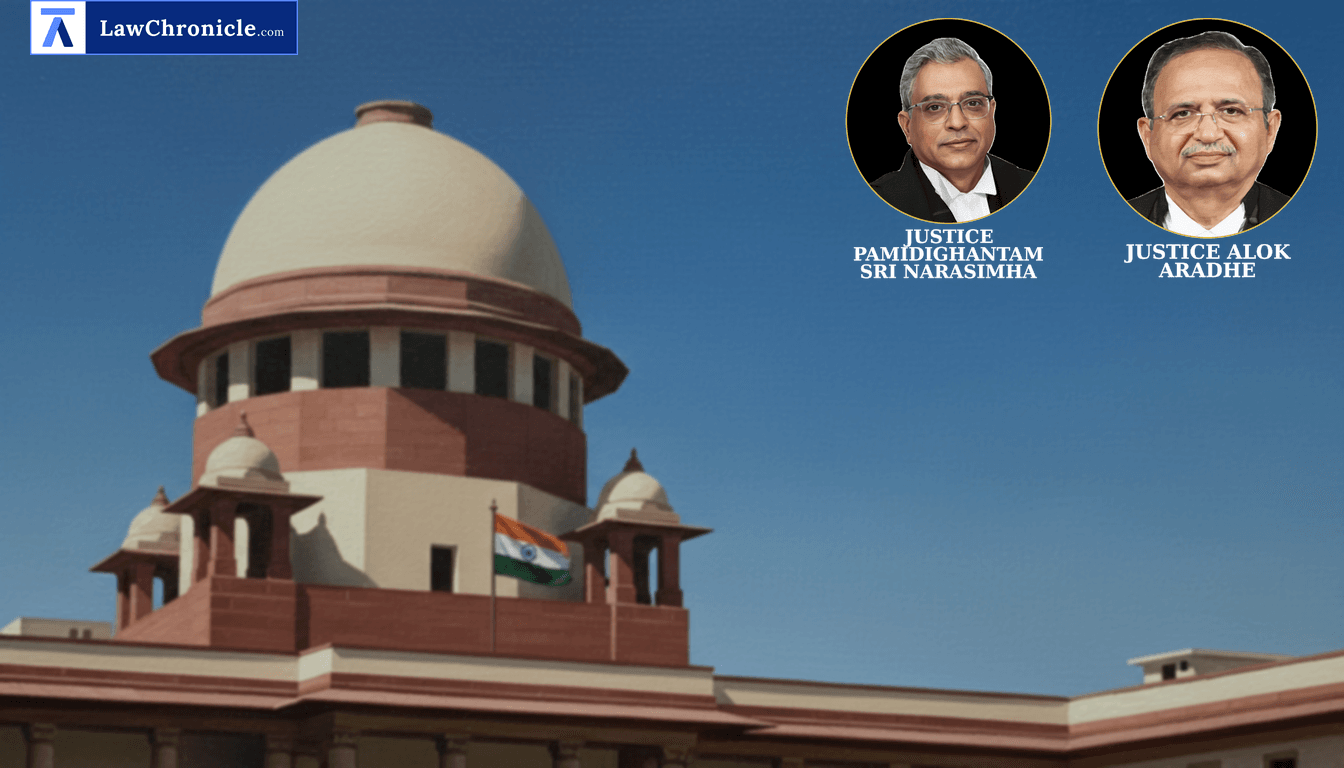
The Supreme Court set aside a High Court judgment directing the appointment of candidates who failed to prove they cleared a recruitment examination, clarifying that mere non-production of records by the employer does not imply a candidate passed the test.
A bench comprising Justice Pamidighantam Sri Narasimha and Justice Alok Aradhe adjudicated the challenge against the Calcutta High Court's decision, which had affirmed a Tribunal order directing the Durgapur Steel Plant to appoint certain candidates despite the absence of evidence regarding their performance in the selection process. The Court emphasized that recruitment must strictly adhere to comparative merit.
Principle of Comparative Merit and Rights of Candidates
The Court observed that instrumentalities of the State are bound to follow the principle of comparative merit during recruitment. It reiterated that appearing in a select list does not grant an automatic right to employment, referencing Union Territory of Chandigarh v. Dilbagh Singh & Ors. ( "(1993) 1 SCC 154": 1992 CaseBase(SC) 131), Mohd. Rashid v. Director, Local Bodies, New Secretariat & Ors. ( "(2020) 2 SCC 582": 2020 CaseBase(SC) 1194), and State of Manipur & Anr. v. Takhelmayum Khelendro Meitei & Ors. ( "(2019) 3 SCC 331": 2019 CaseBase(SC) 1153).
In its reasoning, the Court observed: "The State or its instrumentalities, while filling vacancies, are obligated to adhere to the principle of comparative merit of candidates based on their performance in the recruitment process, and no discrimination is permissible. It is well settled in law that a candidate whose name appears in the select list does not acquire any indefeasible right to appointment to the post in the absence of any specific rule entitling such appointment."
On Transparency and Preservation of Recruitment Records
Addressing the lack of transparency alleged by the respondents, the Court noted that neither the recruitment rules nor the advertisement mandated the publication of marks for all candidates. Furthermore, the Court accepted the appellant's explanation regarding the destruction of records as bona fide, since no rule mandated their preservation for an extended period. It held that an adverse inference could not be drawn against the employer simply because the records of the 2008 examination were no longer available.
Final Directions and Relief
While setting aside the directions for appointment, the Court granted monetary compensation to the lone contesting respondent who had been litigating for over 15 years. The Court has following directions:
"(i) impugned order and judgment, in so far as it directs the appellants to provide appointment to the respondents to the post of Plant Attendant, is set aside.
(ii) direct the appellants to pay a sum of Rs.5,00,000/- (Rupees Five Lakhs) to respondent no.1 within a period of two months."
Background:
The dispute originated from a 2007 recruitment advertisement for the post of Plant Attendant at the Durgapur Steel Plant. Out of over 52,000 applicants, 194 candidates eventually joined service. The respondents filed a writ petition in 2009, later transferred to the Central Administrative Tribunal, seeking the disclosure of their marks and challenging the recruitment of others. The Tribunal had directed their appointment on the grounds that the appellants failed to produce evidence showing the respondents had failed the exam.
The appellants argued before the Supreme Court that the examination was conducted by an independent agency and that the qualifications for the post had since been revised in 2008. They further contended that the recruitment was conducted in accordance with the law. The respondents, relying on Kerala Public Service Commission & Ors. v. State Information Commission & Anr., Sachin Kumar & Ors., v. Delhi Subordinate Service Selection Board (DSSSB) & Ors. ( "(2021) 4 SCC 631": 2021 CaseBase(SC) 1057), Union of India & Ors., v. O. Chakradhar ( "(2002) 3 SCC 146": 2002 CaseBase(SC) 478), and Poonam Rani v. State of Haryana & Anr., argued that the process violated Article 14 of the Constitution of India due to a lack of transparency. The Supreme Court ultimately allowed the appeal, noting that the respondents failed to establish they had actually passed the written examination.
Case Details:
Case No.: Civil Appeal No. of 2026 (@ SLP (Civil) No. 41 of 2020)
NeutralCitation: 2026 INSC 459
Case Title: Durgapur Steel Plant & Ors. v. Bidhan Chandra Chowdhury & Ors.
Appearances:
For the Petitioner(s): Mr. Ranjit Kumar, Senior Counsel
For the Respondent(s): Mr. Subhasish Bhowmick, Counsel
Source: 2026 CaseBase(SC) 393
Similar Articles
 Breaking News


