


SC Modifies 3-Year Bar Practice Rule For Entry-Level Judicial Officers
 Copy Link
 Share
 Save
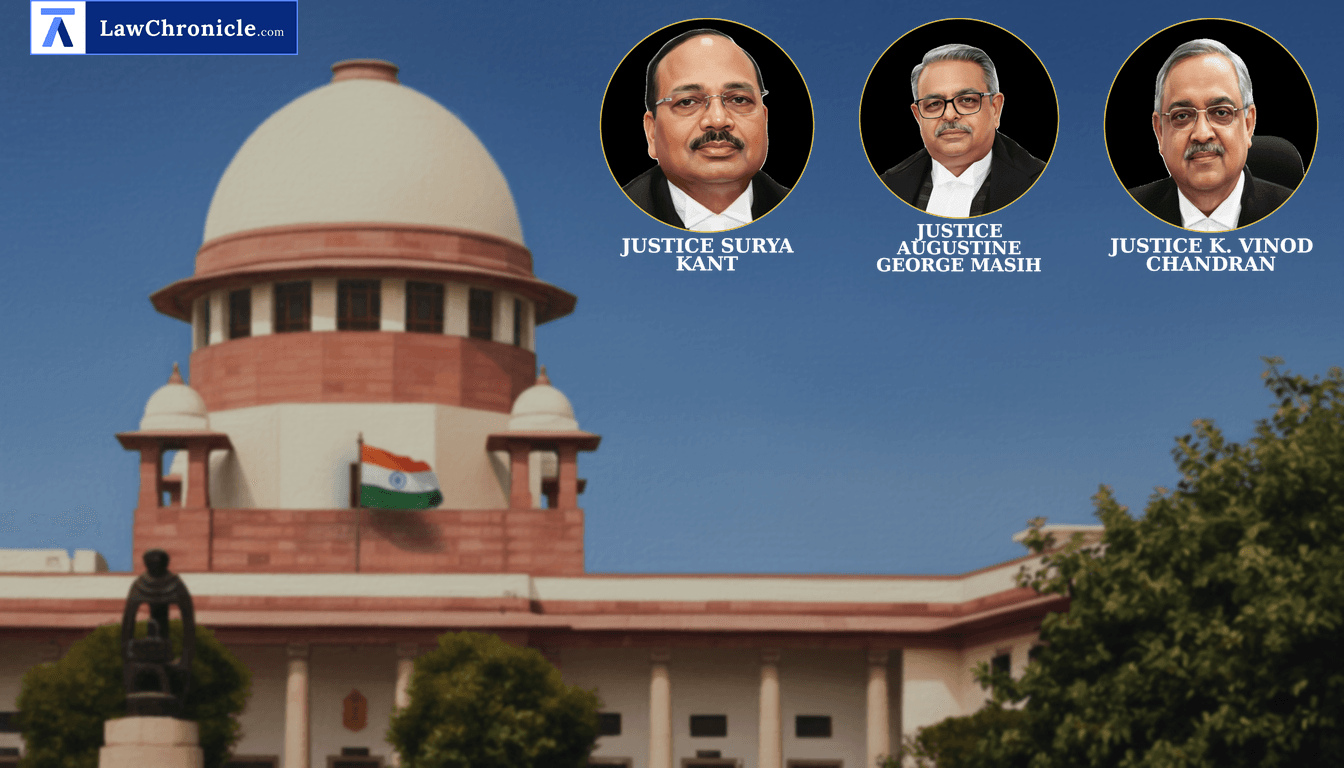
In a momentous recalibration of eligibility norms for the sub-ordinate judiciary, the Supreme Court has modified its earlier judgment to permit all law graduates to apply for the post of Civil Judge (Junior Division) during a transitional period up to March 31, 2027, deeming them to have completed one year of active practice.
A three-Judge Bench comprising Chief Justice Surya Kant, Justice Augustine George Masih, and Justice K. Vinod Chandran delivered a split judgment while modifying the previous directions in the review proceedings arising out of Writ Petition (Civil) No. 1022 of 1989. While the majority led by CJI Surya Kant modified the implementation framework to ease hardship for fresh law graduates, Justice K. Vinod Chandran dissented, holding that no ground for review was made out to alter the 3-year mandatory practice requirement.
Key Takeaways
Deemed Practice Credit: All law graduates can appear for Civil Judge examinations advertised up to March 31, 2027, with a deemed credit of one year of active practice.
Trainee Judicial Officers Status: Selected candidates in the transitional period will be designated as Trainee Judicial Officers and undergo a compulsory one-year institutional training at State Judicial Academies.
Structured Law Clerkship: Post-academy training, candidates will undergo a year-long structured Law Clerkship under District Judges and sitting High Court Judges before full induction.
Future Requirement from April 2027: For notifications issued on or after April 1, 2027, candidates must possess at least one year of actual practice supported by a Certificate of Practice.
5-Year Experimental Horizon: The new modified scheme will remain in force for five years, after which the Court will empirically evaluate its efficacy.
Court's Rationale and Directions
The majority judgment recognized the necessity of basic courtroom exposure for judicial officers, but emphasized that translating this need into a rigid multi-year eligibility bar severely impacted young law graduates, particularly women and candidates from economically weaker backgrounds.
The Court has following directions:
"(i) All law graduates shall be eligible to apply, notwithstanding the three-year practice requirement. Having regard to the fact that more than one year has elapsed since the Judgment under Review was pronounced, such candidates shall, for the purposes of their applications, be deemed to have completed one year of active practice. They shall not be required to furnish a separate Certificate of Practice in support of the said deemed period;
(ii) Candidates selected pursuant to the aforesaid recruitment shall, upon appointment, be designated as "Trainee Judicial Officers" and shall undergo a compulsory period of one year of intensive training at the concerned State Judicial Academy. This period shall be treated as equivalent to one year of practice at the Bar for the purposes of the three-year requirement;
(iii) During the period of such training, the Trainee Judicial Officers shall be paid a fixed emolument equivalent to one-half of the remuneration payable to a Judicial Magistrate First Class in the concerned State. They shall, in addition, be entitled to the facilities and other benefits ordinarily made available to trainees at the concerned State Judicial Academy;
(iv) Upon successful completion of the aforesaid training, the Trainee Judicial Officers shall undergo a further period of one year of structured Law Clerkship. The first six months shall be spent as a Law Clerk under the supervision of the Principal District/District and Sessions Judges or Members of the Higher Judicial Services, and the remaining six months under the supervision of a sitting Judge of the concerned High Court;
(v) The aforesaid one-year period of Law Clerkship shall also be treated as equivalent to one year of practice at the Bar for the purposes of satisfying the three-year requirement;
(vi) During the period of Law Clerkship, the Trainee Judicial Officer shall be paid same emoluments as admissible during their training in State Judicial Academies, with no further allowance, etc.; and
(vii) Upon completion of the Law Clerkship, the sitting Judge of the High Court under whose supervision the Trainee Judicial Officer has served shall submit a reasoned evaluation report concerning the performance and suitability of the trainee. Upon such evaluation being found satisfactory, the Trainee Judicial Officer shall be appointed to the regular post in the field and shall thereafter be entitled to the regular pay scale and other service benefits attached to the post."
The Court, in its reasoning, observed: "The purpose of an eligibility rule is to secure suitable candidates for judicial office. It should not, by the manner of its implementation, exclude candidates whom the judicial system would otherwise benefit from attracting."
Ratio
While practical courtroom exposure is an essential prerequisite for entry into the judicial service, the mandate of prior Bar experience can be harmonized and fulfilled through a combination of limited active practice, intensive institutional training, and supervised judicial clerkships without creating arbitrary barriers for fresh law graduates.
Background
In 1993, the Supreme Court in All India Judges’ Association & Ors. v. Union of India & Ors. ( "(1993) 4 SCC 288": 1991 CaseBase(SC) 374) had initially mandated a 3-year practice requirement at the Bar for recruitment as Civil Judge (Junior Division). However, following the recommendations of the Shetty Commission, a three-Judge Bench in All India Judges’ Association & Ors. v. Union of India & Ors. ( "(2002) 4 SCC 247": 2001 CaseBase(SC) 1233) did away with the requirement, allowing fresh law graduates to directly join the judicial service.
This regime continued until May 20.05.2025, when a coordinate Bench in All India Judges Association v. Union of India ( "2025 SCC OnLine SC 1184": 2025 CaseBase(SC) 817) restored the 3-year practice requirement, finding that unexposed candidates lacked courtroom decorum and procedural familiarity. Challenging this restoration, review petitions and writ petitions were filed by various entities including NGO Bhumika Trust, arguing that the sudden alteration impacted prospective judicial aspirants disproportionately, especially under Article 233 and Article 217 framing of statutory rules.
Dissenting from the majority modification, Justice K. Vinod Chandran affirmed that courtroom experience cannot be substituted by institutional clerkships or pre-service training, holding that "Neither knowledge derived from books nor pre-service training can be an adequate substitute for the first-hand experience of the working of the court-system and the administration of justice begotten through legal practice." He concluded that there was no error apparent on the face of the record to justify reviewing the 2025 decision.
Case Details:
Case No.: Writ Petition (Civil) No. 1110/2025 WITH Review Petition (Civil) No. 420/2026
Neutral Citation: 2026 INSC 904
Case Title: Bhumika Trust v. Union of India and others
Appearances:
For the Petitioner(s): Ms. Pinky Anand (Sr. Adv.), Ms. Vibha Makhija (Sr. Adv.), Mr. Colin Gonsalves (Sr. Adv.)
For the Respondent(s): Shri Siddharth Bhatnagar (Amicus Curiae)
Source: 2026 CaseBase(SC) 816
Similar Articles


 Breaking News


