


SC Prioritizes Human Safety Over Stray Dog Rights
 Copy Link
 Share
 Save
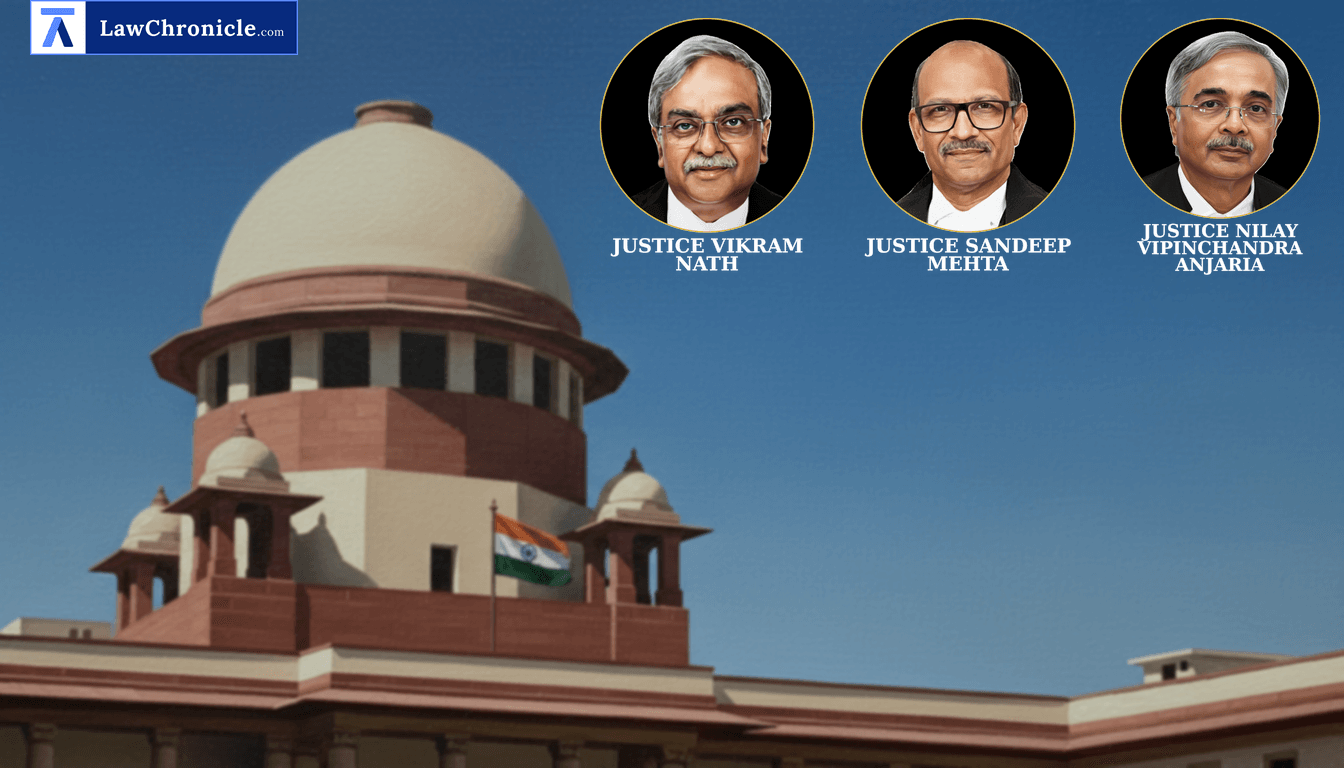
The Supreme Court has ruled that the right to life and safety under Article 21 takes precedence over the interests of stray animals, particularly within sensitive institutional spaces. The Court held that while animal welfare is a constitutional and moral significance, it cannot eclipse the State's obligation to safeguard human bodily integrity and public safety.
A bench of Justice Vikram Nath, Justice Sandeep Mehta, and Justice N.V. Anjaria delivered this significant verdict while adjudicating a batch of petitions and interlocutory applications concerning the escalating menace of stray dog attacks across the country. The Court was particularly concerned with the safety of children, patients, and the elderly in areas such as schools, hospitals, and transport hubs. The bench emphasized that the persistence of such preventable hazards reflects systemic administrative lapses and violates the fundamental right to life guaranteed under Constitution of India.
Legal Validity of Non-Release in Sensitive Zones
The Court examined the applicability of the Animal Birth Control Rules, 2023 in relation to institutional and restricted-access premises. It clarified that the requirement under Rule 11(19) of the said Rules to release dogs back to their original locality does not apply to sensitive areas like educational institutions, hospitals, and sports complexes. The Court reasoned that these spaces are meant to be sterile and secure, and the presence of stray dogs therein poses immediate health and safety hazards.
In its reasoning, the Court, observed: "The statutory scheme underlying the Prevention of Cruelty to Animals Act, 1960, and the Rules framed thereunder, namely, the Animal Birth Control Rules, 2023, does not mandate, nor can it be interpreted to require, the continued presence or compulsory reintroduction of stray dogs within institutional premises or other restricted-access areas. Consequently, stray dogs found within such institutional spaces... cannot be held to fall within the scope of the classification contemplated under Rule 7(2) of the Animal Birth Control Rules, 2023."
Directives for State Authorities and NHAI
Addressing the failure of the Animal Birth Control Rules, 2023 implementation, the Court underscored that the State cannot plead financial or logistical constraints to ignore human safety. The Court has the following directions:
" A. The States and Union Territories shall forthwith take decisive, coordinated and time-bound steps for enhancing and augmenting the infrastructure necessary for effective implementation of the Animal Birth Control framework, including the expansion of sterilisation and vaccination capacity, strengthening of existing facilities, and creation of additional institutional mechanisms commensurate with the scale and urgency of the issue.
B. The States and Union Territories shall ensure the establishment of at least one fully functional Animal Birth Control Centre in each district, duly equipped with requisite veterinary infrastructure, trained personnel, surgical facilities and supporting logistics, so as to enable the systematic, continuous and largescale implementation of sterilisation and vaccination programmes. Such centres shall be made operational in a time-bound manner and shall function with adequate capacity to address the local population of stray dogs, with proper record-keeping, monitoring and periodic reporting to ensure effective and sustained implementation of the Animal Birth Control framework. It is further directed that, having regard to the population density and territorial extent of each district, the concerned departments of the States and Union Territories shall take an appropriate decision with respect to the expansion of the number of Animal Birth Control Centres, wherever necessary, so as to ensure effective coverage and implementation of the Animal Birth Control framework.
C. The concerned departments/authorities of the States and Union Territories shall take all necessary measures to implement the directions issued by this Court, and shall ensure that the same are carried out in letter as well as in spirit, without any delay or dilution, and shall also strictly comply with the Standard Operating Procedures issued by the Animal Welfare Board of India in this regard.
D. The concerned departments/authorities of the States and Union Territories, as well as the Union of India (in respect of public areas/spaces falling within its jurisdiction), shall take an informed and reasoned decision regarding the extension of the directions issued by this Court to other public spaces characterised by high footfall and public utility, including but not limited to places of public congregation and transit, having due regard to the necessity of ensuring a safe and secure environment for public at large. Such decision shall be taken upon a careful assessment of ground realities, risk to public safety, and the functional nature of such spaces, and shall be implemented in a time-bound and coordinated manner so as to ensure uniformity and effectiveness in enforcement.
E. The States and Union Territories shall undertake comprehensive capacity-building measures, including training of personnel, augmentation of veterinary services, strengthening of vaccination drives and creation of adequate shelter facilities, in coordination with relevant departments and agencies.
F. The States and Union Territories shall also ensure adequate availability of anti-rabies vaccines and immunoglobulin in all Government medical facilities, and shall put in place effective public health response mechanisms to deal with cases of dog bites.
G. The NHAI shall, in coordination with the concerned States and Union Territories, formulate and implement a comprehensive and time-bound mechanism for addressing the presence of stray cattle and other animals on National Highways and National Expressways, including the deployment of specialised transport vehicles for the safe handling and relocation of stray cattle and other animals, and the creation or earmarking of appropriate holding and shelter facilities, and entering into appropriate arrangements with animal welfare organisations, gaushalas, and other competent agencies for their safe handling and relocation. The NHAI shall also establish an effective monitoring and coordination framework to ensure continuous oversight and prompt response in such matters.
H. In areas where the population of stray dogs has assumed alarming proportions and where incidents of dog bites or aggressive attacks have become frequent and pose a continuing threat to public safety, the concerned authorities may, subject to due assessment by qualified veterinary experts and strictly in accordance with the provisions of the Prevention of Cruelty to Animals Act, 1960, the Animal Birth Control Rules, 2023 and other applicable statutory protocols, take such measures as may be legally permissible, including euthanasia in cases involving rabid, incurably ill or demonstrably dangerous/aggressive dogs, so as to effectively curb the threat posed to human life and safety.
I. It is made emphatically clear that the officers and officials of the municipal authorities, Panchayati Raj institutions, local bodies and the concerned departments of the States and Union Territories, autonomous bodies/institutions and the persons in-charge of all other institutions, i.e., schools, colleges, hospitals, etc., who are entrusted with the implementation of the directions issued by this Court, shall be entitled to due protection for acts performed by them in good faith and in bona fide discharge of their official duties and compliances carried out pursuant to the present order and the earlier orders passed by this Court in the present proceedings. Accordingly, no First Information Report, criminal complaint or coercive proceedings shall ordinarily be initiated against such officers or officials in respect of actions bona fide undertaken for the purpose of implementing the directions issued by this Court, save and except where a prima facie case of mala fides, gross abuse of authority or actions wholly dehors the directions issued by this Court is made out. If necessary, the High Court in seisin of the continuing mandamus in terms of the present order shall be at liberty to pass appropriate orders to prevent frivolous, vexatious or malicious proceedings against such officers or officials.”
Decentralized Monitoring by High Courts
To ensure ground-level compliance, the Supreme Court transitioned the monitoring of these directions to the jurisdictional High Courts. Each High Court has been directed to register a suo moto writ petition as a "continuing mandamus" to oversee the implementation within its respective State.
Background:
The case originated from a suo moto writ petition titled "City Hounded by Strays, Kids Pay Price," following reports of tragic deaths and injuries caused by stray animals. Various animal welfare organizations challenged the Court's earlier order dated November 7, 2025, which prohibited the re-release of stray dogs into institutional areas after sterilization. The applicants argued that such relocation violated the Animal Birth Control Rules, 2023 and the scientific "vacuum effect" principle. Conversely, other applicants highlighted the exponential rise in dog population from 2.5 crore to 8 crore and the resulting public health emergency.
While exercising its plenary powers under Article 142 of the Constitution of India, the Court relied on Union Carbide Corporation v. Union of India ( "(1991) 4 SCC 584": 1991 CaseBase(SC) 403) and Supreme Court Bar Association v. Union of India ( "(1998) 4 SCC 409": 1998 CaseBase(SC) 265) to affirm that it can "iron out the creases" in a cause to do complete justice. It also noted the recent case of Shilpa Sailesh v. Varun Sreenivasan ( "(2023) 14 SCC 231": 2023 CaseBase(SC) 872) regarding the limits of these powers. The Court ultimately dismissed the applications seeking to modify the non-release direction, holding that the safety of citizens in learning and healing spaces is paramount.
Case Details:
Case No.: Suo Moto Writ Petition(Civil) No(s). 5 of 2025
NeutralCitation: 2026 INSC 506
Case Title: In Re: “City Hounded By Strays, Kids Pay Price”
Appearances:
For the Petitioner(s): Shri Gaurav Agrawal (Amicus Curiae)
For the Respondent(s): Senior Counsel and advocates for various States, UTs, NHAI, and Animal Welfare Organizations
Source: 2026 CaseBase(SC) 444
Similar Articles
 Breaking News


