


Second Rejection of Plaint Application Barred By Res Judicata: SC
 Copy Link
 Share
 Save
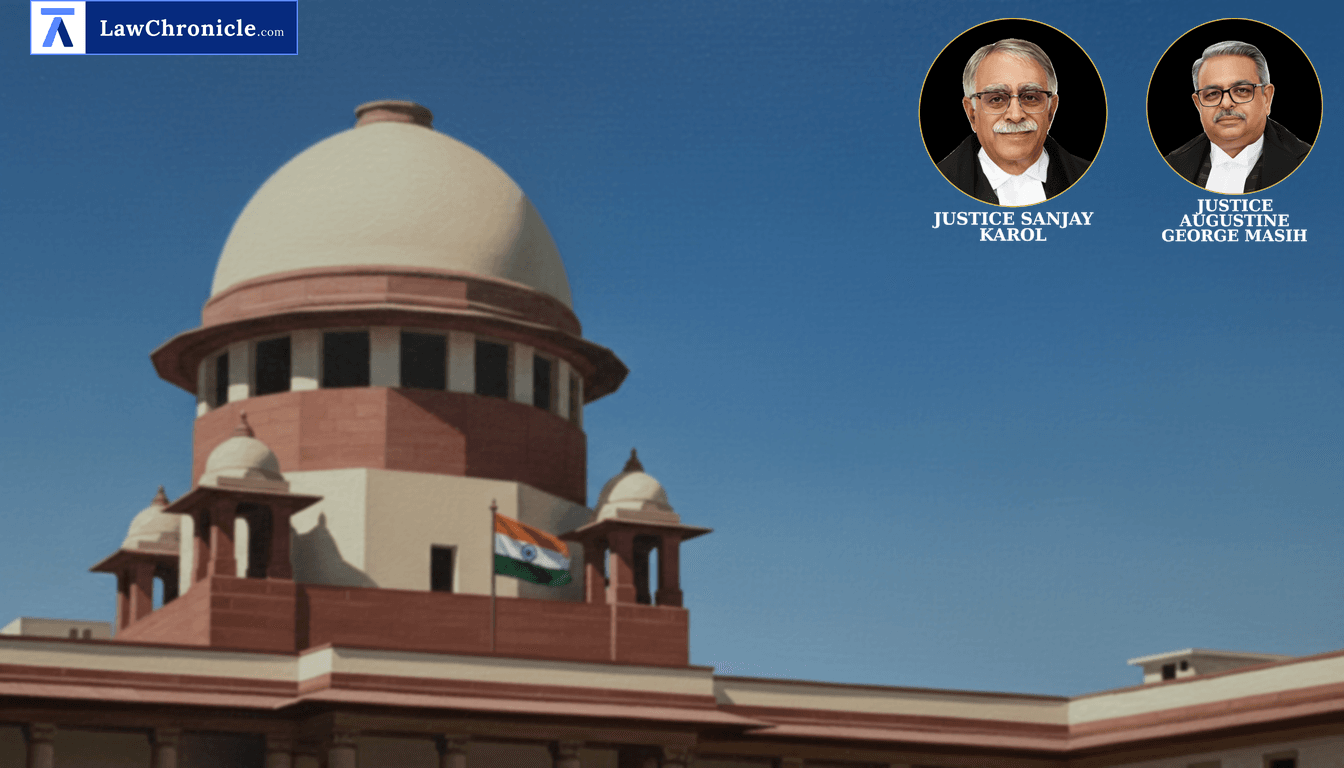
The Supreme Court has clarified that a party cannot re-agitate the rejection of a plaint under Order VII Rule 11 of the Code of Civil Procedure, 1908 once a similar plea has been dismissed and attained finality. The Court emphasized that even if there is an alleged 'change in law', the principle of interlocutory res judicata prevents defendants from repeatedly challenging the maintainability of a suit on the same grounds.
Justice Augustine George Masih and Justice Sanjay Karol, while presiding over the appeal, set aside a Karnataka High Court order that had rejected a partition suit filed by three daughters. The Bench held that the High Court erred in allowing a second application for rejection of the plaint when the same issue regarding the impact of a registered partition deed had been settled in earlier proceedings between the same parties.
The Doctrine of Interlocutory Res Judicata
The Court observed that the principle of res judicata, as codified in Section 11 of the Code of Civil Procedure, 1908, is not restricted to separate suits but applies between different stages of the same litigation. Since a prior application under Order VII Rule 11 had been dismissed by the High Court in 2013 and remained unchallenged, the defendants could not file a second application for the same relief.
The Court, in its reasoning, observed: "The principle of res judicata applies also as between two stages in the same litigation to this extent that a court, whether a trial court or a higher court having at an earlier stage decided a matter in one way will not allow the parties to re-agitate the matter again at a subsequent stage of the same proceedings."
Addressing the High Court's reasoning that the second application was filed by different legal representatives, the Supreme Court noted that all defendants shared a common interest and litigated under the same title. Relying on Singhai Lal Chand Jain v. Rashtriya Swayamsewak Sangh, Panna and Others, the Bench held that the interest was indivisible and the earlier order bound all parties involved.
No 'Change in Law' via Vineeta Sharma Judgment
The respondents argued that the decision in Vineeta Sharma v. Rakesh Sharma and Others ( "(2020) 9 SCC 1": 2020 CaseBase(SC) 1056) constituted a change in law that justified a fresh application. However, the Bench rejected this, noting that Vineeta Sharma v. Rakesh Sharma and Others ( "(2020) 9 SCC 1": 2020 CaseBase(SC) 1056) did not alter the fundamental right of daughters to claim a share under Section 8 of the Hindu Succession Act, 1956 when a father dies intestate.
The Court, in its reasoning, observed: "What Vineeta Sharma does not do is alter the settled position which was the foundation of the 2013 order, that where a Hindu male dies intestate, his property devolves under Section 8 on all Class I heirs including daughters. The 'basis' of the 2013 judgment remains entirely undisturbed by Vineeta Sharma."
Section 6(5) Is a Saving Clause, Not a Jurisdictional Bar
The Bench further clarified that Section 6(5) of the Hindu Succession Act, 1956, which saves partitions effected before December 20, 2004, is a defense on merits and not a bar to the institution of a suit. Whether a partition was validly executed without the daughters' consent is a question of fact that requires trial.
The Court has following directions:
"The impugned judgment and order dated 29.08.2024 passed by the High Court of Karnataka in C.R.P. No. 144 of 2023 is accordingly set aside. The order dated 15.11.2022 passed by the LXI Additional City Civil and Sessions Judge, Bengaluru, dismissing I.A. No. IV, is restored. The plaint in O.S. No. 5352/2007 shall stand restored to file. The status quo with respect to the subject properties, as directed by this Court’s order dated 25.10.2024, shall continue to remain in operation until further orders of the Trial Court. The Trial Court shall proceed with the suit expeditiously and endeavour to conclude the trial at an early date."
Background:
The dispute arose after Sri B.M. Seenappa died intestate in 1985. His daughters filed a suit in 2007 for partition, challenging a registered Partition Deed dated June 16, 2000, which they claimed was executed by their mother and brothers "secretly" without their knowledge.
Initially, the Trial Court rejected the plaint in 2008, but this was overturned by the High Court in 2013 on the grounds that even if they were not coparceners, the daughters had a right as Class I heirs under Section 8 of the Hindu Succession Act, 1956. In 2021, the legal representatives of one brother filed a second application for rejection of the plaint, citing the judgment in Vineeta Sharma v. Rakesh Sharma and Others ( "(2020) 9 SCC 1": 2020 CaseBase(SC) 1056). While the Trial Court dismissed this second attempt as being barred by res judicata, the High Court of Karnataka later allowed it, leading to the present appeal in the Supreme Court.
The Supreme Court reiterated the importance of following precedents such as Satyadhyan Ghosal and Others v. Deorajin Debi (Smt) and Another ( "AIR 1960 SC 941": 1960 CaseBase(SC) 164) for interlocutory res judicata, Nusli Neville Wadia v. Ivory Properties and Others ( "(2020) 6 SCC 557": 2019 CaseBase(SC) 3629) regarding disputed facts in Order VII Rule 11, and Mayar (H.K.) Ltd. and Others v. Owners & Parties, Vessel M.V. Fortune Express and Others regarding the limited scope of threshold inquiry. The Court also cited Ganduri Koteshwaramma and Another v. Chakiri Yanadi and Another and Prasanta Kumar Sahoo and Others v. Charulata Sahu and Others ( "(2023) 9 SCC 641": 2023 CaseBase(SC) 680) to emphasize that Section 6(5) only applies to finalized partitions by registered deed or decree.
Case Details:
Case No.: Civil Appeal No. OF 2026 (Arising out of SLP (C) No. 23709 of 2024)
NeutralCitation: 2026 INSC 499
Case Title: B.S. LALITHA AND OTHERS v. BHUVANESH AND OTHERS
Source: 2026 CaseBase(SC) 432
Similar Articles
 Breaking News


