


Section 98(2) Gujarat Prohibition Act Not An Embargo On Vehicle Release: SC
 Copy Link
 Share
 Save
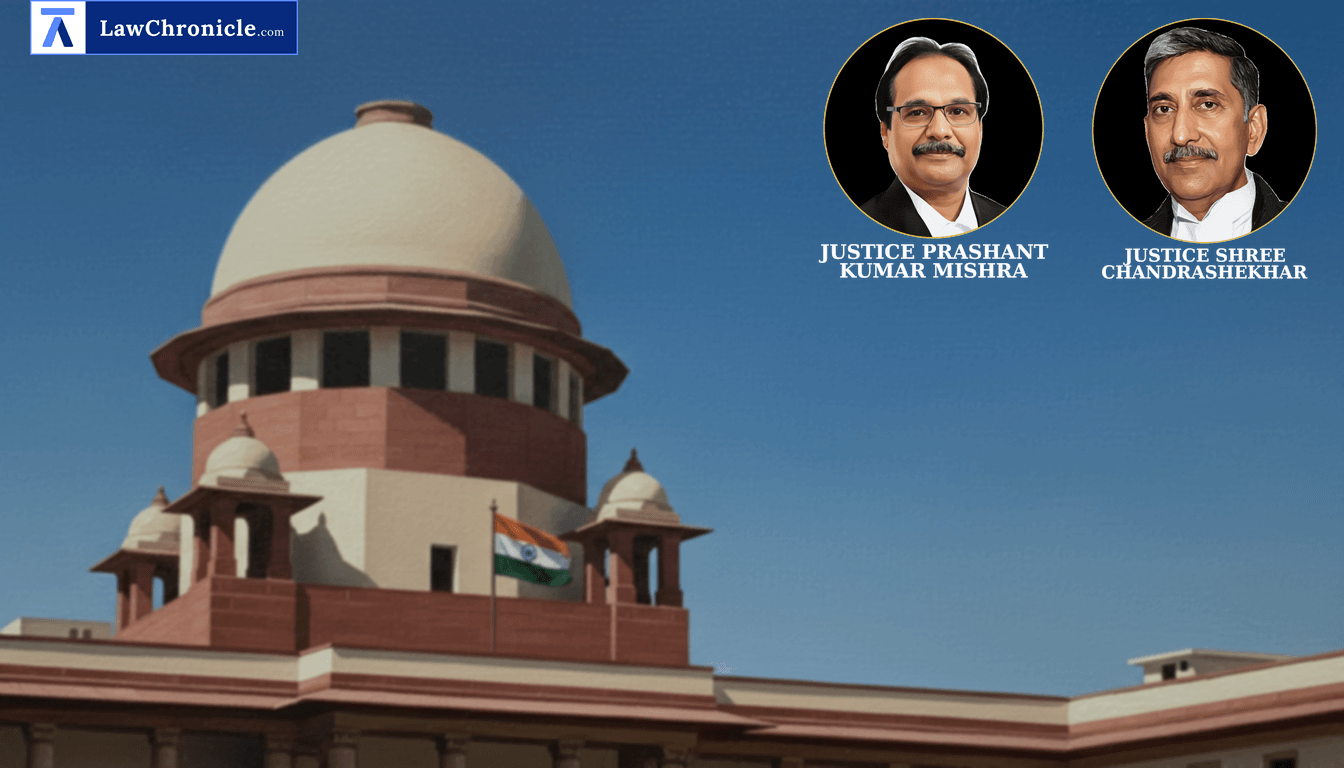
In a major relief for transport vehicle owners, the Supreme Court has ruled that Section 98(2) of the Gujarat Prohibition Act, 1949 does not operate as an absolute legal embargo on releasing seized vehicles to their owners pending trial. The decision reinforces that criminal courts retain broad discretionary powers to grant interim custody of seized property under procedural law to prevent vehicles from languishing and deteriorating at police stations.
Demarcating the powers of trial courts from statutory confiscation regimes, a two-judge bench comprising Justice Prashant Kumar Mishra and Justice Shree Chandrashekhar set aside an order of the Gujarat High Court that denied the release of a commercial truck transporting illicit liquor. The Supreme Court underscored that property seized during investigation should not be retained in custody longer than necessary, especially when trial proceedings could stretch over several years.
Key Takeaways
- No Absolute Embargo Under Prohibition Act: Section 98(2) of the Gujarat Prohibition Act, 1949 does not completely bar courts from granting interim custody of vehicles under procedural criminal law.
- Prevention of Vehicle Deterioration: Seized vehicles left sitting at police stations suffer continuous decay and loss of roadworthiness, serving no legitimate judicial purpose.
- Preservation of Evidence via Alternatives: Physical retention of vehicles is unnecessary when evidentiary requirements can be met using detailed panchnamas, photography, and videography.
- Balance of Interests: Courts must balance the owner's loss of livelihood and hardship against trial integrity by imposing appropriate financial conditions and security bonds.
Court's Rationale and Observations
The Supreme Court observed that the lower courts erred in adopting a narrow interpretation of judicial powers under Sections 451, 457, 458, and 459 of the Code Of Criminal Procedure, 1973. Reiterating its landmark rulings in Sunderbhai Ambalal Desai v. State of Gujarat ( "2002 INSC 418": 2002 CaseBase(SC) 113), Khengarbhai Lakhabhai Dambhala v. The State of Gujarat ( "2024 INSC 285": 2024 CaseBase(SC) 58), and Basavva Kom Dyamangouda Patil (Smt.) v. State of Mysore and Another, the Court stressed that applications for interim custody must be dealt with expeditiously and judiciously.
The Court, in its reasoning, observed: "The legislative purpose of these provisions is to grant courts broad discretion to assess a variety of factors and direct the custody or disposal of any property produced during inquiry or trial... Continued seizure of the truck causes it real and ongoing loss of livelihood to the appellant. The vehicle occupies space in the Police Station and serves no further purpose lying idle at the Police Station deteriorating and losing value with each passing day."
Addressing the precedent in General Insurance Council and Others v. State of Andhra Pradesh and Others ( "2010 INSC 225": 2010 CaseBase(SC) 310) cited by the High Court, the Bench noted that it related to a different statutory framework under the Indian Forest Act, 1927, which expressly excludes court jurisdiction once confiscation proceedings are intimated. Conversely, the Gujarat Prohibition Act, 1949 provides its own procedural mechanisms which do not oust the powers of the trial court under procedural law pending trial.
The Court issued the following directions:
"(i) The appellant shall furnish a personal bond, together with appropriate security, in a sum of Rs.15,00,000/- (Rupees Fifteen Lakh only) to the satisfaction of the Trial Court;
(ii) The appellant shall undertake to produce the truck before concerned Investigating Officer or Trial Court as and when directed;
(iii) The appellant shall not alienate or create a third-party interest over the subject vehicle during the pendency of the trial;
(iv) Before handing over custody, the Investigating Officer shall prepare a detailed panchnama of the vehicle, together with photographs and videography of its condition, in the presence of the appellant through its authorised representative and two independent witnesses, and shall place the same on the record of the Trial Court;
(v) In the event the vehicle is ultimately ordered to be confiscated upon conclusion of the trial or otherwise under Section 98(2), the Trial Court shall be at liberty to proceed against the security furnished, and/or to pass such further or other orders, including for auction of the vehicle under the said provision, as may be permissible in law; and
(vi) The appellant shall abide by all further conditions, if any, that the Trial Court considers necessary to impose in the interest of the prosecution and the pending trial."
Ratio
Section 98(2) of the Gujarat Prohibition Act, 1949 does not take away the statutory discretion of a criminal court under Section 451 of the Code Of Criminal Procedure, 1973 (or Section 497 of the Bharatiya Nagarik Suraksha Sanhita, 2023) to release a vehicle on interim custody to its rightful owner pending trial upon suitable terms and security.
Background
The case arose from the interception of an Ashok Leyland truck belonging to M/S ABC Express in District Mahisagar, Gujarat. The vehicle was found carrying 8,064 bottles of Indian-Made Foreign Liquor valued at Rs. 17.02 lakh under the guise of transporting commercial goods worth Rs. 98.66 lakh. A charge-sheet was subsequently filed against the driver and three others under various provisions of the Gujarat Prohibition Act, 1949.
The appellant filed an application seeking interim custody of the vehicle under Section 497 of the Bharatiya Nagarik Suraksha Sanhita, 2023 before the Chief Judicial Magistrate, Lunawada, which was dismissed. The Sessions Judge, Mahisagar, affirmed the rejection, holding that Section 98(2) of the Gujarat Prohibition Act, 1949 restricted the release of vehicles carrying liquor in excess of prescribed quantities. The High Court of Gujarat, exercising jurisdiction under Articles 226 and 227 of the Constitution read with Section 528 of the Bharatiya Nagarik Suraksha Sanhita, 2023, affirmed the lower courts' view.
Reversing the High Court's judgment, the Supreme Court held that the vehicle had been parked in the police station for over a year, causing severe financial loss to its owner, and that its release on appropriate security conditions was fully justified.
Case Details:
Case No.: Criminal Appeal No. 4172 of 2026
Neutral Citation: 2026 INSC 940
Case Title: M/S ABC Express v. State of Gujarat
Source: 2026 CaseBase(SC) 900
Similar Articles
 Breaking News


