


Severed Body Parts Do Not Exclude Accidental Fall From Train: Allahabad HC
 Copy Link
 Share
 Save
Finding body parts cut into pieces after a train accident cannot automatically lead to a presumption of 'run over' or exclude an untoward accidental fall. Overturning a tribunal order, the High Court held that railways must prove exceptions through cogent evidence rather than mere conjectures.
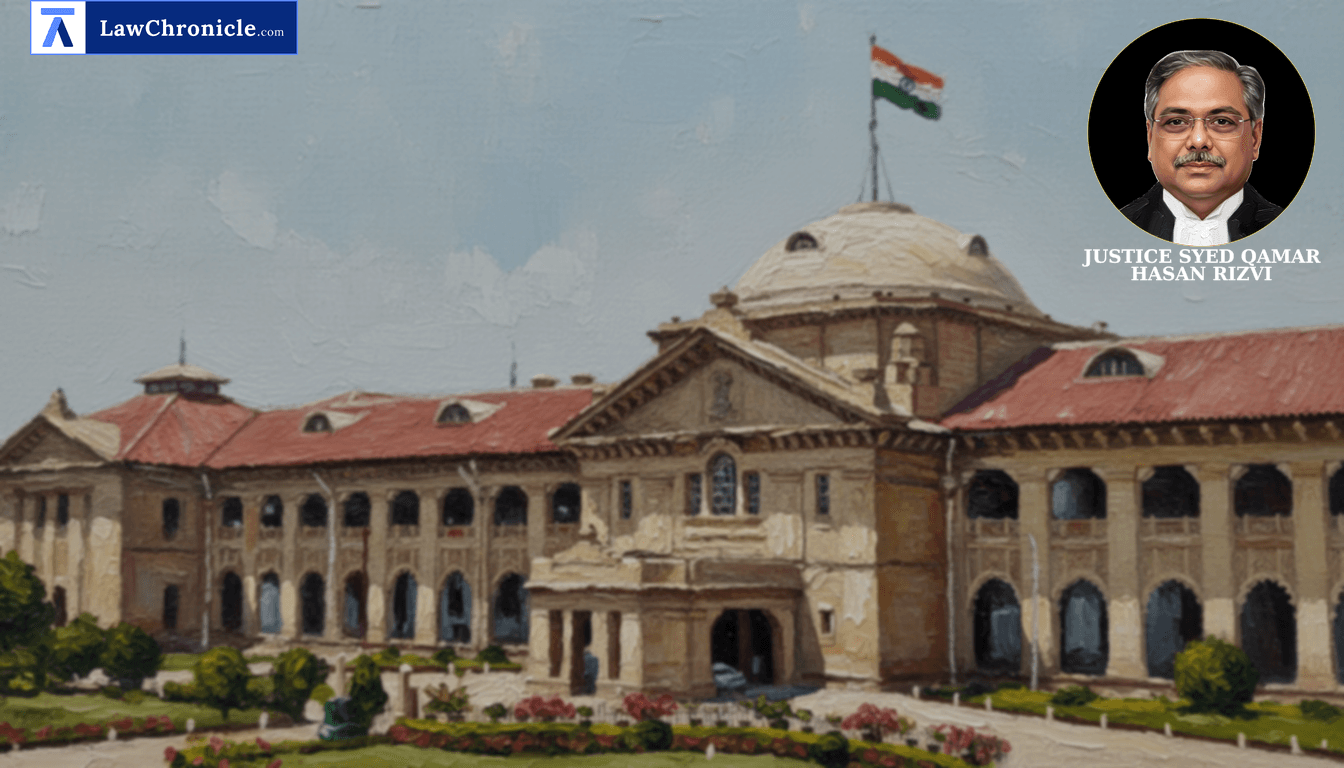
A single judge bench of Justice Syed Qamar Hasan Rizvi allowed a First Appeal From Order challenging the rejection of a compensation claim by the Railway Claims Tribunal, Lucknow Bench.
Key Takeaways
- Presumption Rebuffed: Body fragmentation alone does not prove a run-over case or negate an accidental fall.
- Burden of Proof Shift: Initial burden on claimants is discharged via affidavit; Railways must produce evidence to dispute bona fide travel.
- Enhanced Compensation: Claimants are entitled to the higher amended statutory limit of ₹8 lakh even for pre-2017 accidents.
Court's Rationale on Untoward Incidents and Burden of Proof
The High Court held that when a passenger falls due to sudden jolts or overcrowding, contact with moving train parts can cause body severance, which cannot automatically disentitle dependents from claiming under Section 124A of the Railways Act, 1989. Addressing the non-recovery of a ticket, the Court observed that mere absence of a physical ticket during search does not disprove bona fide passenger status when supported by witness testimony.
The Court has following directions:
"(i) The Respondent/Railways is directed to pay a lump-sum compensation amount of Rs.8,00,000/- (Rupees Eight Lakhs only) to the Appellant within a period of eight weeks from today.
(ii) In case, if, the Respondent fails to deposit/pay the said amount within the stipulated period of eight weeks, the awarded sum shall carry interest at the rate of 9% per annum thereafter till the actual date of payment, in the light of the principle as laid down by the Hon'ble Apex Court in the case of Rina Devi (supra)"
The Court, in its reasoning, observed: "...the mere fact that the body of the deceased was found in multiple pieces cannot, by itself, lead to a conclusive inference that the case was one of the circumstances specified in the proviso to Section 124A of the Railways Act, 1989. For attracting the exceptions contained in the proviso to Section 124-A of the Railways Act, 1989, the Railways is required to establish the same by leading cogent and substantial evidence."
Ratio
Mere non-recovery of a journey ticket or the presence of a severed body on railway tracks cannot lead to an automatic presumption against an untoward incident; the Railway Administration must adduce affirmative evidence to prove statutory exceptions under the proviso to Section 124A of the Railways Act, 1989.
Background
The dispute arose after the deceased accidentally fell from the 'Lal-Qila Express' on November 21, 2011, while traveling from Etawah to Delhi. The Railway Claims Tribunal dismissed the claim petition filed under Section 16 of the Railway Claims Tribunal Act, 1987 read with Section 124A of the Railways Act, 1989, relying on police inquest and DRM reports under the Railway Passengers (Manner of Investigation of Untoward Incidents) Rules, 2003 to presume a 'run over' case due to the body being cut into three pieces.
Reversing this, the High Court applied precedents including Union of India versus Rina Devi ( "(2019) 3 Supreme Court Cases 572": 2018 CaseBase(SC) 1157) and Union of India versus Radha Yadav ( "(2019) 3 SCC 410": 2019 CaseBase(SC) 1138) regarding burden of proof and quantum under the Railway Accidents and Untoward Incidents (Compensation) Rules, 1990. It distinguished Kamrunnissa versus Union of India on facts, and referred to principles in Solanki Chimanbhai Ukabhai versus State of Gujarat ( "(1983) 2 Supreme Court Cases 174": 1983 CaseBase(SC) 309), Sh. Prempal Singh and Another versus Union of India, and Smt. Manju Yadav versus Union of India to hold that technical assumptions cannot oust valid compensation claims. Setting aside the tribunal order, the High Court directed payment of ₹8,00,000 as compensation.
Case Details:
Case No.: FIRST APPEAL FROM ORDER No. - 18 of 2018
Case Title: Lali v. Union Of India
Appearances:
For the Petitioner(s): Manish Kumar Srivastava
For the Respondent(s): Nishant Shukla, Neerav Chitravanshi, Shiv P. Shukla
Source: 2026 CaseBase(ALL) 625
Similar Articles
 Breaking News


