


Snapped Chain Of Circumstances Cannot Sustain Conviction In Murder Trials: Gujarat HC
 Copy Link
 Share
 Save
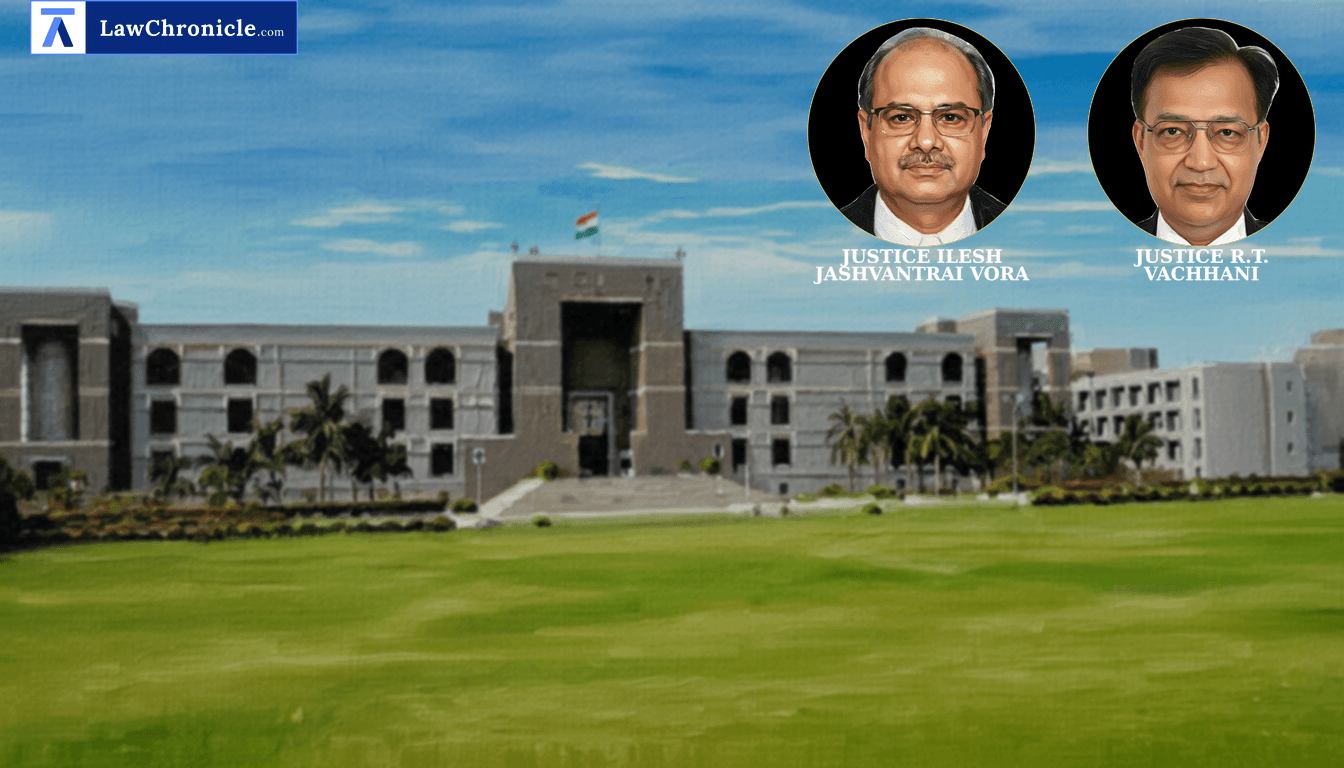
Reinforcing the 'cardinal principle' of criminal jurisprudence, the Gujarat High Court has refused to overturn a murder acquittal, ruling that a conviction based on circumstantial evidence cannot stand unless the prosecution establishes a seamless, conclusive chain of events that leaves no room for any alternative hypothesis. The Court emphasized that unless a trial court's findings are found to be 'patent perversity' or 'demonstrably unsustainable,' an appellate court must stay its hands, even if a different view is possible.
A bench comprising Justice Ilesh J. Vora and Justice R. T. Vachhani adjudicated an appeal filed by the State under Section 419 of the Bharatiya Nagarik Suraksha Sanhita, 2023. The State challenged the acquittal of five respondents by a Vadodara Sessions Court in a case involving the alleged kidnapping and murder of a businessman, Bhaumik Patel, whose body was discovered in a decomposed state inside an industrial wastewater canal.
Key Takeaways
Precedence of Trial Court Views
In acquittal appeals, if two reasonable conclusions are possible, the appellate court must favor the one that upholds the trial court's finding of innocence.
Mandatory Three-Link Chain
For successful prosecution based on circumstantial evidence, the State must prove three specific links: motive, last-seen-together circumstances, and the recovery of the weapon of assault.
Admissibility vs Probative Value
Compliance with Section 65-B of the Evidence Act ensures the admissibility of electronic evidence like CCTV, but it does not automatically confer probative value or prove a criminal conspiracy.
Innocuous Association Not Proof
Mere presence at a business establishment or a short conversation between accused persons is considered an 'innocuous circumstance' and is insufficient to establish a conspiracy without evidence of the subject matter.
Court Observations and Directions
The Court noted that the prosecution failed to bridge the significant temporal gap between when the deceased was last seen alive and the discovery of his car and body. It observed that the theory of the deceased being "called out" remained entirely unproved. Regarding the CCTV footage relied upon by the State to prove a meeting between the accused, the Court clarified that such association, during working hours at a business premises, is equally consistent with innocence.
The Court, in its reasoning, observed: "In a case of circumstantial evidence, the chain is required to be completed as mandated under the law so as to indicate the guilt of the accused while discarding any other theory of the crime. If one of the link goes missing and not proved, in view of the settled law on the point, the conviction is required to be interfered with. One must look for a complete chain of circumstances and not on snapped and scattered links which do not make a complete sequence."
The Court has the following directions:
"In light of the above legal position and for the reasons recorded in the foregoing paragraphs, the present appeal fails and is accordingly dismissed."
Ratio
An appellate court cannot substitute its own view by reversing an acquittal into a conviction unless the trial court's findings are perverse, contrary to the material on record, or manifestly erroneous. In cases resting on circumstantial evidence, the failure to prove even a single vital link such as motive or last-seen renders the entire prosecution case unsustainable as it fails to establish a chain that unerringly points toward the guilt of the accused.
Background
The prosecution alleged that respondent No.1 and the deceased were business partners. It was claimed that a conspiracy was hatched to kill the deceased after he demanded the return of borrowed money. The State alleged that Accused Nos. 4 and 5 were hired for Rs. 3,00,000 to execute the murder. The deceased went missing on March 3, 2018, and his blood-stained car was found abandoned. Two days later, his body was found in a canal.
However, the Sessions Court acquitted the accused for offences under Sections 302, 201, and 120-B of the Indian Penal Code, 1860 and relevant sections of the Arms Act, 1959, citing the lack of evidence regarding the 'last seen' theory and the failure to prove the conspiracy. Relying on the precedent in Tulasareddi @ Mudakappa & Anr. v. The State of Karnataka & Ors. ( "2026 INSC 67": 2026 CaseBase(SC) 72), the High Court affirmed that unless the trial court’s reasoning is demonstrably unsustainable, the High Court should not interfere in an acquittal appeal.
Case Details:
Case No.: R/CRIMINAL APPEAL (AGAINST ACQUITTAL) NO. 2300 of 2026
Neutral Citation: 2026:GUJHC:69175-DB
Case Title: State Of Gujarat Versus Shahrukh @Chechi Iqbalbhai Vora & Ors.
Appearances:
For the Petitioner(s): Ms Vrunda Shah APP
Source: 2026 CaseBase(GUJ) 31972
Similar Articles


 Breaking News


