


Specific Performance Decree Not Automatically Rescinded for Delayed Payment: SC
 Copy Link
 Share
 Save
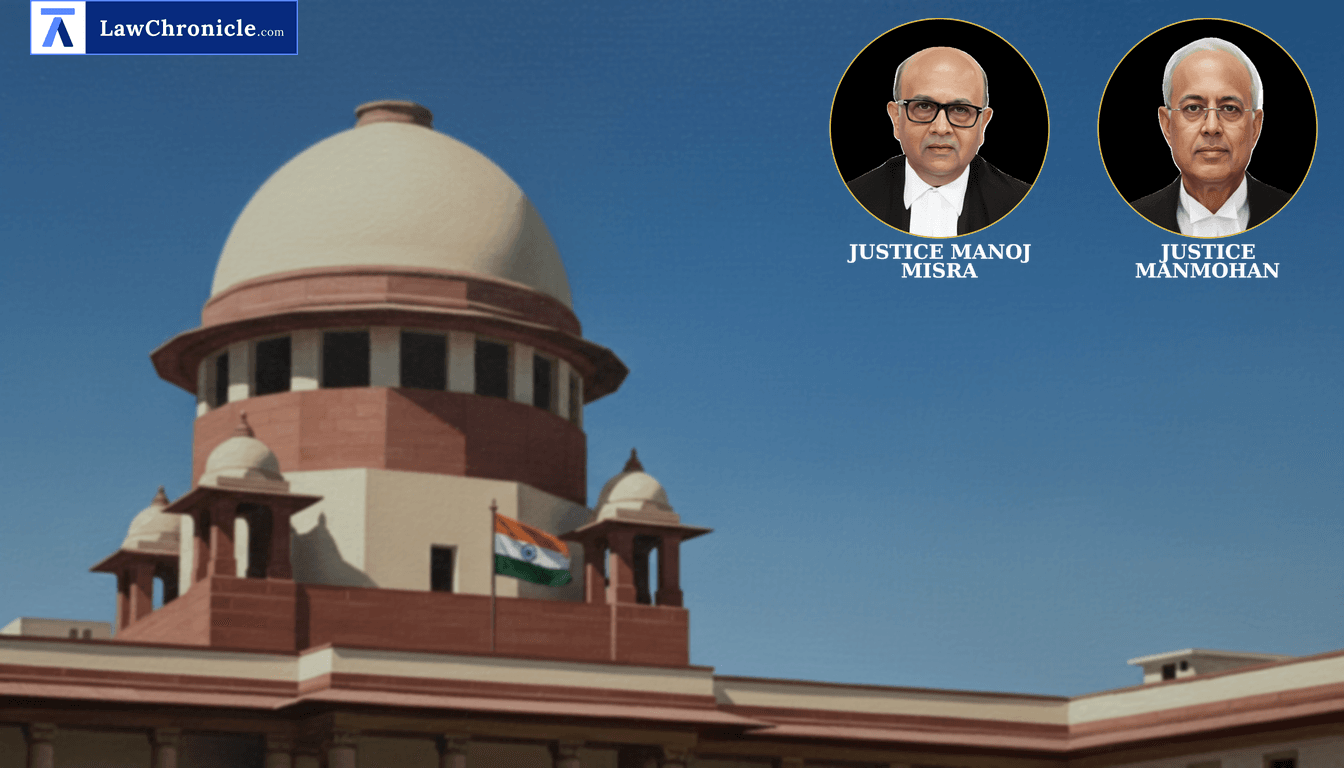
The Supreme Court, in Anand Narayan Shukla v. Jagat Dhari, has clarified that a decree for specific performance does not automatically stand rescinded due to a delay in depositing the balance sale consideration, provided the decree did not explicitly stipulate dismissal for non-performance.
A bench of Justice Manoj Misra and Justice Manmohan heard the appeal challenging a High Court order that had upheld the dismissal of an execution petition due to a delay in payment by the decree-holder. The Court emphasized that a justice-oriented approach is required rather than a hyper-technical one when dealing with such delays.
Court's Interpretation of Section 28 of the Specific Relief Act
The Court observed that Section 28 of the Specific Relief Act, 1963 grants the court discretionary power to either rescind a contract or extend the time for payment. It was noted that the court which passes a decree for specific performance does not become functus officio and retains control over the decree until the sale deed is executed.
The Court, in its reasoning, observed: "Use of phrases 'may, by order, rescind' and 'such further period as the court may allow' make it clear that the provision leaves discretion in the court either to rescind the contract and, consequently, the decree, or to extend the time for making payment/ deposit... the legislative intent is clear that it is a discretionary power and, therefore, there is no automatic rescission in the event of default."
Guidelines for Extension of Time and Balancing Equities
The Supreme Court summarized several legal principles for exercising power under Section 28. It held that while a decree-holder is not required to explain every single day's delay as under the Limitation Act, 1963, the court must test whether the conduct reflects a "willful negligence" or a positive refusal to complete the contract.
The Court has following directions:
"...we deem it appropriate to set aside both the impugned orders, namely, the order of the High Court and of the Execution Court, and restore the Execution Application and all other applications filed therein qua rescission of contract/ extension of time to deposit to their original number on the file of the Execution Court/ the Court of first instance for a fresh consideration in accordance with the law and in light of the observations made in this judgment. Further, the Court shall deal with those application(s) as application(s) in the suit and shall be numbered as such."
Background:
The case originated from a 2017 decree directing the appellant to pay approximately Rs. 57.50 lakhs within one month for the sale of land. While the appellant issued a notice to the respondent for execution, the balance amount was not deposited in court within the one-month period. Instead, an execution application was filed in July 2017. During the pendency of the execution and a subsequent appeal by the respondent, the execution court did not pass a specific order to deposit the money until 2019. Eventually, the deposit was made in November 2020 during the COVID-19 pandemic.
The execution court had dismissed the application, holding the decree inexecutable due to the delay. The High Court affirmed this. However, the Supreme Court relied on precedents like Kunhayammed and others v. State of Kerala and another ( "(2000) 6 SCC 359": 2000 CaseBase(SC) 4), Ramankutty Guptan v. Avara ( "(1994) 2 SCC 642": 1994 CaseBase(SC) 1133), and Ram Lal v. Jarnail Singh to establish that the power to extend time exists even after the stipulated period expires. The Court also addressed the doctrine of merger, noting that since the first appeal was dismissed for non-prosecution and not on merits, the trial court decree did not merge into an appellate decree as per Section 2(2) of the Code of Civil Procedure, 1908.
Case Details:
Case No.: CIVIL APPEAL No. 7355 OF 2026
NeutralCitation: 2026 INSC 463
Case Title: ANAND NARAYAN SHUKLA v. JAGAT DHARI
Appearances:
For the Petitioner(s): Mr. Saurabh Mishra, Senior Counsel
For the Respondent(s): Mr. Ajay Marwah, Counsel
Source: 2026 CaseBase(SC) 414
Similar Articles
 Breaking News


