


Supreme Court Restores Execution of Specific Performance Decree Despite Short Delay in Deposit of Balance Consideration
 Copy Link
 Share
 Save
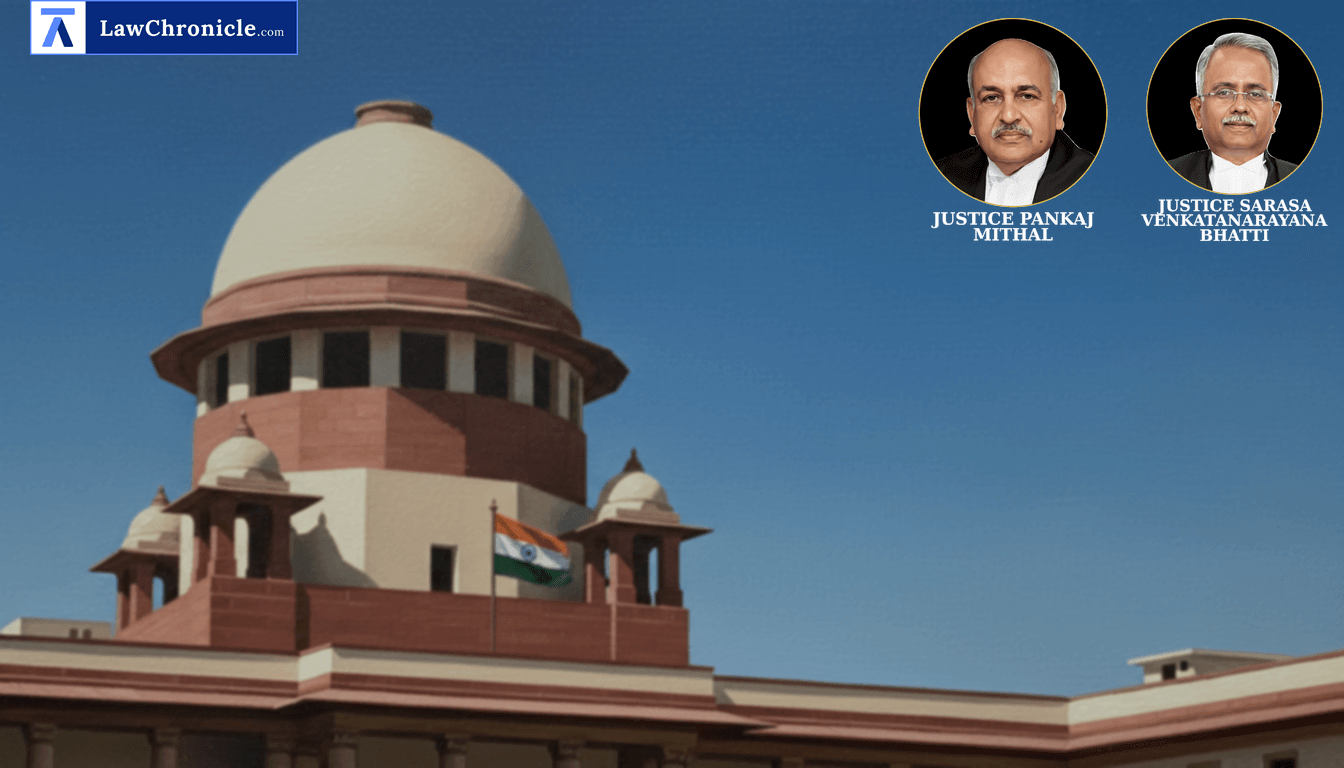
A bench of Justices Sanjay Karol and Manoj Misra heard an appeal against a judgment of the High Court of Punjab & Haryana at Chandigarh which had allowed objections to the execution of a decree for specific performance on the ground that the decree-holder had not deposited the balance sale consideration within the two-month period stated by the Trial Court.
The Court allowed the appeal, set aside the High Court's order and restored the executing court's dismissal of objections, directing the executing court to proceed with execution of the Trial Court’s decree for specific performance. The Court held that failure to deposit the balance within the stipulated period did not automatically result in rescission of the contract and that a short delay (27 days beyond the two-month period in this case) did not strike at the root of the agreement where readiness and willingness to perform had been established. The Court further noted the application of Section 28 of the Specific Relief Act and the doctrine of merger as relevant to the dispute. The Court, in its reasoning, observed: “However, such non-grant of extension of time cannot, in our view, be the end of the transaction. Taking such a view would be a classic example of a hyper-technical approach which, this Court has observed, ought to be eschewed… the non-payment of balance sale consideration within the time period fixed by the Trial Court does not amount to abandonment of the contract and consequent rescinding of the same. The real test must be to see if the conduct of the plaintiff will amount to a positive refusal to complete his part of the contract.” The Court also recorded the High Court’s contrary view that “the Executing Court has no power to extend the time even if an application is filed,” but found such a strict approach inconsistent with precedent.
Background The dispute arose from an agreement to sell dated 11 December 2004 for a plot in Kalka, Panchkula, for Rs.9,05,000/-. The purchaser (appellant) paid Rs.1,00,000 as earnest money and sued for specific performance; the Trial Court decreed specific performance on 14 May 2011 and directed execution of the sale deed on payment of the balance within two months. The First Appellate Court set aside the decree and awarded double earnest money, but the second appeal restored the Trial Court’s decree, finding the purchaser ready and willing to perform. The decree-holder filed an execution petition on 4 July 2016 but deposited the balance in two instalments only after the two-month period prescribed by the Trial Court. The executing court dismissed objections filed by the judgment-debtor, but the High Court allowed those objections on the view that no application for extension had been filed in the appellate forum and that the decree therefore became “inexecutable.”
The Supreme Court analysed Section 28 of the Specific Relief Act and precedents including V.S. Palanichamy Chettiar Firm v. C. Alagappan, Ram Lal v. Jarnail Singh and recent authority on the doctrine of merger. It emphasised that when a decree for specific performance exists and the decree-holder demonstrated readiness and willingness, courts should avoid hyper-technical rules that automatically rescind contracts for short delays in payment. The Court concluded that the High Court’s interpretation was contrary to law, that the decree of the Trial Court merged with the final decision and that the delay of 27 days did not defeat execution given established readiness and willingness. The appeal was allowed, the High Court order was set aside, and the executing court was directed to proceed with execution in accordance with law; a copy of the Supreme Court judgment was to be sent to the executing court.
Case Details: Case No.: 2025 INSC 1486 Case Title: Dr. Amit Arya v. Kamlesh Kumari Appearances: For the Petitioner(s): Not indicated in the judgment For the Respondent(s): Not indicated in the judgment
Similar Articles
 Breaking News


