


SRA Can't Claim Pre-CIRP Dues While Extinguishing OC Claims: SC Allows Set-Off
 Copy Link
 Share
 Save
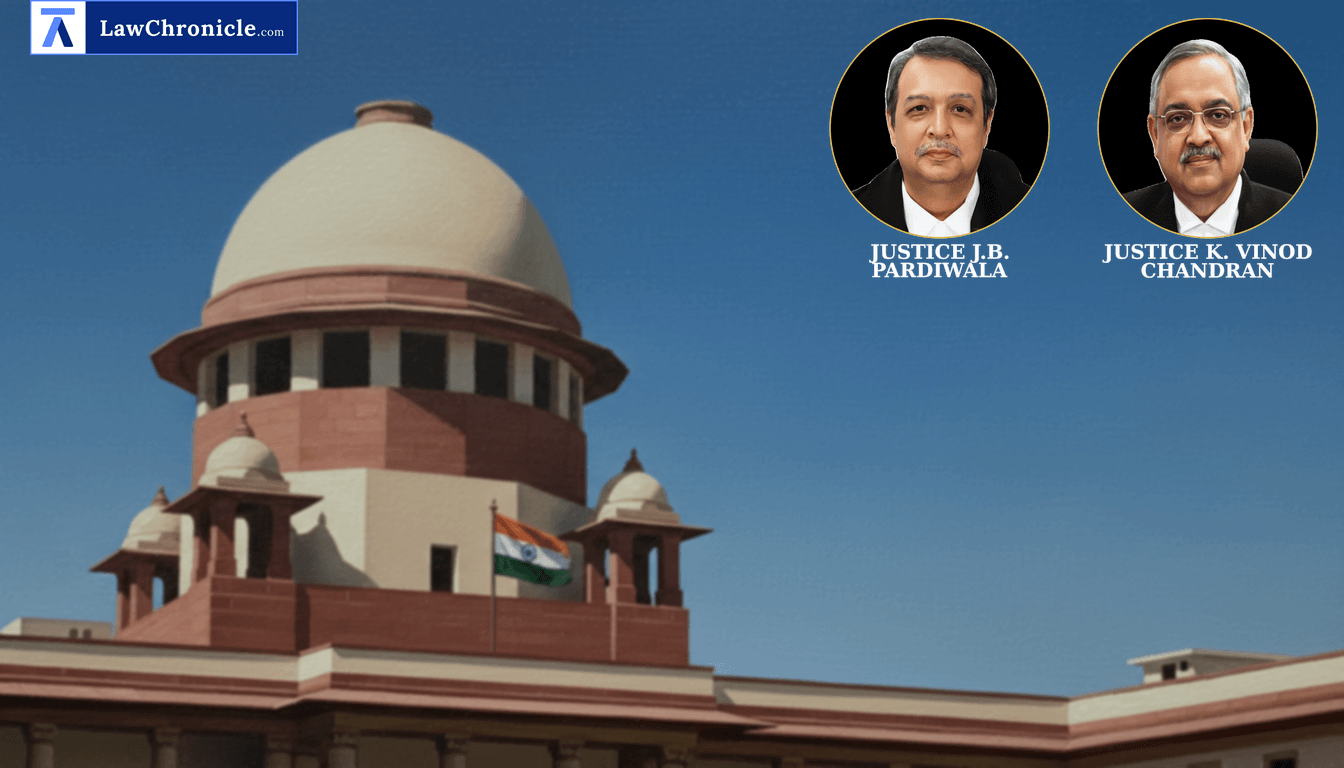
Balancing the scale of statutory protections with commercial equity, the Supreme Court has ruled that a Successful Resolution Applicant (SRA) initiating arbitration to recover pre-CIRP dues against an Operational Creditor must face the creditor's full original counterclaim for the sole purpose of set-off, preventing corporate debtors from using insolvency proceedings as a one-way street to evade mutual liabilities.
A Division Bench comprising Justice J.B. Pardiwala and Justice K. Vinod Chandran delivered the verdict while modifying an order of the Karnataka High Court that had unconditionally referred the parties to arbitration under Section 11 of the Arbitration and Conciliation Act, 1996.
Key Takeaways
Equitable Set-Off Allowed in Post-CIRP Arbitrations: Operational Creditors who suffer massive haircuts during insolvency proceedings can set off their extinguished claims against recovery actions initiated by the SRA.
No Positive Monetary Recovery: While an Operational Creditor can assert its full original claim to wipe out the SRA's monetary demands, it cannot seek affirmative monetary recovery beyond set-off.
Clean Slate Principle Harmonized with Equity: The statutory protection insulating an SRA from pre-resolution liabilities under Section 31 of the Insolvency and Bankruptcy Code, 2016 remains intact, but cannot be weaponized selectively to collect dues from creditors whose own counter-claims were wiped out.
Court Observations and Directions
The Supreme Court observed that while the SRA's right to pursue pre-existing debts of the Corporate Debtor is valid, allowing a one-way arbitration where the creditor is barred from raising set-off would lead to gross inequity.
The Apex Court discussed that "In the above circumstances, we are of the opinion that just as in the decision in Ujaas Energy Ltd., the appellant should be permitted to raise a counterclaim for the sole purpose of claiming set-off and the appellant would not derive any positive or affirmative relief of recovery on the basis of the counterclaim. However, in the more compelling circumstance of the SRA, being the very erstwhile promoters of the CD, who accepted the claim of the OC, in the CIRP with a major haircut by a Resolution Plan, the SRA is deemed to have accepted the entire claim of the appellant/OC. In the arbitration constituted, after considering the monetary claim raised by the respondent/SRA, the Arbitration Tribunal shall allow set-off to the extent of the entire claim raised by the appellant, before the RP in the CIRP, accepted in toto by the SRA in its resolution plan, favoured with a majority of the CoC and approved by the NCLT."
The Supreme Court issued the following directions: "The impugned order is sustained with only the above modification that the appellant would be entitled to raise the counterclaim as specified above only for the purpose of set-off. If any amounts are found due by the Arbitration Tribunal to be paid by the appellant to the respondent then there shall be a set-off to the extent of the entire counterclaim as put forth by the appellant. Even in the extreme event of the claim of the respondent being found untenable in toto the appellant cannot seek any payment on the basis of such award since his claim stands extinguished as against the CD and the SRA. The benefit granted of the set-off, is only to ensure equity and further the process of preservation of assets of CD in the hands of the SRA, within the contours of the IBC. Needless to observe that the issue raised by the respondent regarding the encashment of the bank guarantee furnished by the respondent, whether it was proper or improper, shall also be considered by the Arbitration Tribunal."
Ratio
When a Successful Resolution Applicant (SRA) or a Corporate Debtor post-CIRP initiates arbitral proceedings to enforce claims against an Operational Creditor arising from a pre-existing contract, the Operational Creditor is entitled to raise its original pre-CIRP claim as a counterclaim strictly for the purpose of set-off, notwithstanding the formal extinguishment of that claim under Section 31 of the Insolvency and Bankruptcy Code, 2016.
Background
The dispute stemmed from an agreement dated July 9, 2018, between Modern Asset (appellant) and KNK Construction Private Limited (respondent) for civil and structural construction work worth Rs. 133.68 Crores. Clause 19.13 of the agreement contained an arbitration clause. Following disputes and alleged non-rectification of defects, the appellant terminated the contract on February 25, 2020.
During this period, the respondent was admitted into the Corporate Insolvency Resolution Process (CIRP) on December 11, 2019. The appellant filed an operational claim of Rs. 12,26,30,840/- before the Resolution Professional (RP). Under a resolution plan submitted by the respondent's erstwhile promoters, who qualified as an SRA owing to MSME status under Section 240A(1) of the Insolvency and Bankruptcy Code, 2016, the appellant's claim was subjected to a massive haircut, admitting only 0.72% (Rs. 8,82,942/-).
The NCLT approved the resolution plan on April 5, 2022. Subsequently, the respondent/SRA invoked arbitration under Section 11 of the Arbitration and Conciliation Act, 1996 before the Karnataka High Court, seeking recovery of alleged dues arising from the exact same contract. The High Court appointed an arbitrator, ruling that the doctrine of separability preserved the arbitration agreement and that the effect of the resolution plan could be adjudicated by the Arbitral Tribunal under Section 16.
Challenging the High Court's ruling, the appellant argued before the Apex Court that initiating arbitration after its own claim was extinguished under the 'clean slate' principle of Section 31 of the Insolvency and Bankruptcy Code, 2016 created an unfair one-way street. The respondent relied on SBI General Insurance v. Krish Spinning ( "(2024) 12 SCC 1": 2024 CaseBase(SC) 562), In Re: Interplay between Arbitration Agreements under the Arbitration and Conciliation Act 1996 and the Indian Stamp Act, 1899, Ghanshyam Mishra & Sons (P) Ltd. v. Edelweiss Asset Reconstruction Co. Ltd. ( "(2021) 9 SCC 657": 2021 CaseBase(SC) 355), and Ujaas Energy Ltd. v. West Bengal Power Development Corporation Ltd. ( "2026 SCC OnLine SC 453": 2026 CaseBase(SC) 228) to argue that the SRA preserves the right to recover debts of the CD while operational claims against it stand legally extinguished.
After analyzing the statutory framework of the Insolvency and Bankruptcy Code, 2016 and relying on the equitable principles articulated in Ujaas Energy Ltd. v. West Bengal Power Development Corporation Ltd. ( "2026 SCC OnLine SC 453": 2026 CaseBase(SC) 228), the Supreme Court held that while the 'clean slate' principle under Section 31 remains well-entrenched, it cannot work to create gross commercial inequity. Consequently, the Supreme Court sustained the reference to arbitration but modified the impugned order, permitting the appellant to raise its complete original claim as a defense of set-off.
Case Details:
Case No.: Civil Appeal No. of 2026 [Special Leave Petition (C) No.25068 of 2026]
Neutral Citation: 2026 INSC 1103
Case Title: Modern Asset v. KNK Construction Private Limited
Appearances:
For the Petitioner(s): Sri Shyam Divan, Senior Advocate
For the Respondent(s): Sri Nikhil Nayyar, Senior Advocate
Source: 2026 CaseBase(SC) 8252
Similar Articles

 Breaking News


