


Supreme Court Alters Conviction From Section 307 To 325 IPC Citing Lack Of Murderous Intent
 Copy Link
 Share
 Save
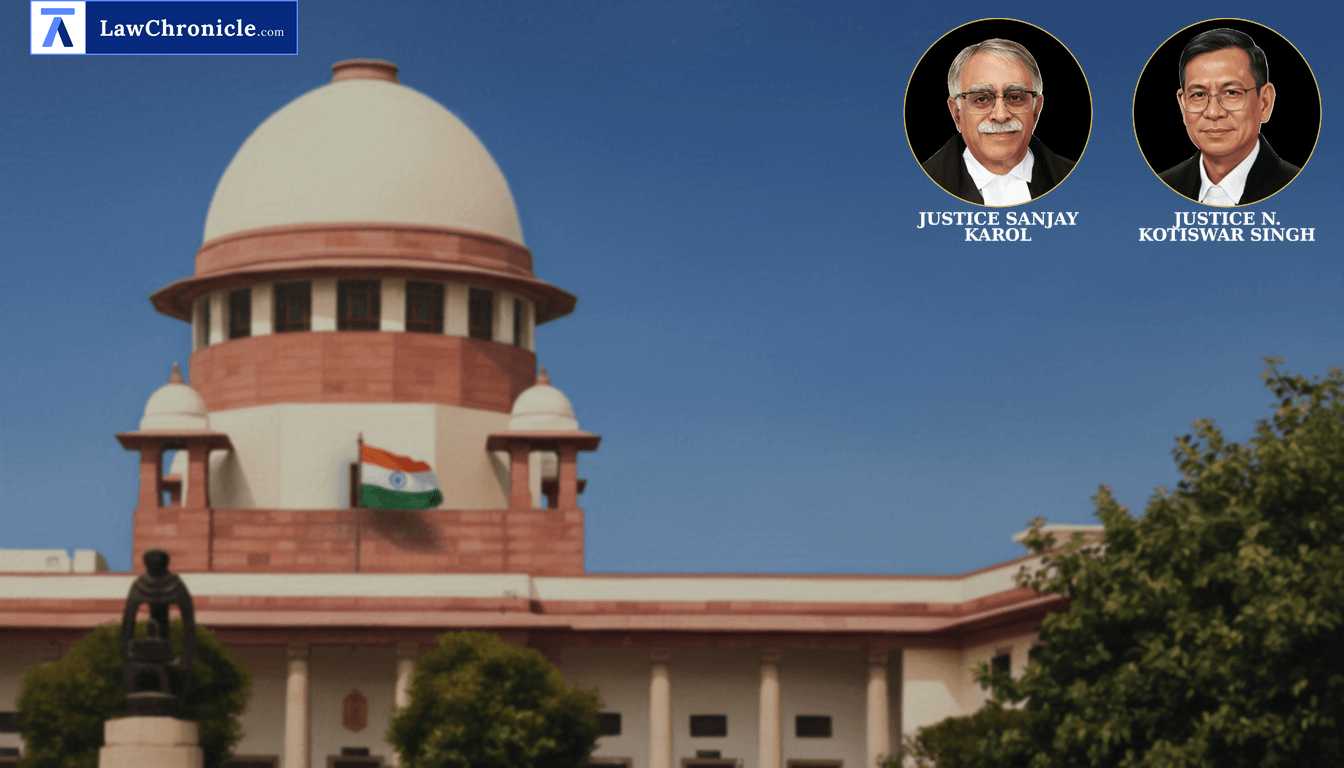
In a significant ruling on the thresholds of criminal liability, the Supreme Court modified the conviction of three appellants from attempt to murder to voluntarily causing grievous hurt, emphasizing that the absence of premeditation and prior enmity negates the 'intent to kill' required under Section 307 of the Indian Penal Code, 1860.
A bench of Justice Sanjay Karol and Justice Nongmeikapam Kotiswar Singh adjudicated on three criminal appeals challenging a common judgment of the High Court of Punjab & Haryana. The appellants sought relief against their seven-year sentences for an assault involving lathis that resulted in a compound fracture to the victim’s scalp. The Court closely examined whether concurrent findings by lower courts were vitiated by any error of law, adhering to the principles of interference established in Dalbir Kaur & Ors. vs. State of Punjab ( "(1976) 4 SCC 158": 1976 CaseBase(SC) 346).
Court's Rationale on Section 307 vs Section 325
The Court scrutinized the essential ingredients of Section 307, noting that while the injury was dangerous to life, the circumstances of the assault arising from a spontaneous intervention in a road-side altercation did not indicate a determined effort to cause death. The bench clarified that the gravity of an injury alone is not the sole determinant for an attempt to murder charge; the prosecution must independently establish the requisite mens rea.
The Court, in its reasoning, observed: "The intention to commit murder cannot be presumed merely because the injuries were ultimately opined to be dangerous to life. In the absence of evidence showing prior motive, premeditation, repeated deliberate blows with deadly weapons, or any conduct indicative of a determined effort to cause death, this Court is unable to hold that the appellants possessed the intention or knowledge necessary to attract Section 307 IPC in the light of Bipin Bihari v. State of M.P. ( "(2006) 8 SCC 799": 2006 CaseBase(SC) 1222)."
Classification of Grievous Hurt
Determining that the injuries fell under the categories defined in Section 320 of the Indian Penal Code, 1860, specifically "Seventhly" (fracture) and "Eighthly" (endangering life), the Court held that Section 325 was the appropriate provision. It relied on State of Madhya Pradesh v. Saleem @ Chamaru ( "(2005) 5 SCC 554": 2005 CaseBase(SC) 115) to reiterate that while the nature of the injury assists in finding intent, it is not the conclusive factor if the intention can be deduced from other circumstances.
The Court has the following directions:
"...the conviction of the appellants under Section 307 read with Section 34 IPC is altered to one under Section 325 read with Section 34 IPC. ...we are of the view that interest of justice will be served if the appellants are sentenced to the period already undergone by them and impose a fine of Rs. 50,000/- each on the appellants, which shall be paid to the injured-informant, failing which the appellants will undergo an additional 6 (six) months simple imprisonment."
Background:
The dispute originated on June 5, 2000, when Amar Singh, a night watchman, intervened to stop the accused from beating a jeep driver. The accused turned on him, inflicting lathi blows to his head and hands. While the Trial Court and High Court convicted the appellants under Section 307 and 506 of the Indian Penal Code, 1860, the appellants argued that the injuries were not inflicted with an intent to kill and that the incident was a sudden fight without premeditation. They also highlighted discrepancies between ocular and medical evidence. The Supreme Court, while upholding the factual occurrence of the assault, ultimately found that the legal threshold for 'attempt to murder' was not met, thus reducing the sentence to the time already served (ranging from 1 to 2.5 years) coupled with a compensatory fine.
Case Details:
Case No.: CRIMINAL APPEAL NO. 2207 OF 2011
Case Title: ROSHAN LAL VS THE STATE OF HARYANA & ANR
Source: 2026 CaseBase(SC) 449
Similar Articles

 Breaking News


