


Supreme Court Holds Concealment of Criminal Proceedings In Recruitment Forms Justifies Cancellation of Appointment
 Copy Link
 Share
 Save

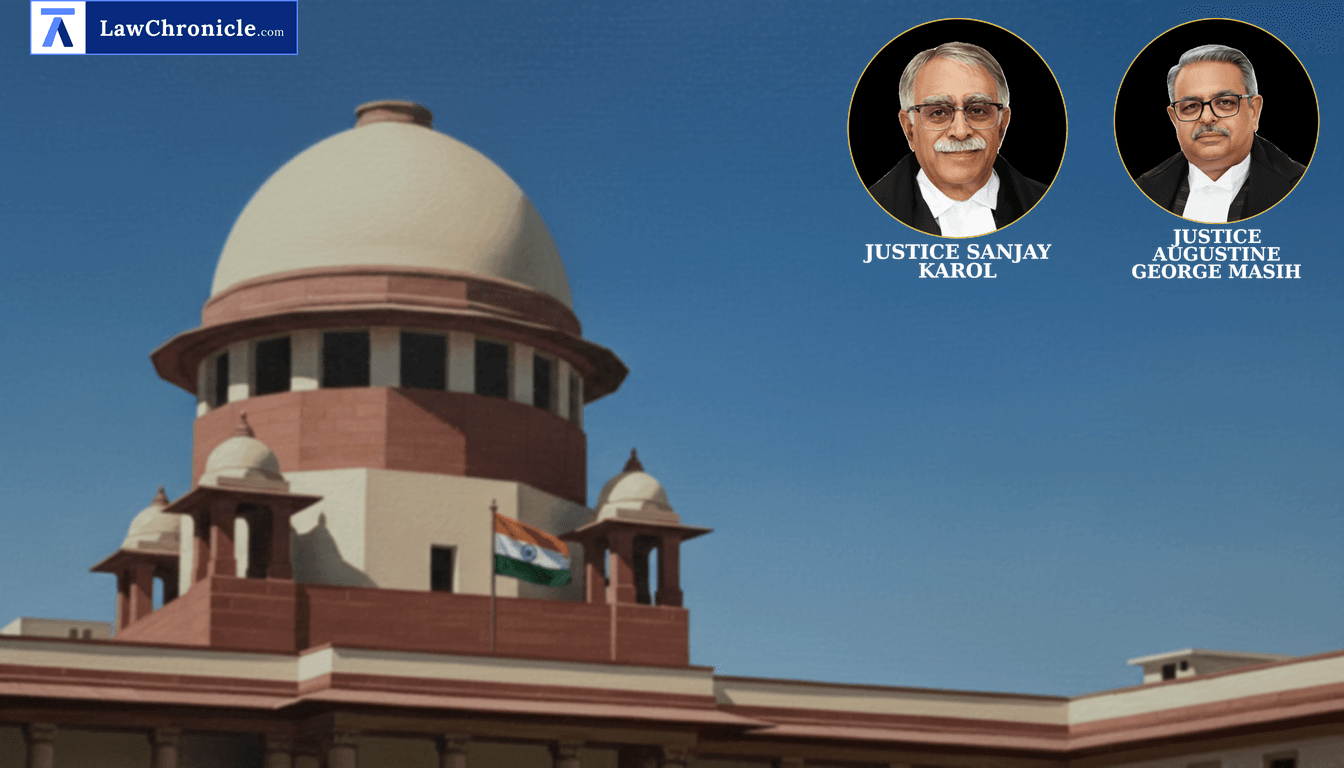
A bench of Justices Sanjay Karol and Nongmeikapam Kotiswar Singh heard the appeal by the State of Uttar Pradesh challenging the Allahabad High Court’s decision that had set aside the cancellation of an appointment of a Sahayak Samiksha Adhikari. The question before the Court was whether concealment of pending criminal proceedings in the attestation and verification forms vitiated a candidate’s selection and justified cancellation of appointment.
The Court allowed the appeal and held that deliberate non‑disclosure of criminal antecedents in statutory application forms justified a strict view by the appointing authority and rendered the candidate ineligible for government service. The Court emphasised that disclosure in applications for government employment was “not a simple procedural formality, but a basic requirement rooted in fairness, integrity, and public trust.” The Court, in its reasoning, observed: “Proper and complete disclosure in applications for government employment is not a simple procedural formality, but a basic requirement rooted in fairness, integrity, and public trust. Government posts attract hundreds, and often thousands, of applicants for a single vacancy, each competing under the same stated conditions, scrupulous vetting of every candidate becomes imperative and essential to ensure a level playing field and to protect the credibility of the selection process. When an applicant withholds information about criminal antecedents, it undermines this process by depriving the appointing authority of the opportunity to make a fully informed assessment of suitability. While the law recognizes that non‑disclosure, depending on the nature of the offence and surrounding circumstances, may not invariably be fatal to a candidature, it nevertheless remains a serious lapse. The gravity is significantly compounded when the non‑disclosure is repeated, as it ceases to be accidental or inadvertent and instead reflects deliberate concealment. Such strikes at the core of trust reposed in candidates for public service, where honesty and transparency are indispensable attributes, and justify a far stricter view by the authorities.” The Court further noted that “juda lex sed lex” — the law may be harsh, but it is law — and concluded that subsequent acquittal or belated disclosure could not accrue to the candidate’s benefit.
Background The Uttar Pradesh Public Service Commission issued an advertisement dated 5 March 2021 for recruitment to Samiksha Adhikari/Sahayak Samiksha Adhikari. The respondent was selected and was required to submit an attestation form and a verification form, both of which asked whether any criminal cases were pending. In both forms the respondent answered in the negative. In fact, two criminal cases were pending against him: Crime No. 198 of 2019 (sections 147, 323, 504, 506 and 325 IPC) and Crime No. 215 of 2018 (section 354D IPC and section 12 POCSO Act). The mismatch came to light during police character verification and through an affidavit filed by the respondent later disclosing the pendency.
The appointing authority initiated cancellation proceedings and rescinded the appointment. The Single Judge of the Allahabad High Court allowed the writ petition preferred by the respondent and set aside the cancellation on findings that the District Magistrate had recorded suitability, that the respondent had not been charge‑sheeted, that non‑disclosure was not invariably fatal, that he had been acquitted in one case, and that he had later filed an affidavit. A Division Bench of the High Court dismissed the State’s appeal, describing the undisclosed information as “of trivial nature.”
The Supreme Court examined the attestation and verification disclaimers which warned that “Giving any false information in this application or concealing any material information will be treated as disqualification and may render the candidate unfit for Government service,” and that “Furnishing of false information in the verification form or suppression of any material information will be punishable and the candidate will be ineligible for employment under the Government.” The Court referred to precedents cited by the respondent, including Avtar Singh v. Union of India and Ravindra Kumar v. State of U.P., but held that the circumstances did not justify overlooking the repeated false responses. The Appeal was allowed and the High Court orders were set aside. Pending applications, if any, stood disposed of.
Case No.: Civil Appeal No. 196 of 2026 (2026 INSC 49) Case Title: State of U.P. & Another v. Dinesh Kumar Appearances: For the Petitioner(s): [Not indicated in the order] For the Respondent(s): [Not indicated in the order]
 Breaking News


