


Supreme Court Reduces Death Penalty to 25 Years in Frustration-Fueled Double Murder
 Copy Link
 Share
 Save
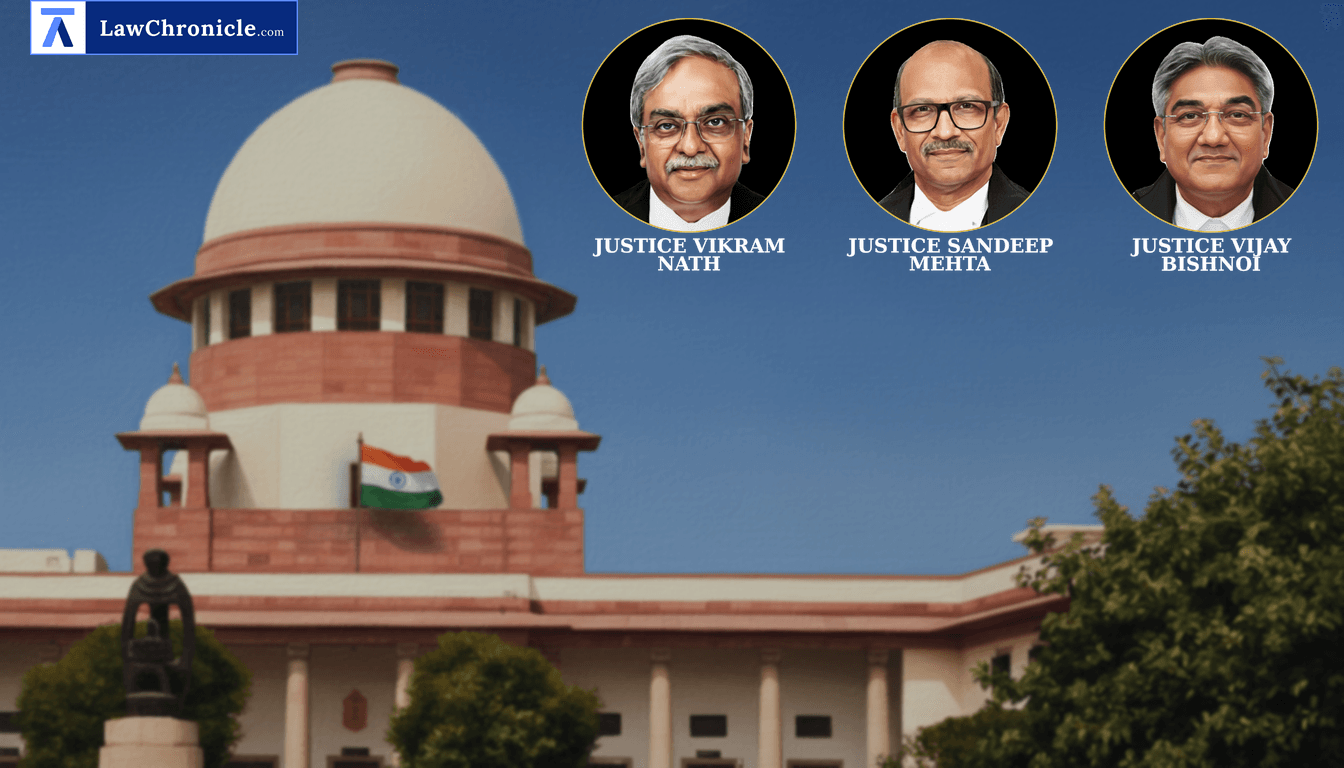
The Supreme Court, while upholding the conviction of a man for a gruesome double murder, commuted the death penalty to 25 years of imprisonment without remission, observing that the crime, though premeditated, was fueled by the personal frustration of losing his livelihood.
A three-judge bench comprising Justice Vikram Nath, Justice Sandeep Mehta, and Justice Vijay Bishnoi heard the appeals filed by the convict against the judgment of the Uttarakhand High Court, which had confirmed the death sentence awarded by the trial court. The case involved the brutal killing of a motorcycle showroom owner and a female supervisor in broad daylight, followed by arson.
Court Affirms Conviction Based on Unimpeachable Eyewitness Testimony
The Court found the testimonies of the eyewitnesses, including a brother of the deceased and a customer whose motorcycle was snatched, to be beyond the pale of doubt. It rejected the appellant's contentions regarding discrepancies in the timing of the incident, noting that minor variations are natural in traumatic occurrences. The Court observed that the ocular evidence was fully corroborated by medical reports and forensic findings, establishing the appellant's guilt under Sections 302, 392, 436, 506, and 411 of the Indian Penal Code, 1860 and Section 25/4 of the Arms Act, 1959.
Rationale for Commutation: Balancing Aggravating and Mitigating Factors
While acknowledging the heinous nature of the crime, the Court held that the case did not fall within the "rarest of rare" category as defined in Bachan Singh v. State of Punjab ( "(1980) 2 SCC 684": 1980 CaseBase(SC) 231). The Bench noted that the appellant belonged to the lower strata of society and acted out of deep frustration after being terminated from employment.
The Court's Directions
The Court has the following directions:
"The conviction of the appellant as recorded by the trial Court and affirmed by the High Court, is upheld. The sentences imposed in respect of offences punishable under sections 392, 436, 506 and 411 of the IPC and Section 25/4 of the Arms Act are also affirmed. However, the sentence of death awarded for the offence punishable under Section 302 of the IPC is commuted to imprisonment for life which shall enure for a fixed term of 25 (twenty-five) years without remission. The appellant shall also pay a fine of Rs.25,000/- (Rupees Twenty-Five Thousand only); in default of payment of fine, he shall undergo further simple imprisonment for a period of six months."
The Court, in its reasoning, observed: "The double murder, though arising from a calculated premeditation, was fueled by the frustration of a man who had been deprived of his livelihood and whose repeated requests for revival of employment were rejected. It is thus, not a case exhibiting such extreme moral depravity or exceptional brutality as would shock the collective conscience of society so as to warrant the imposition of death penalty."
Legal Precedents on Fixed-Term Sentencing
Referring to Swamy Shraddananda v. State of Karnataka ( "(2008) 13 SCC 767": 2008 CaseBase(SC) 1365) and Union of India v. V. Sriharan alias Murugan ( "(2016) 7 SCC 1": 2015 CaseBase(SC) 480), the Court reiterated that in cases where the alternative of life imprisonment with remission is inadequate but death is not warranted, the judiciary can prescribe a fixed period of incarceration. Citing Navas @ Mulanavas v. State of Kerala ( "2024 INSC 215": 2024 CaseBase(SC) 292), the Court noted that 25 years is frequently considered appropriate in double murder cases lacking exceptionally aggravating circumstances.
Background:
The dispute began when the appellant, a head mechanic at 'Hariom Automobile', was fired following a complaint by a colleague, Lalita. On February 10, 2011, the appellant returned to the showroom and stabbed the owner, Sanjay Guleria, in the neck. He then chased Lalita into a vacant plot and inflicted ten stab wounds. After the murders, he set the showroom on fire, threatened bystanders, and fled on a customer’s motorcycle. The trial court awarded the death penalty, which was later confirmed by the Uttarakhand High Court under Section 366 of the Code of Criminal Procedure, 1973. The Supreme Court eventually found that while the conviction was solid, the lack of prior criminal antecedents and the socio-economic background of the appellant necessitated a sentence of 25 years without remission instead of the gallows.
Case Details:
Case No.: CRIMINAL APPEAL NO(S). 491-492 OF 2019
NeutralCitation: 2026 INSC 557
Case Title: SHAHJAD ALI @ ALI UR REHMAN v. STATE OF UTTARAKHAND
Appearances:
For the Petitioner(s): Mr. Sanjay Kumar Dubey, Advocate
For the Respondent(s): Mr. Sudarshan Singh Rawat, Advocate
Source: 2026 CaseBase(SC) 581
Similar Articles

 Breaking News


