


Supreme Court Restores Murder Convictions, Holds Fatal Head Blows Attributed to Common Object of Unlawful Assembly
 Copy Link
 Share
 Save
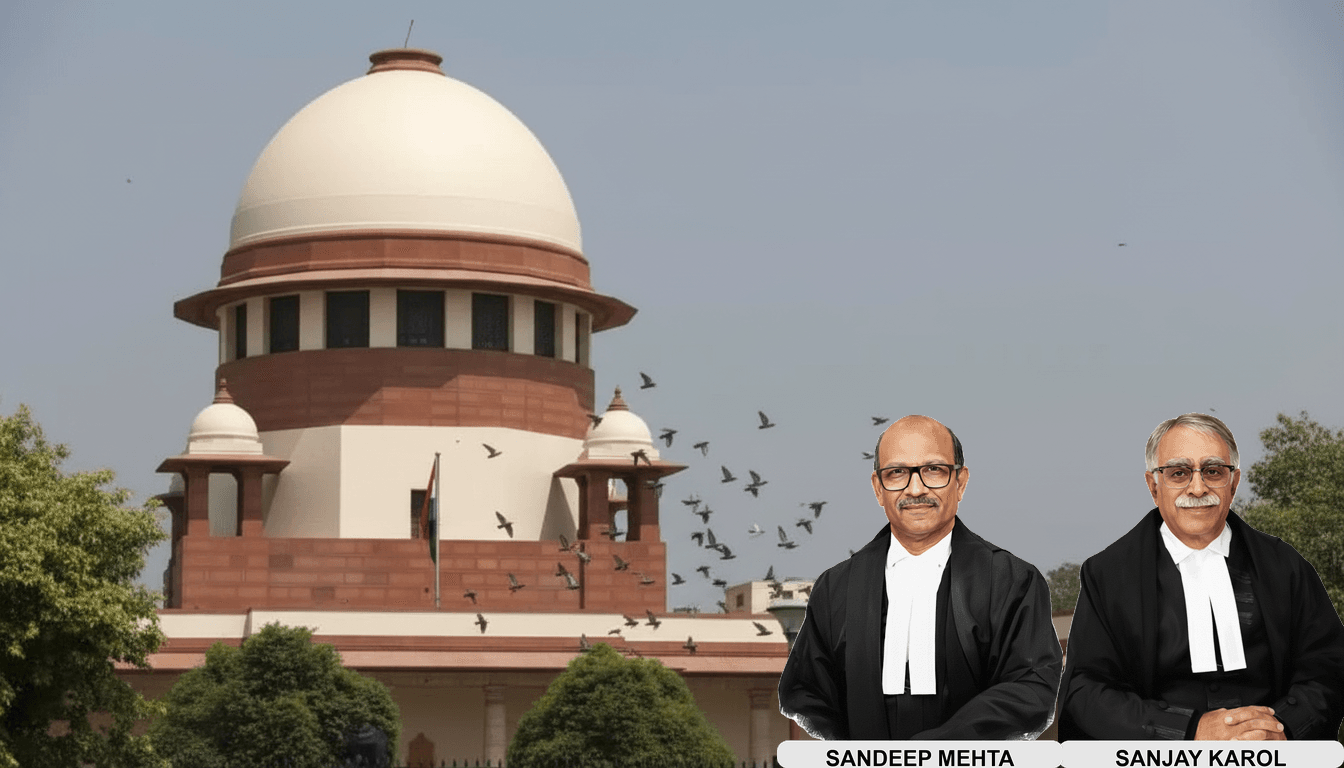
A bench of Justices Sanjay Karol and Sandeep Mehta heard appeals by the de facto complainant and the State challenging a Division Bench judgment of the Madhya Pradesh High Court that had reduced convictions in a communal assault from murder to culpable homicide not amounting to murder. The Court examined whether the prosecution case attracted Section 302 IPC read with Section 149 IPC or only Section 304 Part II IPC read with Section 149 IPC.
The Supreme Court allowed the appeals, set aside the High Court order dated 19 July 2010 and restored the trial court’s convictions and life sentences for the accused for the offence punishable under Section 302 read with Section 149 IPC. The Court held that the evidence, taken as a whole, established that the accused were members of an unlawful assembly who "in furtherance of their common object" subjected the deceased to repeated and targeted blows to the head. The Court, in its reasoning, observed: “From the above conspectus, it emerges that when a Court is confronted with the question whether the offence disclosed by the proved facts is ‘murder’ or ‘culpable homicide not amounting to murder,’ it would be appropriate to approach the issue in a structured manner comprising three stages.” The Court further recorded that the injuries — multiple bone-deep lacerations and a 7 cm linear fracture of the left parietal bone with extradural and subarachnoid haemorrhage — and the manner of attack supported the conclusion that the assailants intended to inflict bodily injury “sufficient in the ordinary course of nature to cause death.”
Background
The case arose from a Dehati Nalishi dated 11 July 2003 reporting that Bhaggu (Bhag Chand) and others were waylaid while returning by mini-bus after a bath in the Narmada; tube-well pipes were allegedly used to block the road and the occupants were assaulted by a group armed with lathis. The informant Sitaram Kuchhbedia (now deceased and substituted) accompanied the injured to hospital; Bhaggu succumbed to head injuries. The FIR was registered for offences including Sections 147, 148, 149, 302 and Section 3(2)(v) of the SC/ST Act. Post-mortem findings recorded 29 ante-mortem injuries on the deceased, including multiple deep lacerations and a parietal fracture; the medical jurist opined that death resulted from coma due to head injury.
The trial court convicted several accused under Sections 148, 323/149, 325/149 and 302/149 IPC and sentenced them, including life imprisonment for murder. The High Court, on reappreciation, concluded that death resulted from a single head injury and that the fatal blow appeared to be the individual act of one assailant; it reduced the murder conviction to Section 304 Part II read with Section 149 IPC and imposed six years’ RI. The State and the de facto complainant challenged the High Court’s reduction before the Supreme Court.
The Supreme Court accepted the prosecution case on key points: the unlawful assembly lay in wait after deliberately obstructing the road, the attack was concerted and repeated, the head injuries were vital and bone-deep, and the post-mortem report had been admitted by the accused at trial. The Court observed that the unlawful assembly and invocation of Section 149 IPC were not disputed and that vicarious liability attached where an offence was committed “in prosecution of the common object.” Concluding that the conduct of the accused demonstrated the requisite mens rea under Clause (3) of Section 300 IPC, the Court restored the trial court’s conviction and life sentence and directed surrender within eight weeks.
Case Details:
Case No.: Criminal Appeal Nos. 1837-38 of 2011; Criminal Appeal Nos. 1835-36 of 2011 (2026 INSC 178)
Case Title: Sitaram Kuchhbedia v. Vimal Rana and Others
Appearances:
For the Petitioner(s): Counsel not specified in the extract
For the Respondent(s): Counsel not specified in the extract
Source: 2026 CaseBase(SC) 148
Similar Articles


 Breaking News


