


Supreme Court Sets Three-Month Deadline For High Courts To Pronounce Reserved Judgments
 Copy Link
 Share
 Save
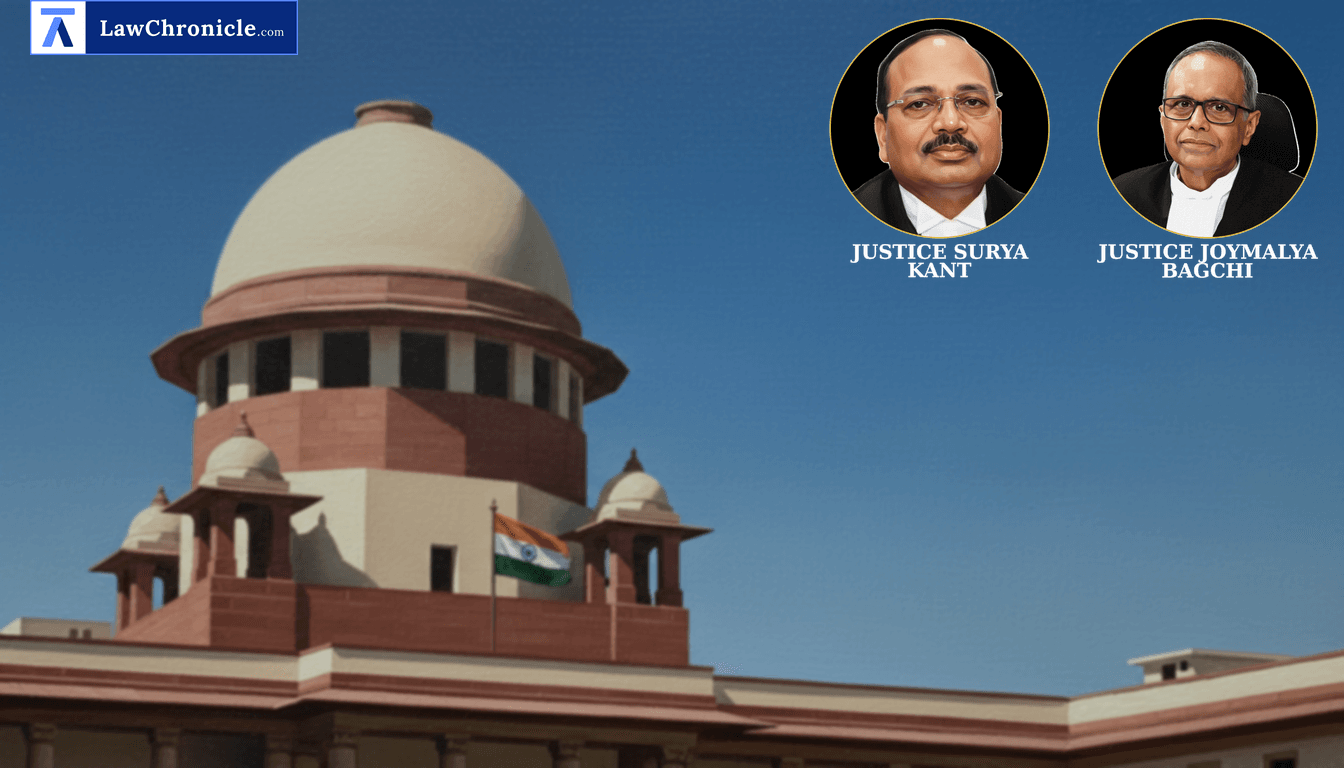
To protect the right to life and personal liberty, the Supreme Court has issued comprehensive and binding guidelines to eliminate indefinite delays in the pronouncement of reserved judgments by High Courts across India.
A bench led by Chief Justice of India Surya Kant and Justice Joymalya Bagchi expanded the scope of individual writ petitions to address a systemic crisis of judicial delay. The Court emphasized that the right to an expeditious trial under Article 21 of the Constitution of India extends to the final pronouncement of the decision, noting that justice delayed at the judgment stage can render legal reliefs nugatory.
The Mandate for Timely Justice
The Court, in its reasoning, observed: "The right to life and personal liberty guaranteed under Article 21 of the Constitution of India is not confined to the expeditious conduct of a trial. It extends to every stage of the proceeding and is as much violated by such delay in pronouncing a reserved judgement as by a denial of the right to be heard... Such regularity in pronouncement is neither a procedural nicety nor a matter of administrative convenience. It is the condition on which citizens’ confidence in the justice delivery system rests."
Recognizing the statutory lacuna regarding time limits for High Courts unlike the specific provisions in the Code of Civil Procedure, 1908 or the Code of Criminal Procedure, 1973 the Supreme Court invoked its extraordinary powers under Article 142 of the Constitution of India to fill this gap.
Binding Directions Issued to High Courts
The Court has the following directions:
"The High Court shall endeavour to pronounce a reasoned judgement promptly, within a maximum period of 3 months from the date of reserving such judgement. The High Courts shall display extra promptitude in pronouncing judgements and orders in matters of personal liberty, e.g. regular bail, anticipatory bail, criminal appeals (where the convict is in custody), death references, etc. As soon as the bail application is heard, the order should preferably be pronounced and uploaded on the same day. In the event the order is reserved, it is expected to be pronounced on the next day and uploaded to the website. Orders granting regular bail, suspending sentence, or acquitting a convict in custody should be communicated to the jail authorities and the Trial Court on the date it is pronounced... In the event the reserved judgment is not delivered within 3 months, the Registrar General shall place the matters before the Chief Justice for orders, and the Chief Justice shall bring it to the notice of the concerned Bench for pronouncing the judgment within 2 weeks thereafter. In the event the reserved judgment is still not delivered within the extended period of 2 weeks, the Chief Justice should assign the case to another Bench with a notification to the advocates and the parties."
Accountability and Transparency Measures
To ensure compliance, the Court mandated the creation of an automated monitoring system. Chief Justices of High Courts are to receive monthly automated emails listing all pending reserved judgments. Furthermore, if a judgment remains unpronounced for three and a half months, litigants have been granted the liberty to move an application before the Chief Justice to withdraw the case and have it reheard by a different bench.
Background:
The proceedings originated from a batch of petitions, including one by Pila Pahan, whose criminal appeal remained undecided for years despite being heard by the Jharkhand High Court. While the petitioners in the lead case were eventually released after the Supreme Court's intervention, the Bench realized the problem was "pervasive" across the country. Data collated by the Amicus Curiae, Ms. Fauzia Shakil, revealed a "disquieting" pan-India scenario where judgments remained reserved for months or even years.
The Supreme Court built upon the foundations laid in Anil Rai v. State of Bihar ( "(2001) 7 SCC 318": 2001 CaseBase(SC) 553) and Ratilal Jhaverbhai Parmar v. State of Gujarat ( "2024 SCC OnLine SC 2985": 2024 CaseBase(SC) 812). In Anil Rai v. State of Bihar ( "(2001) 7 SCC 318": 2001 CaseBase(SC) 553), the court had previously suggested a six-month limit for reassignment, which has now been tightened to three and a half months. While acknowledging the "mammothian obligations" and high caseloads handled by High Court judges, the Court maintained that institutional pressures cannot justify the violation of fundamental rights caused by excessive delay.
Case Details:
Case No.: Writ Petition (Crl.) No. 169 / 2025
Case Title: Pila Pahan @ Peela Pahan and others versus State of Jharkhand and another
Appearances:
For the Petitioner(s): Ms. Fauzia Shakil (Amicus Curiae), Ms. Tasmiya Taleha, Ms. Mallika Agarwal
Source: 2026 CaseBase(SC) 517
Similar Articles


 Breaking News


