


Allahabad HC Rebukes Judicial Inertia, Issues Directions on Bail Sureties and Trial Delays
 Copy Link
 Share
 Save
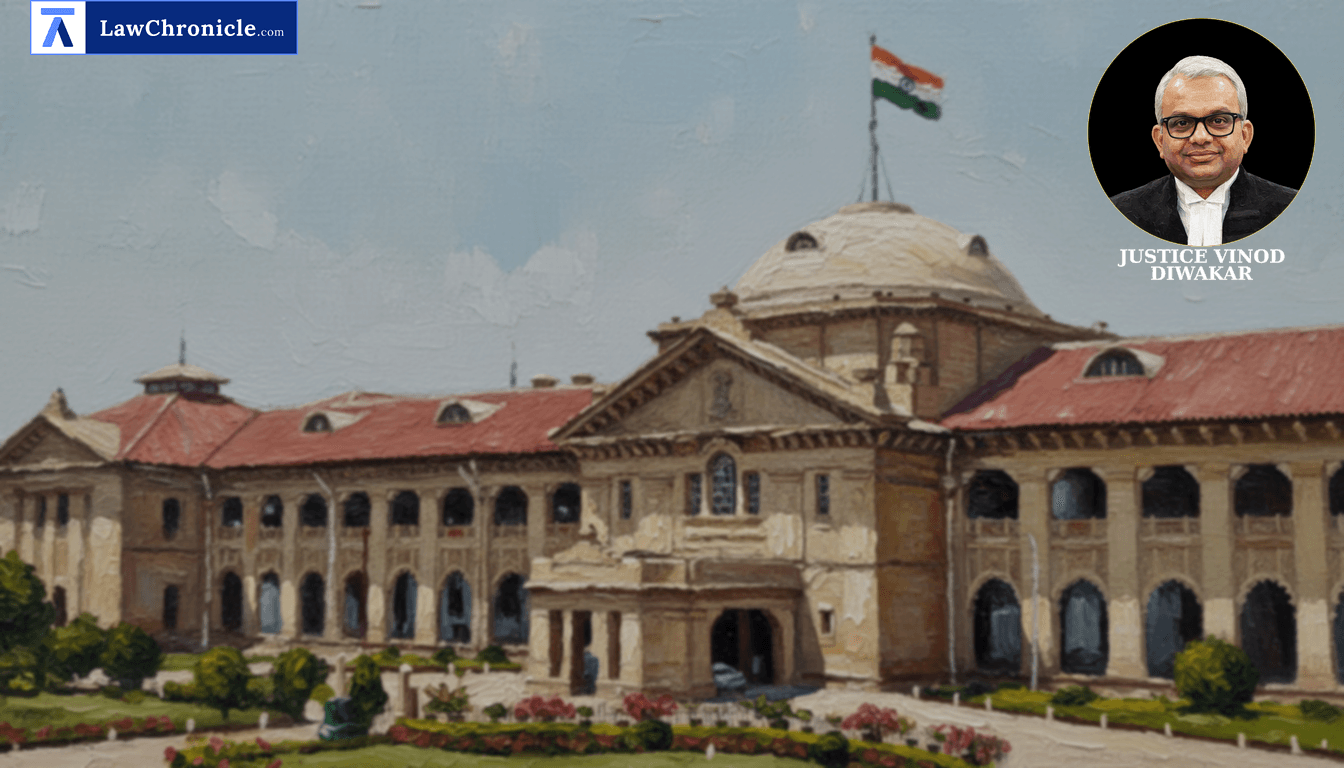
In a searing indictment of institutional apathy, the Allahabad High Court has exposed a systemic collapse in judicial discipline, revealing that trial courts across Uttar Pradesh persistently ignored binding constitutional precedents on personal liberty while allowing over 16 lakh cases to languish without even the framing of charges.
A single-judge bench of Justice Vinod Diwakar, while adjudicating four connected petitions, observed that judicial appointments are not patronage but fundamentally shape a nation's ideological character and international credibility. The Bench confronted the "distressing" reality of trial judges operating in "clear defiance" of settled law, particularly regarding bail conditions and the right to a speedy trial.
Key Takeaways
- Erosion of Personal Liberty: The Allahabad High Court identified a concerning pattern where trial courts remanded accused persons to custody in cases where no arrest occurred during investigation, violating Article 21.
- Systemic Non-Compliance: Over 1.5 lakh bail orders were passed in "recalcitrance" of the High Court's earlier guidelines, favoring redundant practices over constitutional mandates.
- Staggering Trial Pendency: Empirical data revealed 16,15,655 cases pending in the State where charges have not been framed, with some cases dating back to 1981.
- Administrative Over-Centralization: The Allahabad High Court critiqued the Chief Justice-centric model of High Court administration, advocating for participative governance and adherence to the Allahabad High Court Rules, 1952.
Judicial Rationale on Constitutional Morality
The Allahabad High Court emphasized that judicial character is cultivated through sustained training and accountability. It noted that the willingness of citizens to accept judicial decisions rests upon the belief that the institution belongs equally to all, rather than being influenced by dynastic privilege or nepotism.
The Allahabad High Court expressed that "Judicial morality demands that every Judge, irrespective of rank, faithfully follows the law declared by the Constitutional Courts. The conduct of Judges does not remain confined to the four walls of the courtroom; it shapes public perception of the justice-delivery system and, in turn, moulds the moral fabric of society. When judicial orders are disregarded, not only is the rule of law undermined, but the faith of the people - on which the very foundations of a healthy democracy rest - stands shaken."
Directions on Bail for Trial Courts
The Allahabad High Court issued the following directions:
"(i) Applications for personal exemption filed by an accused shall be disposed of by reasoned orders. Repetitive applications for personal exemption be not entertained in a routine manner, and where filed, shall be dismissed with reasonable costs.
(ii) If the situation so warrants, the bail bonds of the accused(s) shall be forfeited, and, upon the accused being taken into judicial custody, the trial court shall proceed to conclude the trial at the earliest within a reasonable period.
(iii) Necessary action shall also be taken against the erring police officers responsible for the failure to effect proper service of summons, bailable warrants and non-bailable warrants upon the accused."
In matters relating to the Negotiable Instruments Act, 1881, the Allahabad High Court directed that: "(i) The accused shall be bound down to appear before the trial court on each date fixed, or as may be directed.
(ii) In the event the accused fails to appear, the Senior Superintendent of Police, Kanpur Nagar, shall ensure his presence before the learned trial court."
Ratio
Judicial discipline and adherence to the hierarchy of courts are constitutional imperatives that sustain the rule of law. A trial court's failure to apply binding constitutional precedents, or its selective interpretation of procedural norms to satisfy customary practices, constitutes an institutional lapse that defeats the guarantee of a fair and speedy trial under Article 21 of the Constitution of India, 1950. Administrative discretion within the judiciary must be rule-bound, transparent, and participative to maintain institutional integrity.
Background
The proceedings arose from four petitions. In the primary case, the petitioner challenged a bail condition requiring excessive sureties of Rs. 1,00,000, which ignored the mandate of Smt. Bacchi Devi v. State of U.P. and Satender Kumar Antil v. CBI. Other petitions highlighted trials pending for 16 years without charge framing despite hundreds of listings. The High Court had previously devised a structured mechanism in Smt. Bacchi Devi v. State of U.P. to operationalize the Supreme Court's directions in Satender Kumar Antil v. CBI, Siddharth v. State of U.P., and In Re: Policy Strategy for Grant of Bail. However, reports from District Judges showed widespread non-compliance, with thousands of bail orders still demanding two sureties contrary to the "single surety" rule for the socio-economically disadvantaged.
The Allahabad High Court further analyzed comparative judicial behavior, citing seminal works to explain why trial judges might hesitate to follow High Court mandates, attributing it to systemic constraints and behavioral patterns. The Bench concluded by requesting the Chief Justice to explore the necessity of convening Full Courts to address the "grim" pendency and infrastructure issues.
Case Details:
Case No.: MATTERS UNDER ARTICLE 227 No.15205 of 2025
Case Title: Pappu Met @ Pappu Versus State of U.P. and Another
Appearances:
For the Petitioner(s): Arun Pratap Singh, Kamaluddin
For the Respondent(s): G.A.
Source: 2026 CaseBase(ALL) 1186
Similar Articles
 Breaking News


