


Tribunals Cannot Grant Unlimited Adjournments Defying SARFAESI Timelines: Andhra Pradesh HC
 Copy Link
 Share
 Save
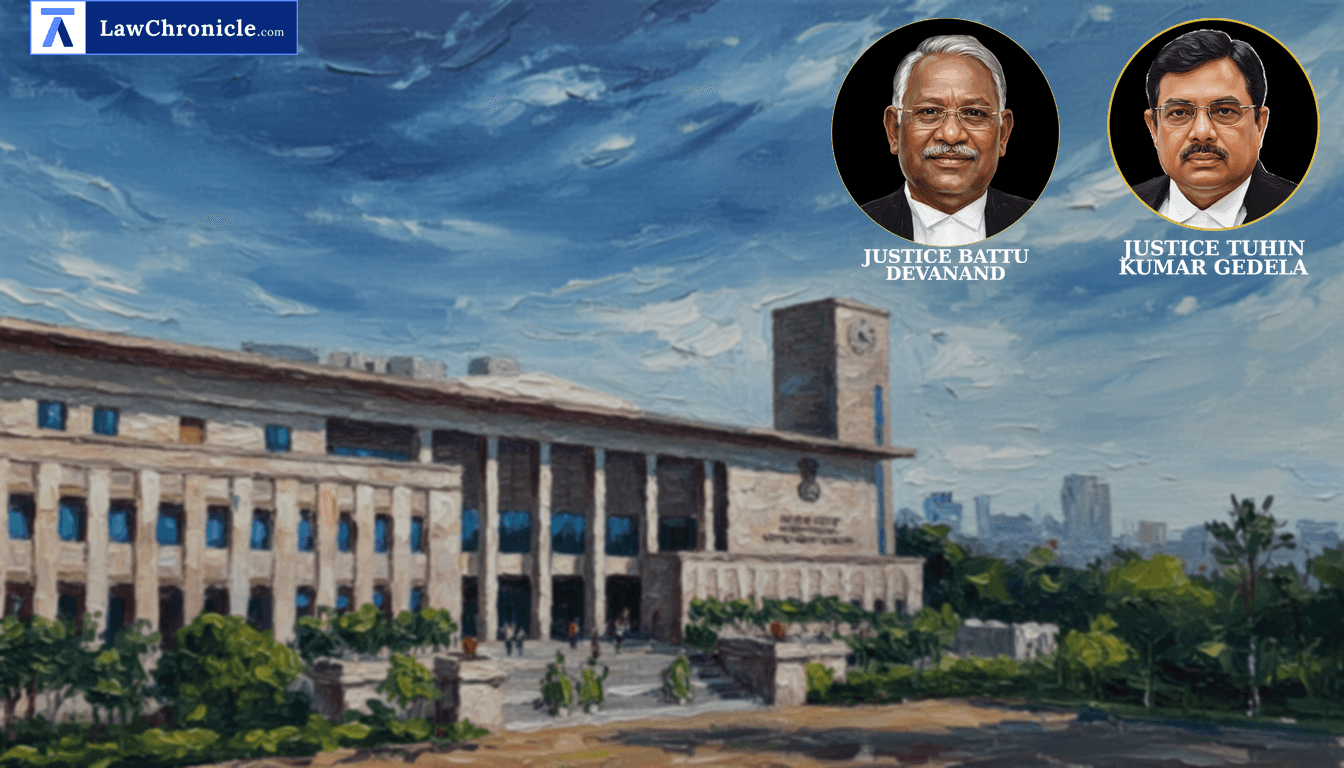
In a stern rebuke to procedural lethargy, the Andhra Pradesh High Court has ruled that Debt Recovery Tribunals cannot keep securitization applications pending for years, declaring that the 'expeditious' disposal mandate under the law is not a suggestion but a statutory obligation to protect public funds. The judgment effectively curtails the discretionary power of Tribunals to grant repeated adjournments, reinforcing a four-month deadline for final adjudication to prevent financial hardship for secured creditors.
A Bench comprising Justice Battu Devanand and Justice Tuhin Kumar Gedela adjudicated on the persistent inaction of the Debt Recovery Tribunal, Visakhapatnam, which had kept a Securitization Application (S.A.) pending for over three years. The Court was hearing a writ petition filed under Article 226 of the Constitution of India, where a financial institution challenged the Tribunal's failure to decide the matter despite the completion of pleadings and written arguments.
Key Takeaways
Strict Adherence to Section 17(5)
Section 17(5) of the Securitization and Reconstruction of Financial Assets and Enforcement of Security Interests Act, 2002 mandates a 60-day disposal period, extendable only for recorded reasons up to a maximum of four months.
Public Money Accountability
Banks, as secured creditors dealing with public money, are answerable to account holders, and inordinate delays in recovery proceedings negatively impact public interest.
Statutory Intention
The phrase 'as expeditiously as possible' in the Securitization and Reconstruction of Financial Assets and Enforcement of Security Interests Act, 2002 signals that Parliament did not intend to grant unlimited time to Tribunals for adjudication.
Hardship to Auction Purchasers
Delays in final orders cause significant loss not only to banks but also to third-party auction purchasers who invest substantial amounts in sale proceedings.
Mandate for Expeditious Disposal under SARFAESI
The Court emphasized that the statutory timelines are intended to provide a swift resolution to recovery disputes. It noted that while the Securitization and Reconstruction of Financial Assets and Enforcement of Security Interests Act, 2002 allows for extensions, these must be substantiated by reasons recorded in writing. The Bench observed that allowing matters to linger for three years directly contradicts the legislative intent of the Securitization and Reconstruction of Financial Assets and Enforcement of Security Interests Act, 2002.
The Court, in its reasoning, observed: "The language used in Section 17(5) of the Act 'as expeditiously as possible' clearly indicates that it is not the intention of the parliament to grant unlimited time to the Tribunal to dispose of the S.A. pending before it. The intention of the parliament is that the Tribunal shall dispose of the S.A(s) pending before it finally within a period of four months from the date of receipt of the S.A."
Referencing the Indian Overseas Bank vs. M/s Radhey Infra Solutions (Pvt.) Ltd., and Ors. ( "(2025) 190 SCL712": 2025 CaseBase(SC) 2137), the Court reiterated that it is incumbent upon the Debt Recovery Tribunal to abide by the stipulated time, and any failure to do so requires a formal recording of reasons as ordained by the proviso to Section 17(5). Further, the Court relied on its own previous holding in City Union Bank Limited vs. M/s Sree Gopala Krishna Flour and Oil Mill to underscore the four-month cap on pendency.
The Court has issued the following directions:
"The Debts Recovery Tribunal, Visakhapatnam, to dispose of the S.A.No.432 of 2023, in accordance with law, within a period of two (2) weeks from the date of receipt of this order to meet the interests of justice."
Ratio
The primary rule of law declared is that the Debt Recovery Tribunal possesses no discretion to ignore the statutory time limits prescribed under Section 17(5) of the Securitization and Reconstruction of Financial Assets and Enforcement of Security Interests Act, 2002. The 'law declared' establishes that any Securitization Application must be disposed of within a maximum period of four months, and failures to meet these timelines must be justified by recorded reasons to prevent the abuse of the judicial process and safeguard financial stability.
Background
The dispute originated from credit facilities, including OLCC and Agri OD facilities, sanctioned by the petitioner bank to the private respondents. Following a default in repayment, the bank classified the accounts as Non-Performing Assets (NPA) in October 2022 and initiated recovery under the Securitization and Reconstruction of Financial Assets and Enforcement of Security Interests Act, 2002. After the bank issued possession and auction notices, the respondents filed S.A.No.432 of 2023 before the DRT, Visakhapatnam. Although an interim stay was granted in February 2025, the bank contended that the Tribunal was granting numerous adjournments without reason, despite the submission of written arguments. The High Court, finding the three-year delay unacceptable, allowed the writ petition and issued an expedited mandate for disposal.
Case Details:
Case No.: WRIT PETITION NO: 28670/2026
Neutral Citation: 2026:APHC:46241
Case Title: City Union Bank Vs. The Debt Recovery Tribiunal And Ors.
Appearances:
For the Petitioner(s): S Satyanarayana Moorthy, Advocate
Source: 2026 CaseBase(AP) 19878
Similar Articles


 Breaking News


