


Unexplained Possession of Stolen Goods Links Accused to Murder for Gain: Madras HC
 Copy Link
 Share
 Save
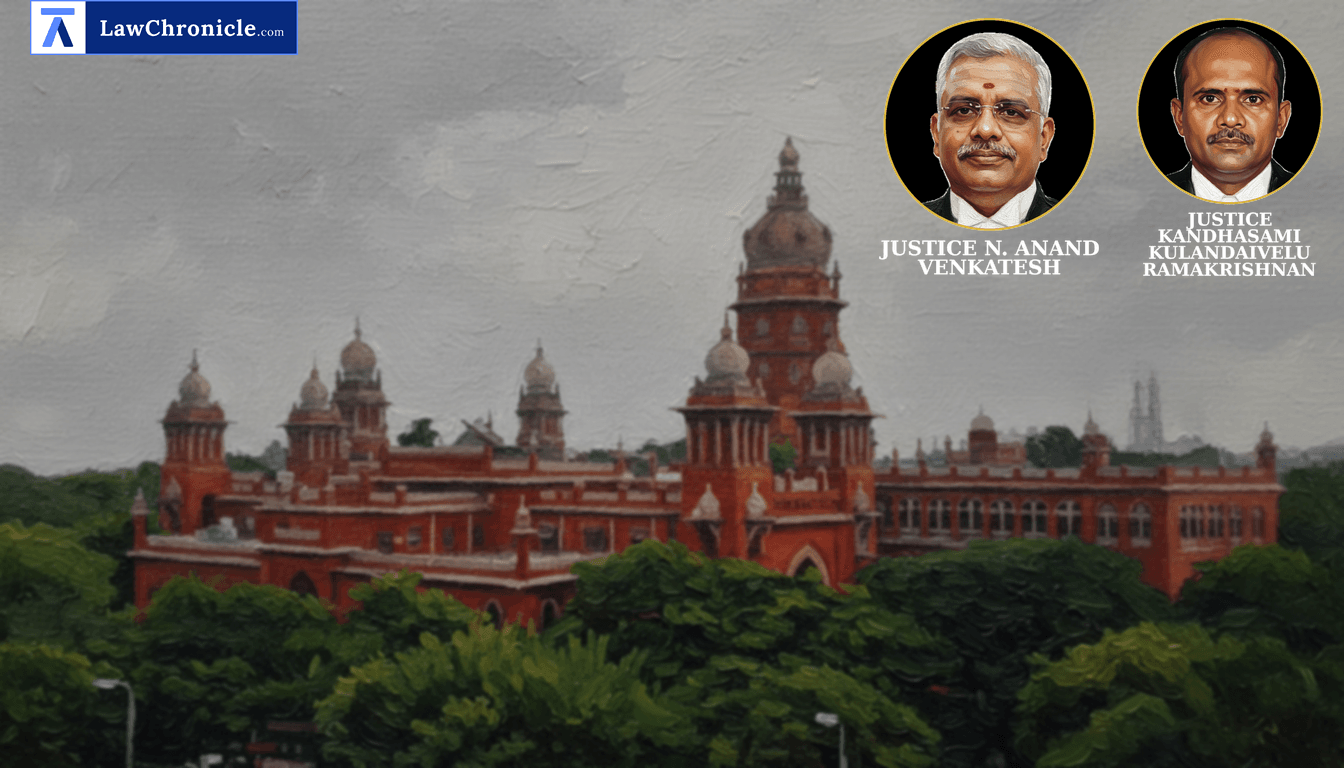
In a decisive ruling reinforcing the evidentiary weight of circumstantial links, the Madurai Bench of the Madras High Court confirmed the life sentence of a man convicted of murder for gain, emphasizing that the possession of a deceased's belongings soon after the crime raises a strong presumption of guilt.
A division bench comprising Justice N. Anand Venkatesh and Justice K.K. Ramakrishnan dismissed the appeal filed by the convict, who was found guilty of brutally stabbing his brother's wife to death and fleeing with 23½ sovereigns of gold jewellery and other valuables.
Establishing the Chain of Circumstances
The prosecution's case rested on the 'last seen' theory and the subsequent recovery of stolen articles. Witnesses corroborated seeing the accused entering the victim's house shortly before the murder and exiting with a handbag. The Court noted that the proximity between the accused's presence at the scene and the discovery of the body, coupled with scientific evidence, left no room for doubt.
Application of Section 114 of the Evidence Act
The Court relied heavily on the presumption under Indian Evidence Act, 1872 to bridge the gap between theft and murder. It held that when a person is found in possession of stolen goods shortly after a murder and fails to provide a satisfactory explanation, it is legitimate to infer their involvement in the more serious offence of murder.
The Court, in its reasoning, observed: "Once the recovery of the stolen properties belonging to the deceased was made from the accused is proved and the appellant is found to have been in possession of those properties soon after the murder, the presumption under Section 114 illustration (a) of the Indian Evidence Act, 1872 squarely applies. where the accused is found in possession of the articles belonging to the deceased soon after a murder committed for gain, and fails to offer any satisfactory explanation for such possession, the Court can legitimately draw the inference that the accused committed both the theft and the murder."
Scientific Evidence and Recovery
Despite the defense's attempt to discredit the investigation by pointing toward potential family disputes or alternate entrances to the house, the High Court found the scientific evidence compelling. Expert reports marked under Ex.P.11 established the presence of the appellant’s fingerprints and footprints at the scene. The recovery of gold jewels and a mobile phone from an auto-rickshaw in the appellant's possession, following a disclosure statement under Section 27 of the Indian Evidence Act, 1872, was deemed proven beyond reasonable doubt.
While the trial court had touched upon the principle of res gestae under Section 6 of the Indian Evidence Act, 1872, the High Court clarified that the case was better grounded in the principles of circumstantial evidence as established in Sharad Birdhichand Sarda v. State of Maharashtra ( "(1984) 4 SCC 116": 1984 CaseBase(SC) 194) and the doctrine of 'last seen together' as seen in State of U.P. v. Satish.
The Court has the following directions:
"The Criminal Appeal is, therefore, dismissed, and the conviction and sentence imposed by the Mahila Fast Track Court, Dindigul District, in S.C.No.12 of 2020 dated 27.02.2023 are hereby confirmed. This Court further directs the concerned Legal Services Authority/High Court Legal Services Committee to pay a remuneration of Rs. 25,000/- (Rupees Twenty-Five Thousand only) to the learned Legal Aid Counsel within a period of two weeks from the date of receipt of a copy of this judgment."
Background:
The incident occurred on January 23, 2019, in Dindigul District. The appellant, Chandrasekar, who was the brother-in-law of the deceased, allegedly trespassed into her home while she was alone and murdered her. The Dindigul Town South Police registered the case under Sections 449, 302, and 380 of the Indian Penal Code. The trial court convicted him on February 27, 2023, leading to the current appeal. The High Court, after re-appreciating the evidence, found that the prosecution had successfully ruled out the involvement of any third person.
Case Details:
Case No.: Crl.A(MD).No.54 of 2024
NeutralCitation: 2026:MHC:2291
Case Title: Chandrasekar v. The State
Appearances:
For the Petitioner(s): Mr.Ponkarthikeyan (Legal Aid Counsel)
For the Respondent(s): Mr.Venkatesh (Counsel For State of TN)
Source: 2026 CaseBase(MAD) 296
Similar Articles

 Breaking News


