


Victim's Appeal Against Acquittal By Assistant Sessions Judge Lies To Sessions Court: Madras HC
 Copy Link
 Share
 Save
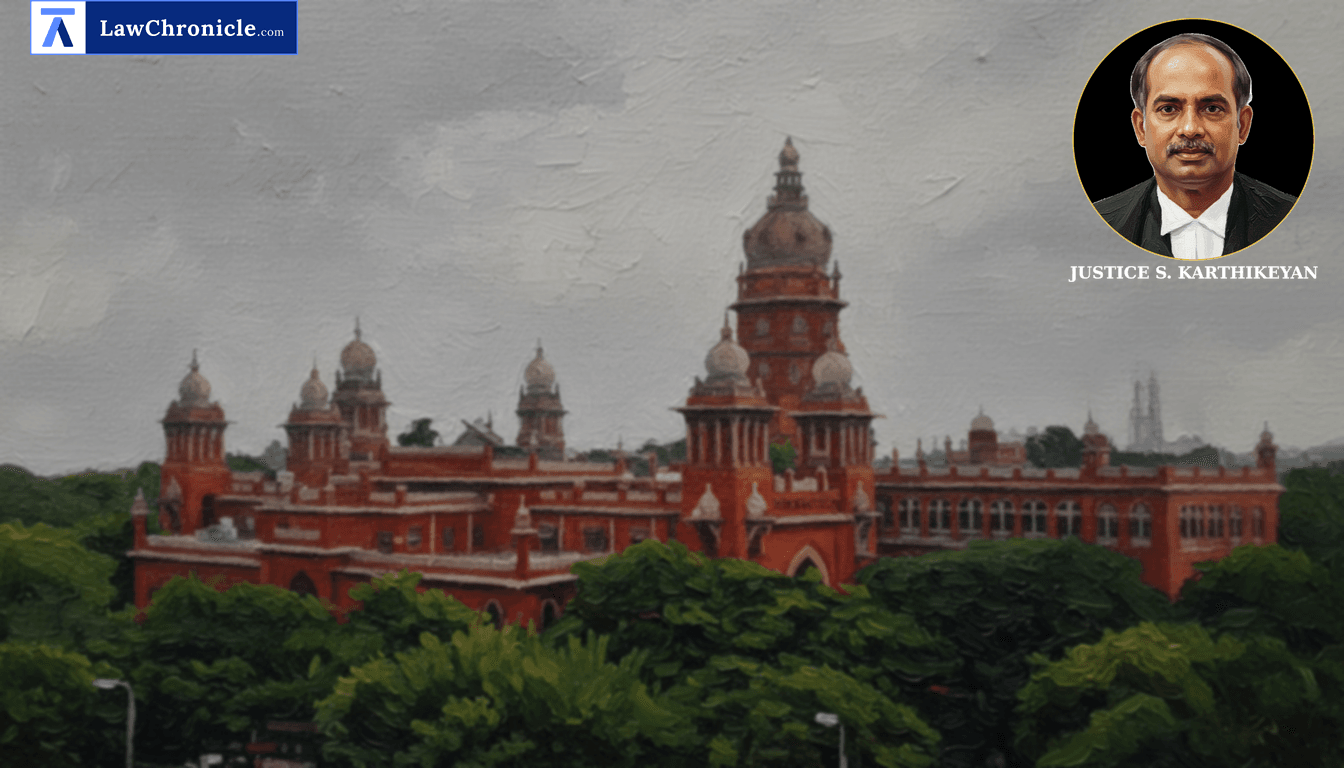
The Madras High Court has clarified the hierarchy of appellate forums during the transition between the old and new criminal codes, ruling that a victim's challenge to an acquittal passed by an Assistant Sessions Judge must be filed before the Court of Session, not the High Court. This decision addresses a critical procedural intersection between the Code of Criminal Procedure, 1973 and the newly enacted Bharatiya Nagarik Suraksha Sanhita, 2023, ensuring that statutory remedies remain consistent despite the repeal of former laws.
Justice S. Karthikeyan, sitting at the Madurai Bench, dismissed the criminal appeal filed by a defacto complainant as not maintainable, granting liberty to the appellant to approach the appropriate forum. The Madras High Court was tasked with determining the maintainability of an appeal filed under Section 419 of the Bharatiya Nagarik Suraksha Sanhita, 2023 against a judgment of acquittal delivered by the Assistant Sessions Judge cum Chief Judicial Magistrate, Tenkasi.
Key Takeaways
Forum Determination for Victim Appeals
The forum for a victim's appeal against acquittal is governed by the forum where an appeal against a conviction would ordinarily lie, not by the status of the acquittal itself.
Survival of Remedies Post-Repeal
Statutory remedies under the Code of Criminal Procedure, 1973 continue to exist for proceedings initiated under the old code, supported by the General Clauses Act, 1897 and saving clauses in the Bharatiya Nyaya Sanhita, 2023.
Clarification on Assistant Sessions Judges
Despite the Bharatiya Nagarik Suraksha Sanhita, 2023 omitting the specific category of 'Assistant Sessions Judge,' appeals from such officers, who are subordinate to Sessions Judges, ordinarily lie to the Court of Session unless a sentence exceeding seven years is imposed.
Legislative Vacuum and Procedural Transitions
The Court noted that while the Bharatiya Nagarik Suraksha Sanhita, 2023 has replaced the Code of Criminal Procedure, 1973, the trial in this instance was conducted under the old Code, and the acquittal was recorded under Section 235(1) of the Code of Criminal Procedure, 1973. The appellant argued that under the proviso to Section 419 of the Bharatiya Nagarik Suraksha Sanhita, 2023 (corresponding to Section 378 of the Code of Criminal Procedure, 1973), the appeal should lie to the High Court.
However, the Madras High Court observed that Section 419 of the Bharatiya Nagarik Suraksha Sanhita, 2023 primarily deals with appeals by the State and Central Government. For victims, the proviso to Section 413 of the Bharatiya Nagarik Suraksha Sanhita, 2023 mandates that an appeal shall lie to the Court to which an appeal ordinarily lies against an order of conviction. Consequently, Section 415 of the Bharatiya Nagarik Suraksha Sanhita, 2023 (formerly Section 374 of the Code of Criminal Procedure, 1973) becomes the operative provision.
Court's Rationale on Subordination
The Madras High Court emphasized that under Section 10 of the Code of Criminal Procedure, 1973, all Assistant Sessions Judges are subordinate to the Sessions Judge. Therefore, an appeal against their orders ordinarily lies to the Court of Session. The Bench noted that "Therefore, on a conjoint reading of the proviso to Section 372 and Section 374 of the Cr.P.C., it is clear that an appeal against an order of conviction passed by an Assistant Sessions Judge would ordinarily lie only before the Court of Session."
The Madras High Court further clarified that “Once the appeal, application, trial, inquiry or investigation has come to an end, an appeal against the order, even though the order was passed under the old Code, would be maintainable only under the re-enacted Code, namely, the BNSS... the statutory remedy provided under the previous Code, namely, the Code of Criminal Procedure, would continue even after the repeal of the Cr.P.C., by virtue of Section 6 of the General Clauses Act, 1897 and Section 358(2) of the BNS.”
Ratio
For the purpose of determining the forum for an appeal against an order of acquittal preferred by a victim under the proviso to Section 372 of the Cr.P.C. (or Section 413 of the BNSS), the forum is dictated by where an appeal against a conviction would ordinarily lie. As Assistant Sessions Judges are subordinate to Sessions Judges, such appeals lie to the Court of Session unless the specific sentence threshold for High Court jurisdiction (more than seven years) is met. Statutory remedies under a repealed criminal code are preserved by the General Clauses Act for proceedings that were pending or initiated under the repealed law.
Background
The case arose from Crime No. 158 of 2014 at Kadayam Police Station, resulting in S.C.No.851 of 2016. The Assistant Sessions Judge cum Chief Judicial Magistrate, Tenkasi, acquitted the accused (Respondents 2 to 9) on June 17, 2026. The appellant, who was the defacto complainant and an injured witness, sought to challenge this acquittal directly before the High Court. The Registry initially questioned the maintainability, leading to this judicial determination. The Madras High Court relied on the precedent in Akhtar Mirza v. State of Assam and others to affirm that the High Court is not the ordinary forum for such appeals. Ultimately, the Court held that despite the procedural shift to the Bharatiya Nagarik Suraksha Sanhita, 2023, the hierarchical structure of subordination remains the guiding factor for appellate jurisdiction.
Case Details:
Case No.: Crl.A(MD)No.1066 of 2026
Case Title: Kapildev Vs. The State and Others
Appearances:
For the Petitioner(s): Mr.S.Vairamuthu
For the Respondent(s): Mr.G.Ganesh Kumar (R1), Government Advocate (Crl. Side)
Source: 2026 CaseBase(MAD) 23699
Similar Articles

 Breaking News


