


Victim's appeal against Order of Acquittal by Magistrate lies before Sessions Court: Supreme Court
 Copy Link
 Share
 Save
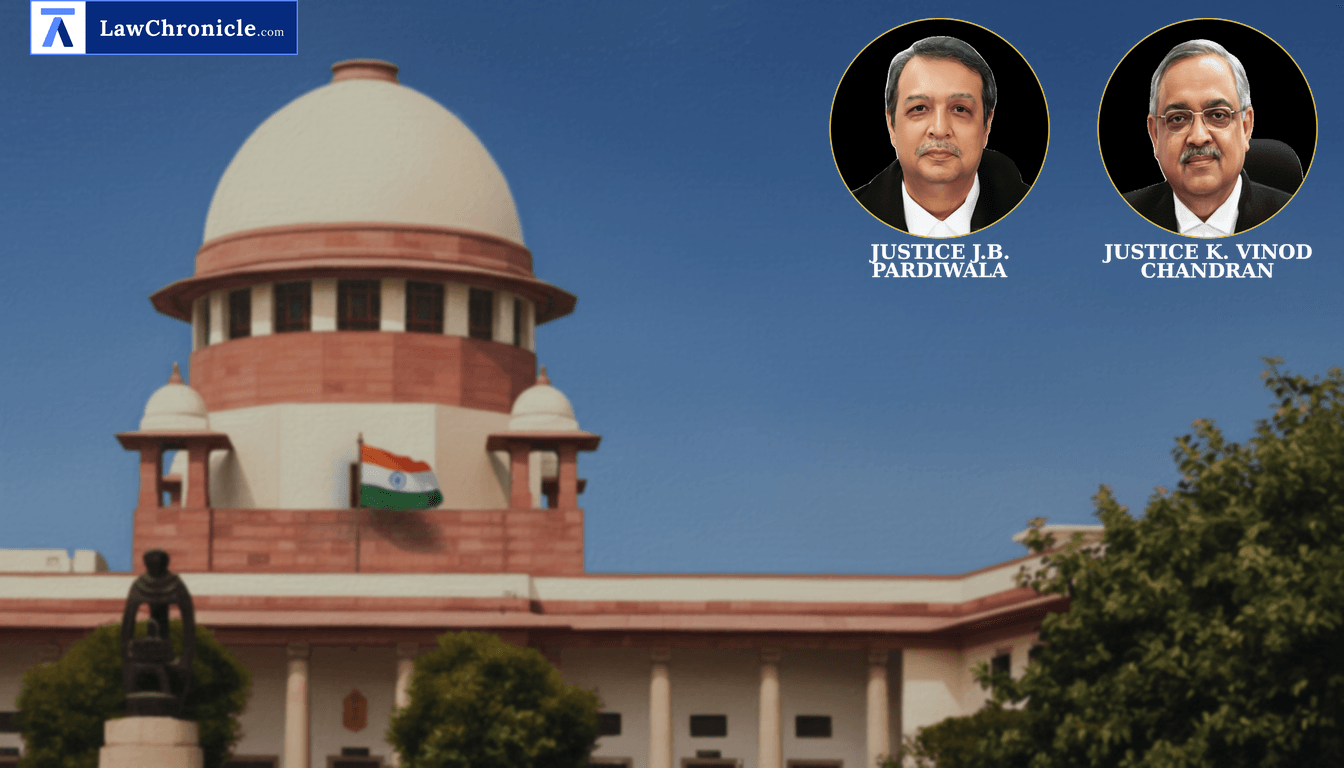
Clarifying the interplay between the statutory provisions governing appeals against acquittals, the Supreme Court ruled that a victim's appeal against order of acquittal by Magistrate is bound by Sessions Court, that means the Court to which an appeal ordinarily lies against a conviction.
A bench comprising Justice J.B. Pardiwala and Justice K. Vinod Chandran upheld a High Court order that rejected a victim's appeal against a Magistrate's acquittal order on the grounds of maintainability, directing the party to approach the jurisdictional Sessions Court instead.
Key Takeaways
- Proper Appellate Forum: Victims opting for appeal against order of acquittal by Magistrate should approach the Sessions Court, mirroring the forum for conviction appeals.
- Clarification on BNSS Provisions: Section 413 proviso of Bharatiya Nagrik Suraksha Sanhita, 2023 governs victim appeals independently of Section 419.
- Maintainability Decisions by Coordinate Benches: A Coordinate Bench at the final hearing stage can dismiss a matter as non-maintainable even if it was initially admitted by another Single Judge.
Interpretation of Victim Appeals Under New Criminal Laws
The Supreme Court analyzed the statutory scheme governing appeal against acquittal by victim in Sessions Court, under Bharatiya Nagrik Suraksha Sanhita, 2023. Distinguishing general appeals filed by the State or investigating agencies, the Apex Court highlighted that a victim's right to appeal against an order of acquittal, conviction for a lesser offence, or inadequate compensation is governed specifically by the proviso to Section 413 of Bharatiya Nagrik Suraksha Sanhita, 2023.
The Apex Court explained the rule pertaining to appeal against order of acquittal by Magistrate, stating that "Hence, the proviso confers on the victim a right to proffer an appeal against any order of acquittal, conviction for a lesser offence or on the ground of inadequate compensation. In which event, such appeal shall lie to the Court to which an appeal ordinarily lies against the order of conviction of such court. Section 419 of the BNSS provides for an appeal in case of an acquittal, which would not be applicable when the proviso is applied. Insofar as an appeal from conviction, one has to look at Section 415 of the BNSS... Going by the proviso to Section 413, an appeal filed by a victim against an order of acquittal also has to be before the Court to which an appeal ordinarily lies against the order of conviction of such Court. The order of acquittal passed by a learned Magistrate, hence, has to be appealed before the Court in which a conviction ordered by a Magistrate can be appealed, which is the Sessions Court."
The Supreme Court further directed that "The petitioner, if still desirous of filing an appeal, can approach the Jurisdictional Sessions Court. We make it clear that if an appeal is filed within one month from the date of this order, the same shall be admitted and heard on merits, without considering the delay which has been caused only by reason of a bona fide proceeding taken by the petitioner."
Ratio
An appeal preferred by a victim under the proviso to Section 413 of the Bharatiya Nagrik Suraksha Sanhita, 2023 against an order of acquittal passed by a Magistrate lies exclusively to the Sessions Court, as it is the forum to which an appeal ordinarily lies against an order of conviction passed by such Magistrate.
Background
The dispute originated from an FIR registered under Section 304A read with Section 34 of the Indian Penal Code, 1860 following the suicide of a patient admitted to a hospital. The deceased's father, acting as the victim, alleged negligence on the part of a doctor and a nurse. The Judicial Magistrate, 9th Court, Alipore, acquitted the accused.
Challenging the acquittal, the father filed an appeal before the High Court. Although a Single Judge initially admitted the matter, another Single Judge subsequently held that the appeal was not maintainable before the High Court and directed the appellant to approach the Sessions Court.
Before the Supreme Court, the petitioner contended that a Coordinate Bench could not dismiss an admitted petition on maintainability, relying on Rajan Chadha and Another v. Sanjay Arora ( "2025 SCC OnLine SC 899": 2025 CaseBase(SC) 886) under the Contempt of Courts Act, 1971. The apex court rejected this contention, explaining that the precedent pertained to contempt proceedings where liability had already been adjudicated. The Supreme Court further analyzed Section 378(2) of the Cr.PC alongside Sections 413, 415, and 419 of Bharatiya Nagrik Suraksha Sanhita, 2023, affirming that victim appeals against acquittal orders passed by Magistrates lie before the Sessions Court.
Dismissing the Special Leave Petition, the Supreme Court upheld the High Court's view and granted liberty to file an appeal before the jurisdictional Sessions Court within one month.
Case Details:
Case No.: Special Leave Petition (Crl.) No.3418 of 2026
Neutral Citation: 2026 INSC 1052
Case Title: Subhas Chandra Sarkar v. The State of West Bengal & Ors.
Appearances:
For the Petitioner(s): Mr. Jayesh Gaurav, Mr. Kuldeep Rai (Amicus Curiae), Petitioner-in-person
For the Respondent(s): Sri Kunal Mimani (AoR for State), Sri Manish Gupta (AoR), Sri Ananta Prasad Mishra (AoR)
Source: 2026 CaseBase(SC) 8087
Similar Articles


 Breaking News


