

When Students Dissent: Why Democracy Needs Uncomfortable Voices
 Copy Link
 Share
Share Save
Save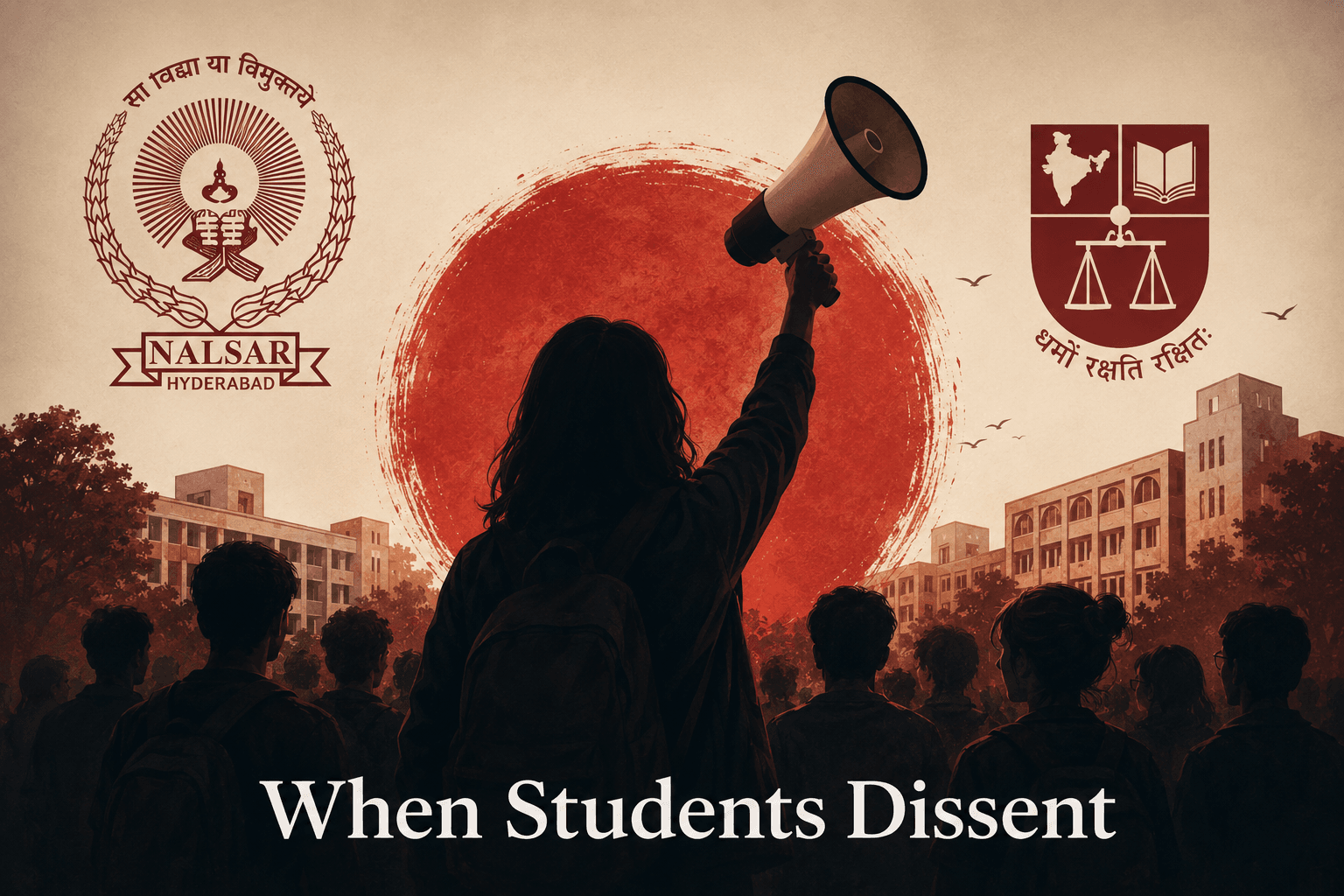
Recently, the National Law School of India University, Bengaluru cancelled its 2026 Convocation. While most of us are connecting the dots with the previous turn of events regarding CJI’s visit and NALSAR student row, there are some missing gaps in the story. This article throws some light upon the whole picture of CJI-NLSIU row to explain why student dissent recently voiced, against all odds, is an embellishment for India’s democracy.
The Back Story of NLSIU Convocation
As per news reports, CJI Surya Kant himself met a group of NLSIU students from the graduating batch of 2026. This happened a few days after students of NLSIU expressed solidarity with students of NALSAR Hyderabad on threats from BCI Chairman barring their Bar enrolment, which was taken back within hours. A group of students of the graduating batch flew to Delhi to meet the CJI were told to vote for CJI’s presence in the event, and the alternate would be cancellation of convocation. While majority voted for the same in order to avoid cancellation, they were told to issue a public statement inviting the Chief Justice to their convocation, a condition which was nowhere mentioned earlier. The student body refused to release any such statement as it would mean retracting from expressing solidarity with the students of NALSAR.
NLSIU 2026 Convocation Cancelled
The officials on 27th August, 2026 announced that the NLSIU 2026 Convocation was cancelled due to “unavoidable circumstances”. The said official statement offered no explanation or details regarding why a crucial event like Convocation was cancelled. However, the backstory gives insights into probable reasons.
The aftermath is that either the graduation certificates as well as gold medals will be dispatched via courier, or students can also receive them at the Campus. The cancellation is disappointing since the authorities had mailed graduating students that the annual Convocation would be held on 12th September, 2026. Several students and their families had already made arrangements for the event.
NALSAR Row
It all started with the National Academy of Legal Studies and Research (NALSAR). The graduating batch of NALSAR students expressed resistance against the Chief Justice of India being the Chief Justice at the Convocation ceremony. While it all started with communications at the institutional level among the students and the administration, things got worse with the BCI Chairman issuing threats vide letterhead of the Bar Council of India, restricting enrolment of NALSAR students graduating in 2026 by any of the State Bar Bodies. Though it was quickly withdrawn and apologies were issued, the damage was already done. NLSIU students at the time had shown support for students of NALSAR and also raised their voice against CJI Surya Kant being the Chief Guest at their Convocation event.
Why Student Dissent is Essential to Democracy?
In India, we are currently at a phase where the party in power is serving its third consecutive term in the government. As much they won people over to get majority of votes, this also reflects upon the failure of opposition in gaining people’s trust. The situation is such that those in power convey a sense of being supreme and unbeatable, and the opposition is seen more on the outside sloganeering against the government rather than sitting in the house arguing against the Bills being passed in the Parliament.
Hence, there was a dire need for someone who could hold the government accountable for their deeds. That’s why the Cockroach Janta Party protest at Jantar Mantar can be regarded as laying the foundation for youngsters to raise their voice to empower democracy. The party/organization was a result of CJI’s Cockroach remark, which also served as the reason why law students at NALSAR and NLSIU refused to receive their graduation certificates from the sitting Chief Justice of India, Justice Surya Kant.
Support for Students’ Voice of Dissent
The voices from Law School premises were not raised in solitude. Several came forward to show support for students standing firm on their stance, dissenting to the Cockroach remarks made by the CJI against the younger generation. These include several advocates, legal professionals, jurists, student bodies, and even Supreme Court’s Justice Ujjal Bhuyan. People beyond the legal fraternity are also not behind in praising and supporting the courage shown by law students.
Students in Solidarity
The Student Bar Council of NALSAR University of Law expressed solidarity with the National Law School of India University, Bengaluru graduating batch of 2026 after authorities declared cancellation of NLSIU 2026 Convocation. They acknowledged that the outcome was NLSIU’s support for NALSAR after the students had objected to the presence of CJI Surya Kant and the BCI Chairman Manan Mishra at the convocation.
Convocation is an important milestone in a student’s life and its cancellation, followed by students being asked to issue a public letter to reinvite the CJI, was particularly condemned by the student body. As expressed in the statement extending solidarity, “it cannot be emphasised enough that a convocation marks a poignant milestone, recognising years of learning, growth, hard work, and the beginning of a new chapter in a student’s life. Snatching this opportunity from students, which would have enabled them to savour this moment with family and friends, is cruel...... it is particularly concerning, and deserves condemnation, that students were asked to issue a public letter of ‘re-invitation’ to the CJI”.
Justice Ujjal Bhuyan’s Support for Students
Supreme Court’s Justice Ujjal Bhuyan has been very much vocal for his thoughts around any controversy which recently surrounded the Apex Court or those holding constitutional offices in the legal profession. In his speech delivered at the National Law University, Delhi’s LLM Convocation, Justice Ujjal Bhuyan criticized threats or punitive action against students for expressing views that deviated from those in authoritative position.
In support of students, Justice Ujjal Bhuyan expressed that “A democratic society cannot be built on the edifice that everyone will think alike. It is built on the understanding that differences will exist and that those differences must be accommodated within the broader constitutional framework. Our Constitution gives this idea of tolerance a deeper meaning.....A University, in my view, should be one of the first places where the habit of thinking freely begins. It should be a space where an idea is not accepted merely because it is familiar, and where students do not hesitate to ask difficult questions simply because the answer may be uncomfortable... ”
The Positive Side
The article discusses the importance of dissent for democracy through the series of events that took place at Law Schools and the Constitutional Institutions, including the Supreme Court and the Bar Council of India.
The discussion reminds of Alfred James Pacino’s final speech in the Scent of a Woman where he cautioned to be careful of the kind of leaders they were creating, as he remarked of “killing the very spirit the institution proclaims it instills”. That’s what the authorities have been trying to do, by attempting to silence the voice of dissent raised by students of NLSIU and NALSAR.
The positive side is that the students and the alumni, and several others, are coming forward against suppression while supporting the students, strengthening the spirit of democracy. These law students are going to be future legal professionals, some of them will be holding authoritative positions as well. This makes us look forward to a future going in safer hands, who may be GenZ enough to stay locked with their screens while doomscrolling, but are bold enough to raise their voice against those in power.
Also Read: From NALSAR to IIULER: Understanding BCI's Expanding Role
 Breaking News