


Wife Compelled to Leave Matrimonial Home Due to Cruelty Not Guilty of Desertion: Jharkhand HC
 Copy Link
 Share
 Save
The Jharkhand High Court has redefined the boundaries of matrimonial desertion, ruling that a spouse forced to flee the matrimonial home to escape persistent cruelty and physical peril cannot be accused of 'wilful abandonment' of the marriage. This landmark observation underscores that when domestic violence and intoxication render cohabitation impossible, the resulting separation is a compelled legal necessity rather than a voluntary desertion of marital duties.
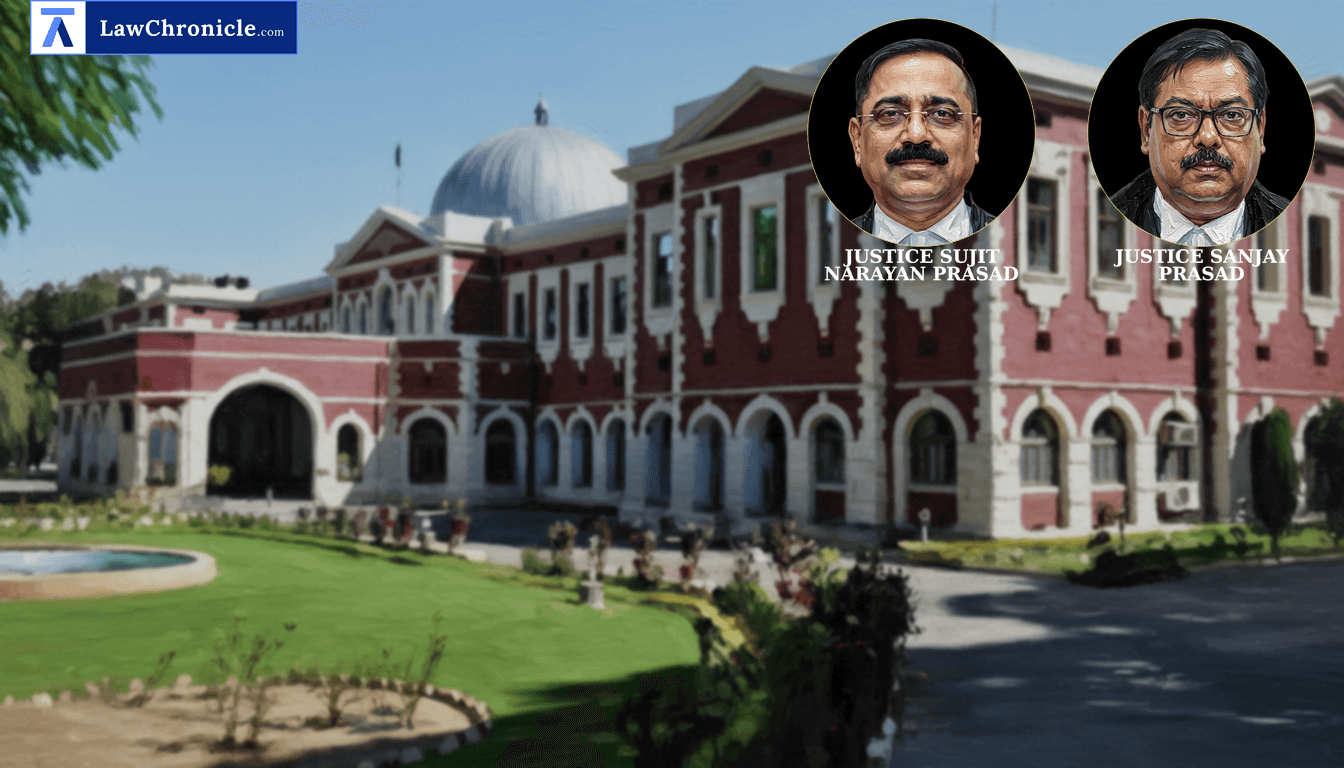
A division bench of Justice Sujit Narayan Prasad and Justice Sanjay Prasad heard the appeal arising from a matrimonial suit. The Court was tasked with determining whether the refusal of a divorce decree by a family court was legally sustainable when allegations of cruelty and desertion remained unrebutted due to the husband's non-appearance.
Key Takeaways
Redefining Compelled Separation
If a spouse is forced to leave the matrimonial home due to cruelty, such departure does not constitute 'desertion' in law but is rather an extension of the cruelty itself.
Evidentiary Value of Police Complaints
The mere non-filing of a formal First Information Report (FIR) is not sufficient grounds to discredit a wife's testimony regarding domestic torture and assault.
Adverse Inference from Non-Appearance
A party's deliberate absence from judicial proceedings despite valid service reflects an indifference toward the marital bond, allowing the court to draw necessary conclusions.
Protection of Children's Rights
The dissolution of a marriage does not impact the minor children's right to inheritance or the father's obligation to provide for their maintenance and education.
In its comprehensive analysis, the High Court emphasized that the concept of 'cruelty' under Section 27(1)(d) of the Special Marriage Act, 1954 must be applied contextually, noting that even a single course of conduct can embitter a relationship beyond repair. The Court noted that the parties had been living separately since 2018, rendering the marriage a "dead wood."
The Court has following directions:
"The Registry of this Court is directed to issue decree of dissolution of Marriage... the Right to inheritance of the children will remain intact and will have no bearing with the dissolution of marriage... it is also left open upon for the appellant to claim the maintenance for her children from the respondent-husband by filing appropriate application before the appropriate forum."
The Court, in its reasoning, observed: "If the cruelty is meted out to the wife, then wife is compelled to leave the house and, in such situation, it cannot be alleged it is the wife who on own volition has left the matrimonial house... His persistent non-appearance, notwithstanding due service, reflects a conscious disregard of the judicial process and underscores his indifference towards saving the matrimonial relationship."
Ratio
Departure from a matrimonial home necessitated by cruelty, domestic violence, or a spouse's habitual intoxication does not amount to 'animus deserendi' (intention to desert). In such circumstances, the separation is a 'compelled act' and the spouse responsible for the cruelty is the one effectively terminating the cohabitation in the eyes of the law.
Background
The marriage was solemnized in 2010 under the Special Marriage Act, 1954. The appellant-wife alleged that after the birth of two children, the respondent-husband became a habitual drunkard and subjected her to physical and mental torture. She claimed she was driven away from her matrimonial home in March 2018. She subsequently filed for divorce under Section 27(1)(b) and (d) of the Special Marriage Act, 1954.
The Family Court had dismissed the suit ex-parte, reasoning that the absence of a formal criminal case meant cruelty was not proved. Challenging this, the appellant moved the High Court. The High Court examined the appellate powers under Section 19(1) of the Family Court Act, 1984, noting it is equivalent to Section 96 of the Code of Civil Procedure, allowing re-appreciation of both facts and law. Relying on Jagdish Singh v. Madhuri Devi ( "(2008) 10 SCC 497": 2008 CaseBase(SC) 339) and Dr. N.G. Dastane Vs. Mrs. S. Dastane ( "(1975) 2 SCC 326": 1975 CaseBase(SC) 376), the Court held that matrimonial matters require a preponderance of probability rather than proof beyond reasonable doubt. It further applied the principles of 'perversity' as defined in Arulvelu and Anr. vs. State [Represented by the Public Prosecutor] and Anr. and Damodar Lal v. Sohan Devi ( "(2016) 14 SCC 197": 2016 CaseBase(SC) 845) to set aside the lower court's findings. The Court also referred to Debananda Tamuli vs. Kakumoni Kataky and Lachman Utamchand Kirpalani v. Meena ( "AIR 1964 SC 40": 1963 CaseBase(SC) 107) to distinguish between voluntary withdrawal and compelled separation, ultimately granting the decree of divorce.
Case Details:
Case No.: F.A. No. 247 of 2026
Neutral Citation: 2026:JHHC:30306-DB
Case Title: Rekha Kumari @ Rekha v. Rakesh Kumar
Appearances:
For the Petitioner(s): Mr. Prabhash Kumar, Advocate; Mr. Ganesh Ram, Advocate
Source: 2026 CaseBase(JHKD) 3195
Similar Articles

 Breaking News


