


Madras HC: Independent Witnesses Not Essential to Prove Matrimonial Cruelty
 Copy Link
 Share
 Save
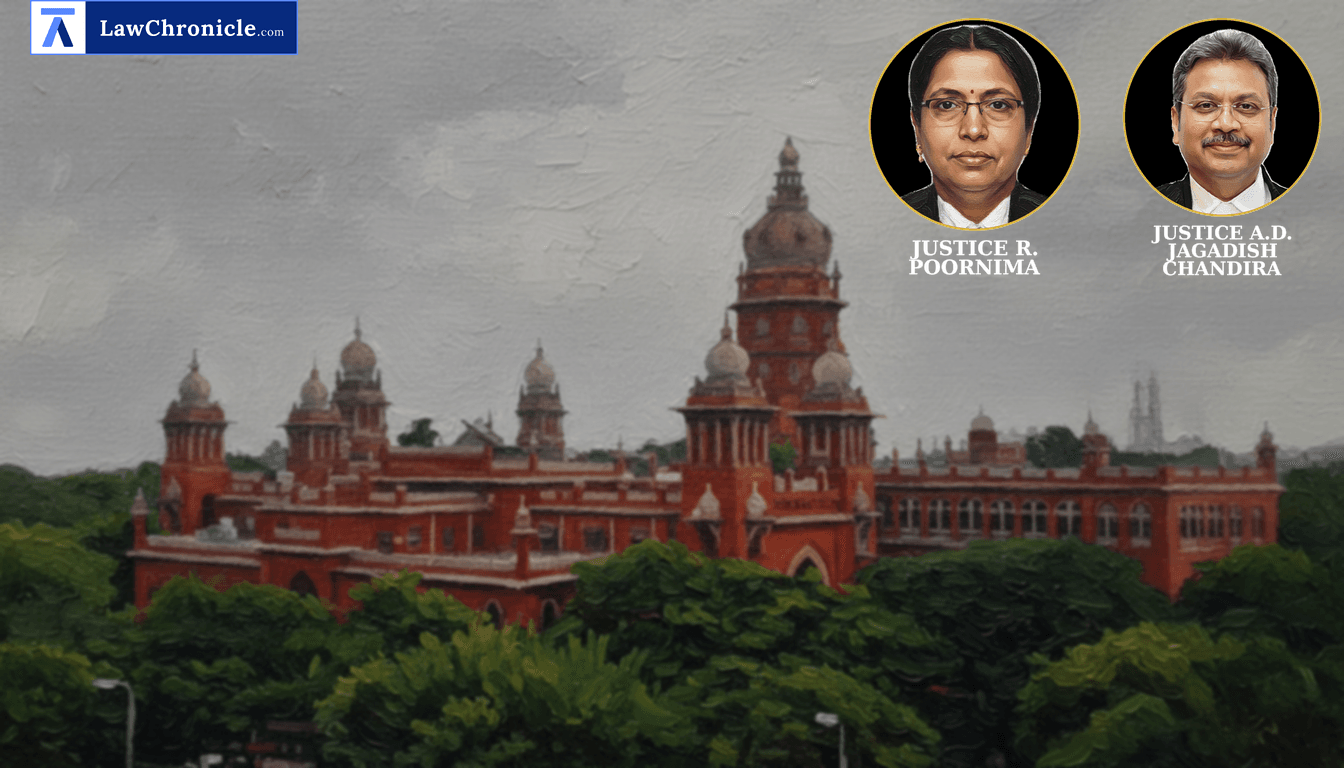
The Madras High Court has overturned a Family Court's dismissal of a divorce petition, ruling that insistence on independent witnesses to prove matrimonial cruelty is unsustainable as such acts typically occur within the private confines of a home. Setting a vital precedent for domestic litigation, the Court held that a husband's failure to contest allegations of physical and mental abuse warrants an adverse inference against him, shielding aggrieved spouses from impossible standards of proof.
A Division Bench comprising Justice A.D. Jagadish Chandira and Justice R. Poornima adjudicated the appeal filed by a wife against the dismissal of her petition for dissolution of marriage under the Family Courts Act, 1984. The Court scrutinized the lower court's reasoning which had rejected the wife's plea solely due to the lack of documentary or independent evidence supporting her claims of cruelty and desertion.
Domestic Privacy and the Standard of Proof
The Court noted that the respondent-husband had remained ex-parte throughout the proceedings, neither filing a counter nor appearing before the High Court. It observed that the different residential addresses on Aadhaar cards established that the parties were living separately, corroborating the petitioner's claim of desertion.
The Court emphasized that the trial court's demand for independent witnesses in matrimonial disputes was disconnected from reality. The Court, in its reasoning, observed: "Acts of matrimonial cruelty ordinarily occur within the four walls of the matrimonial home, where independent witnesses are rarely available. Therefore, it is not always possible for the aggrieved spouse to produce direct or documentary evidence to establish such acts. The Court must assess the pleadings and surrounding circumstances on the touchstone of probabilities."
Adverse Inference Against Absentee Spouses
Drawing upon the Indian Evidence Act, the Court ruled that since the husband was the only person capable of denying the specific allegations of assault and dowry demands, his failure to enter the witness box must be viewed critically. The Court has following directions:
"The fair and decreetal order passed in HMOP No.890 of 2022, dated 23.12.2022, by the Family Court, Theni, is set aside and the marriage between the petitioner and the respondent solemnized on 24.06.2009 is hereby dissolved by a decree of divorce."
Key Takeaways
Realistic Evidence Standards
Courts cannot insist on third-party witnesses for cruelty that happens within the private matrimonial home, recognizing the inherent lack of external evidence in domestic abuse cases.
Consequences of Ex-Parte Non-Appearance
When a spouse refuses to contest serious allegations of cruelty, courts are empowered to draw an adverse inference under evidentiary law, treating the silence as an admission of the facts alleged.
Preponderance of Probabilities
Matrimonial disputes must be decided on the balance of probabilities rather than the 'beyond reasonable doubt' standard, especially when oral testimony remains uncontradicted.
Ratio
In matrimonial proceedings, the absence of independent witnesses or documentary proof cannot be a sole ground for dismissing allegations of cruelty; where specific allegations of domestic ill-treatment remain unchallenged by the respondent, the Court must apply the principle of adverse inference under Section 114(g) of the Indian Evidence Act and decide the matter on the standard of preponderance of probabilities.
Background:
The marriage was solemnized in 2009. The appellant-wife alleged that she was subjected to physical and mental cruelty, including burn injuries and demands for an additional Rs. 2,00,000/- as dowry. Despite the birth of a daughter in 2012, the husband allegedly continued to neglect them and drove her out of the home. A police complaint was lodged in 2016, where the husband promised cohabitation but failed to honor it. The Family Court at Theni dismissed the original petition (HMOP No. 890 of 2022) on December 23, 2022, labeling the evidence as insufficient. The High Court, finding the order cryptic and non-speaking, allowed the appeal and granted the decree of divorce.
Case Details:
Case No.: C.M.A.(MD) No.875 of 2023
Case Title: Veerammal v. Kariamal
Appearances:
For the Petitioner(s): Mr.P.Sivachandran, Advocate
For the Respondent(s): No appearance
Source: 2026 CaseBase(MAD) 1991
Similar Articles
 Breaking News


