


Absence of Wound Certificate Does Not Disprove Matrimonial Cruelty: Madras HC
 Copy Link
 Share
 Save
Setting aside a family court order that refused divorce to a woman, the High Court has ruled that matrimonial cruelty is not confined to visible physical injuries or police complaints, holding that a continuous course of neglect, alcoholism, and financial irresponsibility amounts to mental cruelty.
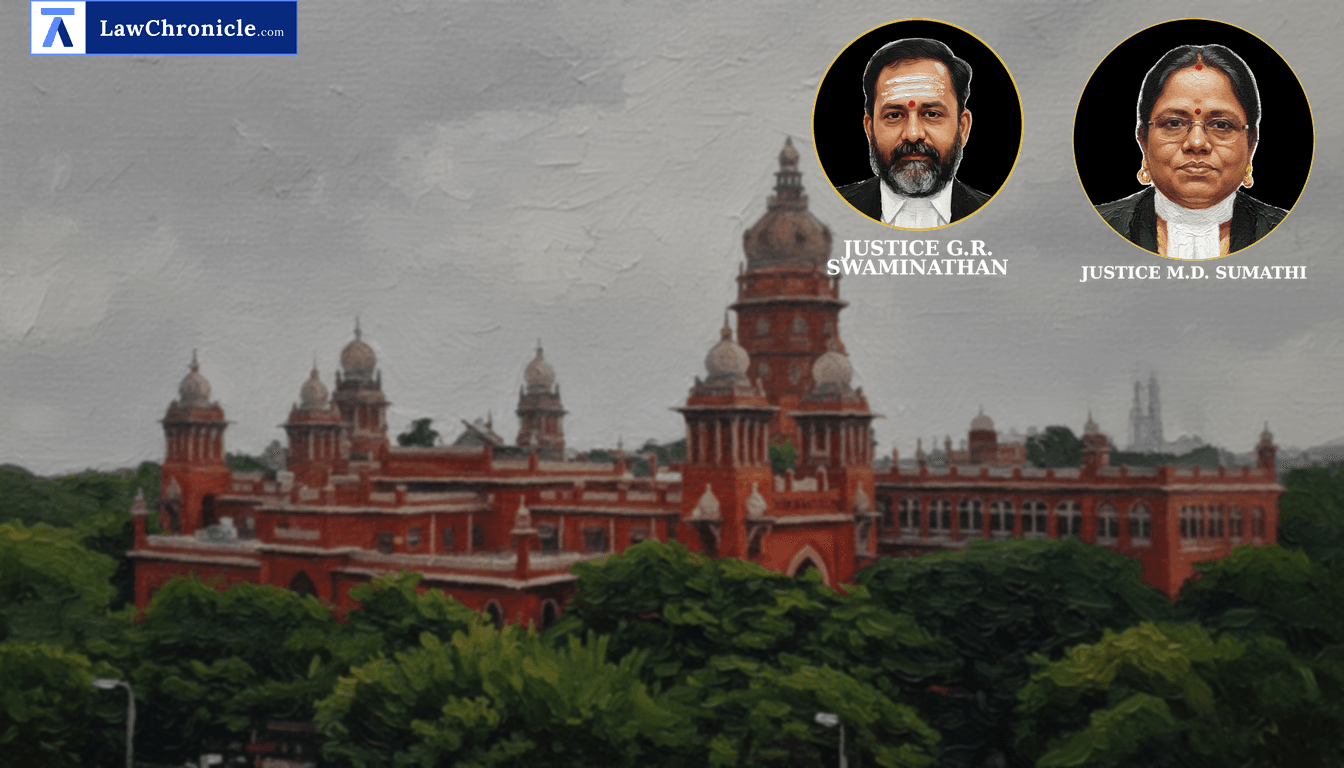
An appellate bench comprising Justice G.R. Swaminathan and Justice M.D. Sumathi heard an appeal filed under Section 55 of the Indian Divorce Act, 1869 read with Section 19 of the Family Courts Act, 1984 against the dismissal of a divorce petition by the Family Court, Sivagangai.
Key Takeaways
Physical Violence Not Mandatory For Cruelty: Absence of a wound certificate or police complaint cannot be treated as conclusive proof that physical or mental cruelty did not occur.
Cumulative Effect Matters: Courts must assess matrimonial cruelty from the totality of a spouse's continuous course of conduct rather than examining incidents in isolation.
Unrebutted Testimony Holds Weight: When a respondent stays ex-parte and fails to enter the witness box, the court is entitled to consider the evidentiary consequences flowing from such abstention.
Delay Not An Absolute Bar: Unexplained delay in seeking divorce is a discretionary bar under the Indian Divorce Act, 1869, and genuine reasons such as working abroad to clear family debts adequately explain the delay.
The High Court observed that the trial court took a hyper-technical approach by examining each allegation in isolation. The Court held that the husband's complete indifference, prolonged separation, and failure to maintain his family constituted both cruelty and desertion.
The Court, in its reasoning, observed: "The absence of wound certificate for sustained
injuries or a contemporaneous police complaint cannot to prove the grounds of cruelty by itself, be treated as conclusive proof that the alleged physical and mental cruelty did not occur. Matrimonial cruelty is not confined only to acts which result in visible bodily injuries or which are reported to the police. The consistent course of conduct of one spouse, when viewed cumulatively, may constitute mental cruelty and may render the continuation of matrimonial life impossible."
The Court relied upon the precedent in Shri Rakesh Raman Vs.Kavitha to highlight that the long separation and complete breakdown of meaningful bonds amounts to cruelty. It further referred to the decisions in G.Ramakrishna Pillai vs.J.Vijayakumari Amma and Ors and Chandrika v. M. Vijayakumar to affirm that delay in presenting a divorce petition is not fatal when properly explained.
Ratio
Matrimonial cruelty under the law is not limited to physical violence supported by medical or police records. A continuous course of conduct demonstrating alcoholism, financial neglect, abandonment, and indifference, when viewed cumulatively, constitutes mental cruelty and desertion, entitling the aggrieved spouse to a decree of dissolution of marriage.
Background
The parties were married on May 16, 2008, as per Christian rites and had two children. The wife alleged that from the inception of the marriage, the husband was addicted to alcohol, abused and assaulted her, demanded money and jewels, and failed to contribute to household expenses. To support her family, the wife undertook tailoring work, incurred debts, and eventually went to Singapore for employment to clear family loans. She left the matrimonial home on December 22, 2018, and later issued a legal notice seeking divorce, maintenance, and compensation.
When the husband failed to reply or contest, she filed I.D.O.P.No.175 of 2021 before the Family Court, Sivagangai. The husband remained ex-parte. However, the Family Court dismissed the petition on February 22, 2022, citing lack of specific dates of cruelty, absence of police complaints or wound certificates, failure to produce documentary proof of debts, and delay in filing the petition.
Reversing the trial court's order, the High Court held that the wife's testimony remained wholly unrebutted and that the Family Court erred in applying criminal prosecution standards to a matrimonial dispute. Consequently, the High Court allowed the Civil Miscellaneous Appeal and dissolved the marriage solemnized on May 16, 2008.
Case Details:
Case No.: C.M.A(MD)No.870 of 2022
Case Title: Salaith Mary v. Victor
Appearances:
For the Petitioner(s): Mr.M.Saravanan
For the Respondent(s): No appearance
Source: 2026 CaseBase(MAD) 16267
Similar Articles
 Breaking News


