


Agreement of Sale Not Defeated by Sham Transactions: Karnataka HC
 Copy Link
 Share
 Save
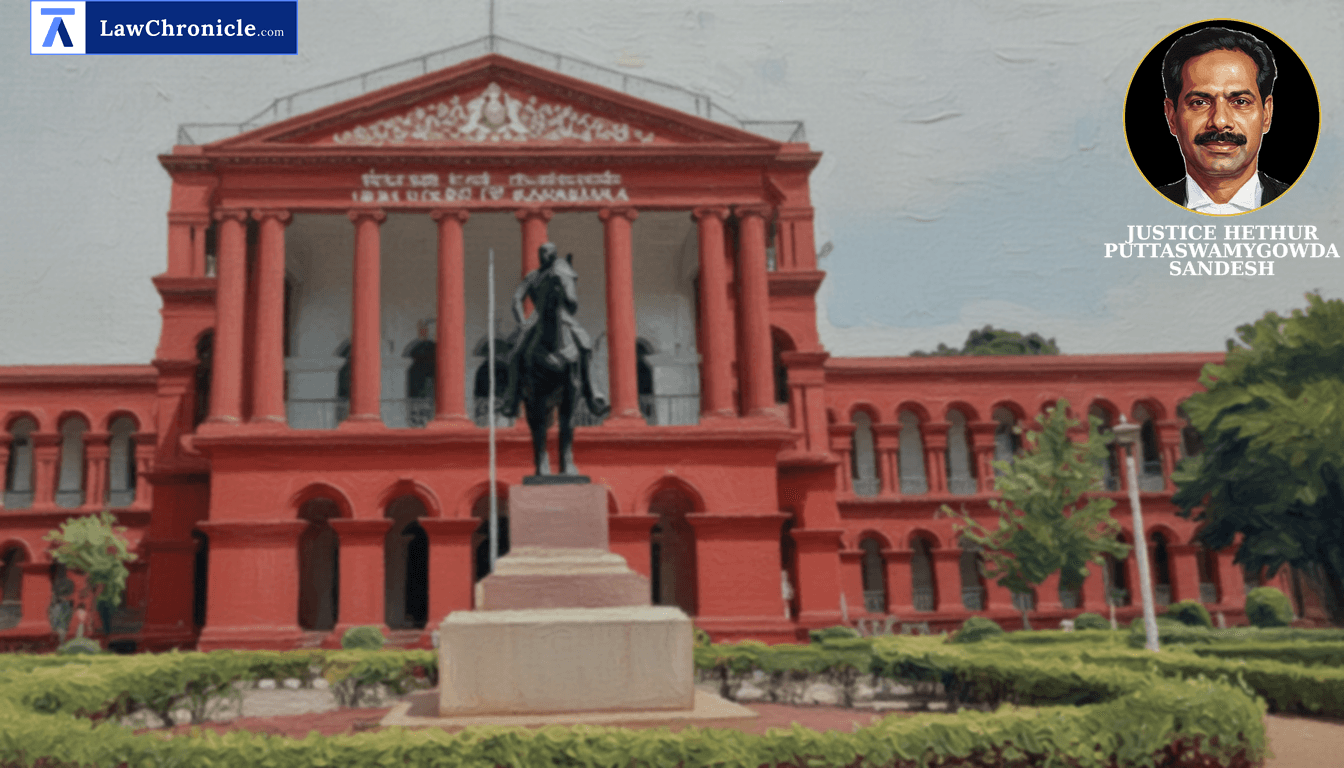
The Karnataka High Court set aside a lower appellate court's decree for the mere refund of money, restoring the trial court's decision for specific performance of a sale agreement. In a significant ruling, the Court found that subsequent sale deeds executed to defeat a prior valid agreement were sham and collusive. A single-judge bench of Justice H.P. Sandesh emphasized that admissions regarding signatures and the flow of consideration must be evaluated with a "prudent man's approach" to uphold the sanctity of contracts.
The matter arose from a challenge to the judgment of the Principal District Judge, which had reversed the trial court's decree for specific performance. The High Court analyzed the interplay between Section 100 of the Code of Civil Procedure, 1908 and the discretionary relief provided under the Specific Relief Act, 1963.
Admissions and the Validity of Endorsements
The Court observed that the first defendant had admitted his signatures on the sale agreement and several endorsements for additional payments. The High Court criticized the lower appellate court for accepting part of an endorsement while rejecting the portion relating to a payment made via cheque to a previous agreement holder. The Court, in its reasoning, observed: "The assertion of defendant Nos.1 and 2 being not in consonance with prudent man's approach admission of signatures itself is sufficient to prove the agreement... the Court has to examine the documents contents and the intention of the parties. The same can be gathered from the circumstances under which document was entered and the language used by the parties."
Sham Documents and Collusive Sales
During the proceedings, the Court scrutinized the conduct of the defendants who set up an earlier sale agreement to justify a subsequent sale deed. Highlighting inconsistencies in the testimony of the defendants (DW1, DW2, and DW4), the Court noted that the alleged prior agreement was a creation intended to "knock off" the property. The Court also drew an adverse inference against the second defendant for failing to subject herself to cross-examination.
Referencing the principle in M S ANANTHAMURTHY AND ANOTHER Vs MANJULA ( "2025 INSC 273": 2025 CaseBase(SC) 290) (also reported as M S ANANTHAMURTHY AND ANOTHER vs MANJULA), the Court reiterated that the title of a document is not as important as its contents and the clear intention of the parties involved. The Court found that the plaintiff had remained ready and willing to perform his part, having paid the entire consideration as evidenced by valid endorsements on the agreement.
Court Directions
The Court issued the following directions: "The second appeals are allowed. The judgment of the First Appellate Court in R.A No.199/2008 connected with cross-objection No.159/2009 dated 13.11.2009 are set aside; the judgment and decree dated 17.09.2008 passed by the Court of the Civil Judge (Senior Division), Anekal in O.S.No.937/2006 (old No. 1530/2004) is also set aside on the Additional Issue Nos.1 and 2 and the judgment of the Appellant Court to pay Rs.77,500/- with interest at 15% from 28.08.2000 till payment is also set aside. Consequently, the suit filed by the plaintiff for the relief of specific performance based on the agreement of sale at Ex.P1 is decreed. Defendant Nos.1 and 2 are directed to execute the sale deed in favour of the plaintiff. If the said defendants failed to execute the sale deed, the plaintiff is given liberty to enforce the agreement of sale in accordance with law."
Background:
The dispute began when the plaintiff sought specific performance of a sale agreement dated 11.07.1999 for land in Huskur Village. The plaintiff claimed that despite paying the full consideration of Rs.1,22,500/-, the defendants clandestinely sold the property to a third party in 2004 once the revenue records (khatha) were updated. The defendants argued that the signatures were obtained on blank papers and that a prior agreement existed with the third-party purchaser. While the trial court initially decreed specific performance, the first appellate court limited the relief to a refund of Rs.77,500/-. The High Court, however, found the appellate court's reasoning perverse and restored the decree for specific performance, declaring the subsequent sale deed as a collusive and sham document.
Case Details:
Case No.: REGULAR SECOND APPEAL NO.239/2010 (SP) C/W REGULAR SECOND APPEAL NO.528/2010 (SP)
Case Title: MR. V. CHANDRASHEKAR vs MR. MUNITHIMMA REDDY @ SUBBARAYAPPA (SINCE DECEASED BY LRS) AND OTHERS
Appearances:
For the Petitioner(s): Sri. Rajesh Mahale, Senior Counsel for Sri. M. Jagadeesh, Advocate
For the Respondent(s): Sri. S.K.V. Chalapathy, Senior Counsel for M/s. Chalapathy & Srinivas, Advocate for R3; Sri. Sundara Swamy Ramadas, Senior Counsel for Sri. R. Vijaykumar, Advocate for R1(a to c); Sri. S. Prasanna Kumar, Advocate for R2(a)
Source: 2026 CaseBase(KAR) 197
Similar Articles

 Breaking News


