


Andhra Pradesh HC: Insurance Company Must Pay Compensation To Gratuitous Passenger And Recover From Owner
 Copy Link
 Share
 Save
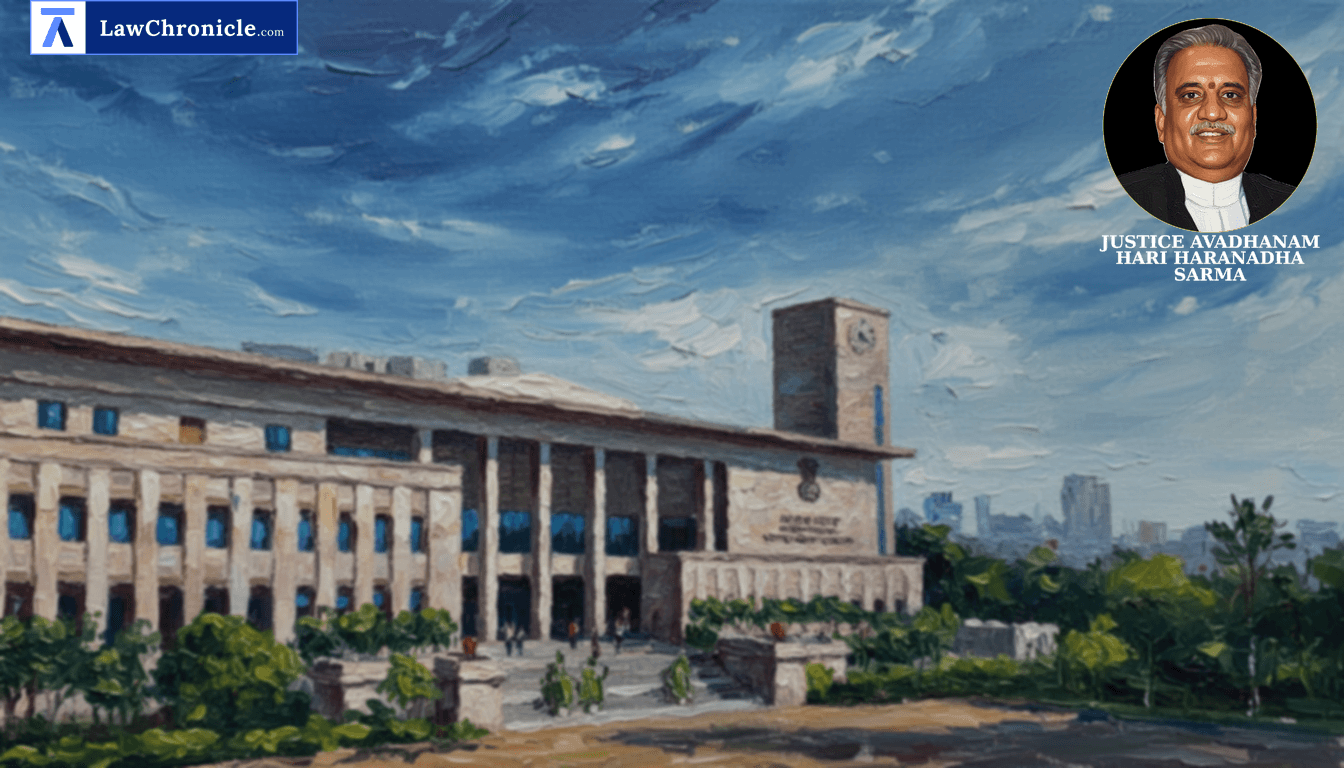
The High Court of Andhra Pradesh has reinforced the 'Pay and Recover' doctrine, holding that insurance companies cannot be fully exonerated from paying compensation to victims travelling as gratuitous passengers in goods vehicles. This ruling ensures that the benevolent object of social welfare legislation is met by prioritizing immediate relief to claimants while preserving the insurer's right to seek reimbursement from the vehicle owner.
Justice A. Hari Haranadha Sarma, sitting in Single Bench, presided over the appeal filed by claimants seeking enhanced compensation and challenging the exoneration of the insurance company. The Court was tasked with determining whether the insurer's liability extends to a passenger in a goods vehicle and the adequacy of the compensation awarded by the Motor Accidents Claims Tribunal (MACT).
Application of 'Pay and Recover' Principle for Gratuitous Passengers
The Court analyzed the liability of the insurance company in cases where the deceased was travelling as a gratuitous passenger in a vehicle meant for carrying goods. While acknowledging that the policy might not explicitly cover such risks, the Court emphasized the protective nature of the Motor Vehicles Act, 1988. Drawing from judicial precedents like National Insurance Company Limited Vs. Saju P. Pal ( "(2013) 2 SCC 41": 2013 CaseBase(SC) 788) and Manuara Khatun Vs. Rajesh Kumar Singh ( "(2017) 4 SCC 796": 2017 CaseBase(SC) 211), the Court applied the 'Pay and Recover' doctrine.
The Court, in its reasoning, observed: "While holding that the Insurance Company cannot be held liable in view of the benevolent object of the Act, issued directions to the Insurance Company to pay awarded compensation to the claimants and recover from the owner and applied pay and recover doctrine."
Standard of Proof and Reliance on Police Records
Addressing the issue of negligence, the Court highlighted that claim petitions under the Motor Vehicles Act, 1988 are summary in nature. It held that the principle of 'preponderance of probability' applies rather than 'proof beyond reasonable doubt'. Under Rule 476 of the A.P. Motor Vehicles Rules, 1989, Tribunals are empowered to rely on official police records such as FIRs and charge sheets.
Regarding the assessment of evidence, the Court noted: "The principle of standard of proof, beyond reasonable doubt cannot be applied while considering a claim seeking compensation for the death or the injury on account of road accident. The touch stone of the case, the claimants shall have to establish is preponderance of probability only."
The Court has following directions:
"(i) The judgment and decree dated 10.06.2005 passed by the learned MACT dismissing the claim against the 2nd respondent is set aside.
(ii) the compensation awarded by the learned MACT in M.V.O.P.No.423 of 2002 at Rs.2,00,000/- with interest at the rate of 9% per annum is modified and enhanced to Rs.4,78,000/- with interest at the rate of 6% per annum from the date of petition till the date of deposit or realization, whichever is earlier.
(iii) Apportionment:
a. Claimant Nos.2, 3 and 4 are entitled to Rs.1,25,000/- each with proportionate interest and costs. b. Claimant No.1 is entitled for the balance amount of Rs.1,03,000/- with proportionate interest and costs.
Liability:-
(iv) Both the respondents are liable to pay the aforesaid compensation. But, the 2nd respondent is directed to pay/ deposit the entire compensation amount and entitled to recover the same from the 1st respondent, in accordance with law.
(v) Time for payment /deposit of balance amount is two (02) months. a) If the claimants/petitioners furnish the bank account number within (15) days from today, the 2nd respondent shall deposit the amount directly into the bank account of the claimants/petitioners and file the necessary proof before the learned MACT. b) If the claimants fail to comply with clause (v)(a) above, the 2nd respondents shall deposit the amount before the learned MACT and the claimants are entitled to withdraw the amount at once on deposit.
(vi) There shall be no order as to costs in the appeal.
(vii). As a sequel, miscellaneous petitions, if any, pending in the appeal shall stand closed."
Key Takeaways
Priority of Claimant Protection
Insurers must first satisfy the award in favor of third parties and then seek recovery from the owner, ensuring claimants do not suffer during recovery litigation.
Relaxed Standard of Proof
Tribunals should adopt a holistic view based on the preponderance of probabilities rather than strict criminal standards of proof.
Revised Conventional Heads
Compensation for loss of consortium, estate, and funeral expenses must be awarded in line with modern Supreme Court guidelines, significantly increasing award amounts.
Ratio
In cases involving gratuitous passengers in goods vehicles, the insurance company is liable to pay the compensation to the claimants first and subsequently recover the amount from the vehicle owner, adhering to the 'Pay and Recover' principle to fulfill the social welfare objectives of the Motor Vehicles Act, 1988.
Background:
The case arose from a fatal accident on August 9, 2001, when Pasumarthi Indira fell from an auto (goods vehicle) driven rashly. The claimants (husband and children) filed a petition seeking compensation. The MACT awarded Rs. 2,00,000 but exonerated the Insurance Company, citing that the deceased was a gratuitous passenger in a goods vehicle. On appeal, the High Court scrutinized the Motor Vehicles Act, 1988 and various precedents including Sarla Verma (Smt.) and Ors. vs. Delhi Transport Corporation and Anr. for income assessment and National Insurance Company Ltd. vs. Pranay Sethi and Others for future prospects. Relying on Bimla Devi and others Vs. Himachal Road Transport Corporation ( "2009 (13) SCC 530": 2009 CaseBase(SC) 631) and Nagappa Vs. Gurudayal Singh and Others ( "(2003) 2 SCC 274": 2002 CaseBase(SC) 1060), the Court held that just compensation can exceed the original claim and modified the award to Rs. 4,78,000 while directing the insurer to pay and then recover from the owner under Code of Civil Procedure, 1908 procedures.
Case Details:
Case No.: M.A.C.M.A. No. 470 of 2012
NeutralCitation: 2026:APHC:27156
Case Title: Pasumarthi Ravi Chandran & 3 Ors vs. Thanneru Babu Rao & Anr.
Appearances:
For the Petitioner(s): Sri Venkateswarlu Sanisetty, Advocate
For the Respondent(s): Sri M Solomon Raju, Advocate
Source: 2026 CaseBase(AP) 245
Similar Articles
 Breaking News


