


Lorry Passenger Carrying Business Goods Is Not A Gratuitous Passenger: Andhra Pradesh HC
 Copy Link
 Share
 Save
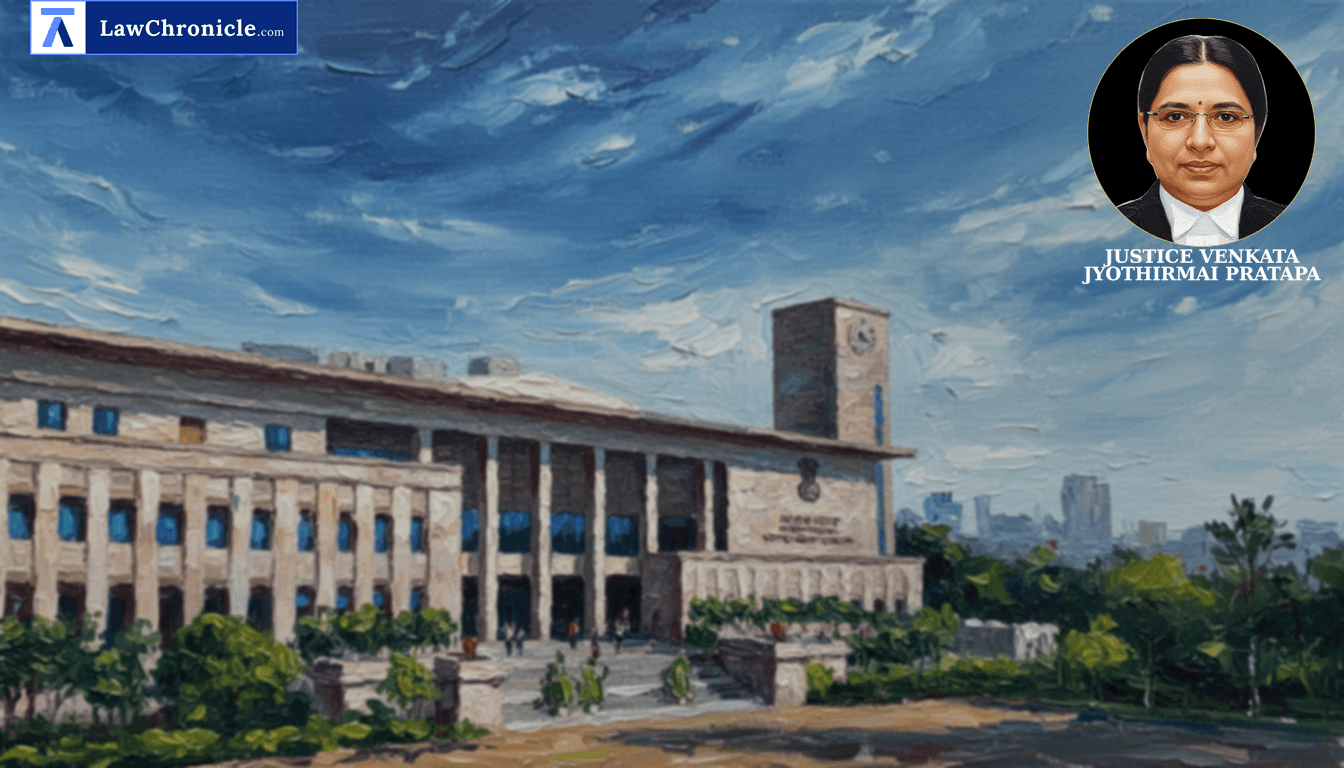
The High Court of Andhra Pradesh affirmed that an individual transporting commercial goods in a goods vehicle cannot be classified as a gratuitous passenger, thereby holding the insurer liable for compensation. The court dismissed the appeal filed by the insurance provider, emphasizing that the protection extends to owners of goods under the statutory framework.
Justice Venkata Jyothirmai Pratapa, presiding as a single judge bench, adjudicated upon the appeal filed by the insurer challenging the liability fixed by the Motor Accidents Claims Tribunal. The primary issue revolved around whether a fruit vendor, who boarded a lorry with his merchandise, could be excluded from insurance coverage as an unauthorized passenger.
The Court, in its reasoning, observed: "The material available on record clearly demonstrates that the deceased was engaged in the business of vending fruits and had boarded the lorry for the purpose of transporting the fruits purchased by him. Merely because the deceased was not the owner of the entire consignment of goods loaded in the vehicle, it cannot be inferred that he was a gratuitous passenger... the insurer failed to adduce any cogent or convincing evidence to establish breach of the policy conditions."
While upholding the Tribunal's award, the Court relied on the principles laid down in National Insurance Co. Ltd. v. Cholleti Bharatamma and United India Insurance Co. Ltd. v. Suresh K.K, which clarify that owners of goods or their representatives are covered under the policy in view of the amendments to Section 147 of the Motor Vehicles Act, 1988. The Court has the following directions:
"In the result, the M.A.C.M.A is dismissed. There shall be no order as to costs. Interim orders granted earlier, if any, stand vacated. Miscellaneous petitions pending if any, stand closed."
Insurance Liability and the 'Owner of Goods' Rule
The court noted that the deceased was a fruit vendor who had purchased jujube fruits on a wholesale basis and was transporting them in the offending lorry. The evidence provided by eye-witnesses and the family confirmed that the fruits were commercial goods and not mere personal luggage. The insurer's failure to provide evidence of a policy breach led the court to conclude that the statutory liability under the Motor Vehicles Act, 1988 remains intact.
Rationale on Statutory Liability
By referencing National Insurance Co. Ltd. v. Cholleti Bharatamma, the court highlighted that since the 1994 amendment to the Motor Vehicles Act, 1988, the risk of the owner of goods or their authorized representative is covered. Furthermore, United India Insurance Co. Ltd. v. Suresh K.K supported the view that an individual accompanying their goods cannot be treated as a 'gratuitous passenger'.
Background:
The dispute arose following a fatal accident on October 23, 2004. The deceased had boarded a lorry at Santhamaguluru with bags of jujube fruits. Due to the rash and negligent driving of the lorry driver, the vehicle struck an electrical pole, causing severe injuries to the deceased, who later succumbed during treatment. The legal heirs filed a claim under Section 166 of the Motor Vehicles Act, 1988, and the Tribunal awarded Rs. 1,49,800/- with 7.5% interest.
The Insurance Company appealed this decision, arguing that the deceased was a gratuitous passenger who boarded the lorry midway, thus violating the insurance policy terms. However, the High Court found that the insurer did not produce any evidence to prove the deceased was traveling unconnected with the goods. Finding no infirmity in the Tribunal's order, the High Court dismissed the appeal.
Case Details:
Case No.: M.A.C.M.A.No: 2491/2006
NeutralCitation: 2026:APHC:24062
Case Title: NATIONAL INSURANCE COMPANY LTD v. SHAIK PYARI JOHN AND OTHERS
Appearances:
For the Petitioner(s): V VEERABHADRA CHARY, Counsel
For the Respondent(s): N SUBBA RAO, Counsel
Source: 2026 CaseBase(AP) 198
Similar Articles


 Breaking News


