Anti-Paper Leak Bill 2026 Passed in Parliament: What's Next?
 Copy Link
 Share
Share Save
Save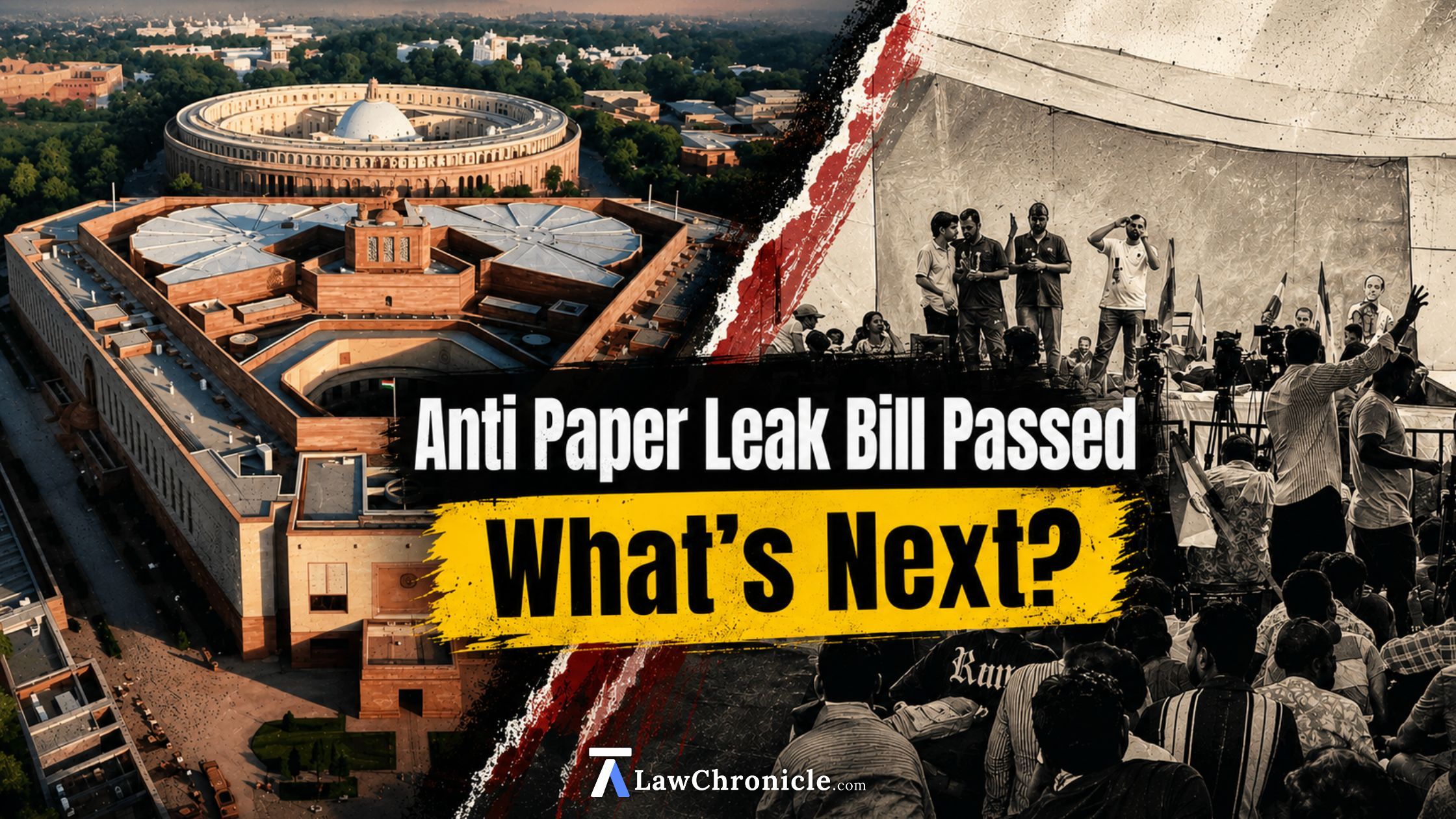
Parliament has cleared the Public Examinations (Prevention of Unfair Means) Amendment Bill, 2026, popularly called the Anti-Paper Leak Bill. The Lok Sabha passed it by voice vote on 29th July The Rajya Sabha followed a day later on 30th July, amid an Opposition walkout. The Paper Leak Bill 2026 shall now be tabled before President Droupadi Murmu for assent, which is the final step before it becomes a law.
The Amendment through Anti Paper Leak Bill toughens the Public Examinations (Prevention of Unfair Means) Act, 2024. This was the parent legislation enacted after the 2024 NEET-UG and UGC-NET controversies to criminalize cheating and paper leaks in examinations conducted by bodies such as the UPSC, SSC, Railway Recruitment Boards, IBPS, and the NTA. Its return to Parliament this year follows a fresh crisis: the NEET-UG 2026 paper leak, weeks of student protests in Delhi, and the resignation of the Union Education Minister Dharmendra Pradhan.
What the Paper Leak Bill Changes
The Public Examinations Amendment Bill 2026 touches upon four areas: punishment, investigation, fast-track trial, and appeals.
Harsher punishment
- For individuals resorting to unfair means, the minimum jail term rises from three years to five years, with the outer limit going up from five to ten years; the maximum fine increases from ₹10 lakh to ₹50 lakh.
- Service providers found responsible face a fine of up to ₹5 crore, against ₹1 crore earlier, and debarment from conducting any public examination for eight years instead of four.
- Where a director or senior manager of a service provider firm is shown to have consented to or connived in the offence, the minimum term goes up from three to five years, and the fine from ₹1 crore to ₹5 crore.
- For organized examination-related crime, offences committed by groups, examination authorities, or service providers acting in concert, the minimum sentence increases from five to seven years, and the minimum fine from ₹1 crore to ₹10 crore.
A Special Task Force option
Under the Public Examinations Act, 2024, the Centre could refer investigations to a Central Investigating Agency. The amendment through Anti-Paper Leak Bill, 2026 adds that the Central Government may instead notify a Special Task Force to investigate; once such a force is constituted, it alone handles the investigation.
Time-bound investigation and trial
A new Section 12A caps investigations within two months, whether conducted by the local police, a Central Investigating Agency, or a Special Task Force. Every State Government and Union Territory Administration must, in consultation with the Chief Justice of the concerned High Court, designate a Court of Session as a Special Fast Track Court for offences under the Act. These courts must hear cases on a day-to-day basis and complete trials within three months of the chargesheet being filed; pending cases stand transferred to them, to be completed within three months of transfer. States must also appoint Special Public Prosecutors for these courts.
Appeal Route Redefined
A new Section 12B allows appeals from a Special Fast Track Court's judgment, sentence, or order, other than interlocutory orders, to the High Court, to be heard by a two-judge bench and disposed of, as far as possible, within three months. Bail orders can also be appealed. Appeals must ordinarily be filed within thirty days, extendable for sufficient cause, but not beyond ninety days.
The Background: NEET-UG 2026 and Student Protests
The Paper Leak Bill's return to Parliament is directly linked to this year's NEET-UG controversy. The medical entrance exam, held on 3rd May, 2026, was hit by allegations of a question paper leak. authorities eventually admitted the irregularity, handed the probe to the CBI, and ordered a re-examination, which was conducted later in June. Results were declared on 16th July.
The controversy triggered sustained protests at Delhi's Jantar Mantar, led by the Cockroach Janta Party (CJP) in mid-May. The CJP began its sit-in at Jantar Mantar on 6th June 6, with a singular demand: the resignation of Union Education Minister Dharmendra Pradhan over the alleged irregularities in NEET-UG 2026. Climate activist Sonam Wangchuk later joined the protest with an indefinite hunger strike alongside several students.
Matters escalated on 20th July 20, when a CJP "Sansad Chalo" march from Jantar Mantar towards Parliament turned violent. Several ended up injured, with Delhi Police registering 15 FIRs in connection with the demonstrations, which witnessed tear gas shelling and lathi charges as crowds clashed with security forces near central Delhi.
Talks between CJP representatives and Union Ministers followed over the next few days. On July 25, Dharmendra Pradhan resigned as Education Minister, citing the need to protect students' interests and prevent the situation from being exploited by disruptive elements. President Murmu accepted the resignation the same day, and Cabinet Minister Pralhad Joshi was given additional charge of the Education Ministry. The CJP subsequently called off its protest, stating that its primary demand had been met, while flagging that three other demands: compensation for families of students who died, withdrawal of cases against protesters, and an apology from the police for the use of force, remained pending.
Alongside the political resolution, the government indicated it would pursue structural changes: a restructuring of the National Testing Agency, and the proposed Anti-Ppaer Leak Bill for Public Examinations Amendment Act that Parliament has now passed.
President's Assent
As of now, the paper Leak Bill awaits the President's assent. Following its passage in the Lok Sabha and the Rajya Sabha, the Public Examinations Amendment Bill will be sent to President Droupadi Murmu, and it becomes law once she signs it.
There is no fixed timeline within which the President must act on a money or ordinary Bill of this kind, though such Bills are typically assented to within a few weeks of transmission. Once assent is granted and the Act is notified, the enhanced penalties, the Special Task Force mechanism, and the Special Fast Track Court framework will take effect, though the deadline-bound designation of these courts by States and Union Territories, and the appointment of Special Public Prosecutors, will still need to follow.
The Aftermath of Anti-Paper Leak Bill 2026
Once notified, the Public Examinations Amended Act 2026 is expected to change how paper-leak cases move through the system in three concrete ways.
- First, sentencing exposure goes up sharply across the board, from a five-year ceiling to a ten-year ceiling for individual offenders, and from a one-crore to a ten-crore fine ceiling for organized crime.
- Second, investigations gain a hard two-month deadline, and the Centre gets the option of routing sensitive cases through a dedicated Special Task Force rather than relying solely on existing central agencies.
- Third, trials move out of the ordinary court calendar and into Special Fast Track Courts bound to hear matters daily and conclude them within three months of the chargesheet, with a matching three-month target for appeals at the High Court.
During the debates, the government's position was that the amendment through Paper leak Bill 2026 respond to lessons from recent examination-related offences and strengthen deterrence. The Opposition's criticism, voiced during the Rajya Sabha debate, centred on the police response to the student protests, with the Congress seeking Union Home Minister Amit Shah's resignation over the handling of the demonstrations, and some members arguing that the Bill needed stronger provisions to actually prevent paper leaks, such as regulation of coaching centres and a published annual examination calendar, rather than only enhancing post-facto punishment. The government indicated that these suggestions would be examined by the newly enabled task force mechanism.
Other Points Worth Noting
A few threads remain open even after the Bill's passage. The CJP's three outstanding demands: compensation for affected families, withdrawal of cases against protesters, and accountability for the police action on 20th July 20, had not been formally resolved at the time of the Bill's passage. The group has indicated that the movement is not fully wound up.
Separately, Delhi Police has set up its own Special Task Force within the Crime Branch to investigate examination-related offences, distinct from the Central Special Task Force the amended Act shall permit the Union Government to notify. Readers tracking implementation should watch for two further developments: the Presidential assent and gazette notification bringing the amendments into force, and the subsequent State-level notifications designating Special Fast Track Courts, which will determine how quickly the new trial timelines actually become operative on the ground.
 Breaking News