


Armed Forces Insurance Societies Are 'State' Under Article 12: Supreme Court
 Copy Link
 Share
 Save
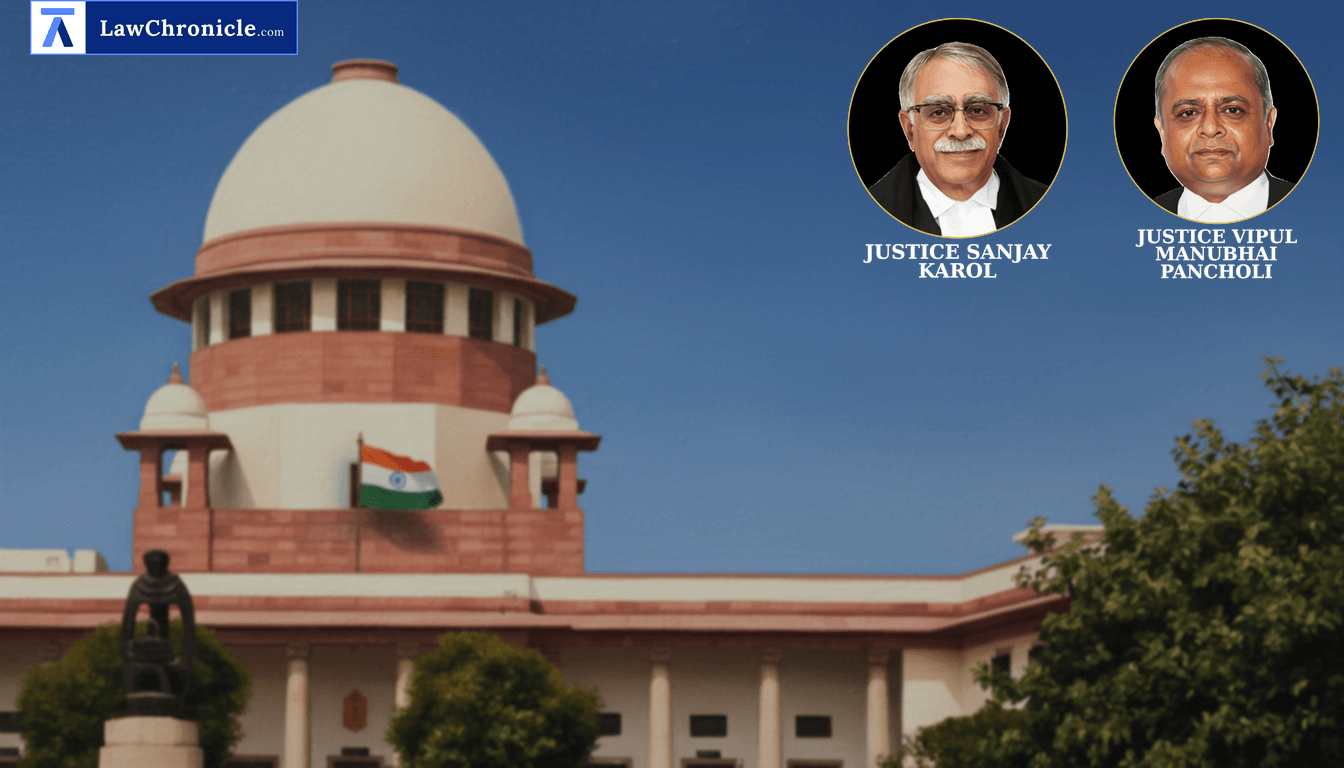
The Supreme Court has expanded the scope of constitutional accountability by holding that welfare and insurance bodies established for armed forces personnel qualify as "State" under the Constitution of India, 1950. The Court emphasized that providing insurance to service members is a vital public function closely linked to national security and sovereignty.
A bench comprising Justice Sanjay Karol and Justice Vipul M. Pancholi heard the appeal challenging a Delhi High Court judgment which had dismissed writ petitions filed by employees of the Air Force Group Insurance Society (AFGIS). The primary issue was whether such a society, though registered under the Societies Registration Act, 1860, could be considered an instrumentality of the State, thereby making it amenable to writ jurisdiction under Article 226 regarding pay parity and service conditions.
AFGIS Performs Essential Public Duty Linked to National Security
The Court observed that the protection and welfare of armed forces personnel is a core government function. It noted that insurance coverage for service members addresses a collective obligation of the State toward a class whose service is indispensable for the nation's security. By providing these services, AFGIS acts as a conduit for the discharge of the State’s sovereign obligations.
Justice Sanjay Karol, writing for the bench, noted that the Society had previously claimed to be "Government" to seek tax exemptions under the Finance Act, 1994 and the Income Tax Act, 1961. The Court remarked, "We fail to understand an organisation can be ‘Government’ for one purpose and not be, for another purpose."
Deep and Pervasive Control Established
While examining the administrative framework, the Court found that the Board of Trustees comprises entirely of senior serving Indian Air Force (IAF) officials. The Court rejected the argument that lack of direct funding from the Consolidated Fund of India precluded the Society from being a State entity. Instead, it focused on the "cumulative effect" of administrative and functional dominance.
The Court, in its reasoning, observed: "In essence, therefore, the administration of the Body is entirely in the hands of Government servants even though the body itself is a purportedly private, a self-contained society... AFGIS does indeed perform a public duty. The protection and welfare of armed forces personnel is a core government function. The role of the armed forces is directly linked to the sovereignty and security of the nation."
Court's Rationale on Article 12 Tests
The bench referred to the foundational principles in Ramana Dayaram Shetty v. International Airport Authority of India ( "(1979) 3 SCC 489": 1979 CaseBase(SC) 73) and Ajay Hasia and Others v. Khalid Mujib Sehravardi and Others ( "(1981) 1 SCC 722": 1980 CaseBase(SC) 356), noting that the tests for an entity to be an agency of the government include financial assistance, functional importance, and deep pervasive control. It also relied on the seven-judge bench decision in Pradeep Kumar Biswas and Others v. Indian Institute of Chemical Biology and Others ( "(2002) 5 SCC 111": 2002 CaseBase(SC) 195), which clarified that the determination must be based on the cumulative facts of the case. The Court found that since membership in AFGIS is compulsory and managed by deputed government officers, it satisfies the criteria for an authority under Constitution of India, 1950.
The Court has the following directions:
"AFGIS would be ‘State’ under Article 12. The writ petition before the High Court accordingly, maintainable. The said writ petition on the grievance of the appellants is restored. The High Court is requested to decide the same expeditiously keeping in view the fact that the same has been filed in the year 2017. Appeal is allowed."
Background:
The dispute began when the AFGIS Board of Trustees, after initially deciding to revise pay scales as per the Sixth Pay Commission, resolved in 2017 to decouple their pay structure from Central Government parity. Employees challenged this before the Delhi High Court. The High Court, relying on Chander Mohan Khanna v. National Council of Educational Research and Training ( "(1991) 4 SCC 578": 1991 CaseBase(SC) 133) and Ex. Sub. Rajender Singh v. Union of India and Others, had ruled that AFGIS was an autonomous self-funded body without pervasive government control. The High Court had further noted that the previous view in Sagarika Singh v. Union of India and Others had been disapproved by a larger bench in Ex. Sub. Rajender Singh v. Union of India and Others.
However, the Supreme Court distinguished these findings, noting that the specific alignment of service conditions and the compulsory nature of the scheme, similar to the facts in Rajkaran Singh v. Union of India ( "2024 SCC OnLine SC 2138": 2024 CaseBase(SC) 237), warranted a different conclusion. The Court also noted exemptions under the Estate Duty Act, 1953 as further proof of the Society's unique status.
Case Details:
Case No.: CIVIL APPEAL NO. OF 2026 (Arising out of SLP (C) 27366 of 2023)
NeutralCitation: 2026 INSC 233
Case Title: RAVI KHOKHAR & ORS v. UNION OF INDIA & ORS.
Appearances:
For the Petitioner(s): Mr. Shoeb Alam, Senior Counsel
For the Respondent(s): Mr. Ankur Chibber, Counsel for AFGIS; Mr. Vikramjeet Banerjee, ASG for Union of India
Source: 2026 CaseBase(SC) 534
Similar Articles
 Breaking News


