


Unexplained Suspicious Circumstances Warrants Striking Down Registered Will: SC
 Copy Link
 Share
 Save
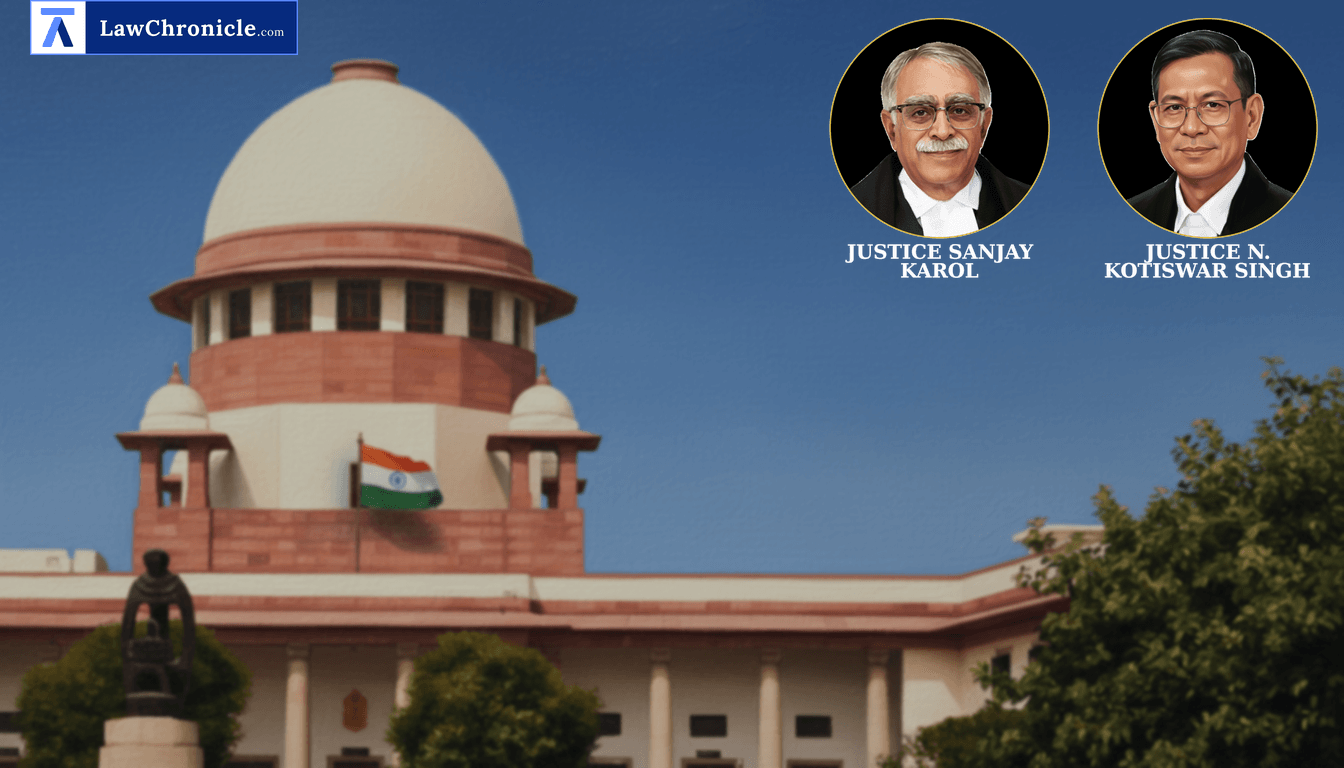
In a decisive verdict on family succession and testament validation, the Supreme Court ruled that a registered Will cannot override intestate succession if propounders fail to independently establish due execution and remove lingering suspicious circumstances. Reversing a decision of the Madras High Court, the apex court held that strict compliance with attestation and statutory proof cannot be bypassed through mere uncorroborated assertions of a witness's death.
A bench comprising Justice Sanjay Karol and Justice Nongmeikapam Kotiswar Singh adjudicated the civil appeals arising out of a longstanding property partition dispute. The controversy centered on the validity of a registered Will executed by an illiterate testatrix in favour of one branch of the family to the total exclusion of others.
Key Takeaways
Proof of Attestation Non-Negotiable: Registration of a Will does not dispense with the strict statutory requirement of proving attestation under Section 68 of the Evidence Act or meeting conditions under Section 69.
Unavailability of Witnesses Must Be Proved: Propounders cannot invoke the relaxed mode of proof under Section 69 of the Evidence Act without adducing credible evidence showing that attesting witnesses are unavailable or untraceable.
Cumulative Effect of Suspicious Circumstances: Material factual errors in recitals, exclusion of natural heirs, and non-examination of key proximity witnesses cumulatively invalidate testamentary claims.
Devolution Under Hindu Law Restored: Upon the failure of a Will, self-acquired or inherited properties of an issueless female Hindu revert strictly according to statutory devolution under Section 15(2)(b) of the Hindu Succession Act, 1956.
Analyzing the statutory scheme governing unprivileged Wills, the Court highlighted the delicate interplay between Section 63 of the Indian Succession Act, 1925 and Sections 68 and 69 of the Evidence Act. The bench reaffirmed precedents established in N. Kamalam v. Ayyasamy, Janki Narayan Bhoir v. Narayan Namdeo Kadam ( "(2003) 2 SCC 91": 2002 CaseBase(SC) 53), M.L. Abdul Jabbar Sahib v. H.V. Venkata Sastri & Sons ( "(1969) 1 SCC 573": 1969 CaseBase(SC) 489), Babu Singh v. Ram Sahai alias Ram Singh ( "(2008) 14 SCC 754": 2008 CaseBase(SC) 1969), H. Venkatachala Iyengar v. B.N. Thimmajamma ( "AIR 1959 SC 443": 1958 CaseBase(SC) 175), and Bharpur Singh v. Shamsher Singh ( "(2009) 3 SCC 687": 2008 CaseBase(SC) 110) to underscore the standard of judicial conscience required to uphold a testamentary disposition.
The Court, in its reasoning, observed: "The initial burden does not stand discharged merely by establishing that the mark appearing on the document belongs to the testatrix. The propounder must establish that the instrument represents the testamentary act of a free and capable testatrix and that it was attested in the manner required by Section 63(c) of the Indian Succession Act and free of suspicious circumstances."
Evaluating the failure to examine the scribe as an attesting witness, the Court noted that a document writer does not automatically become an attestor without explicit animus attestandi. Addressing the propounders' failure to remove suspicious elements surrounding the execution, the Court directed:
"The common judgment and decree dated 28.10.2008 passed by the High Court of Judicature at Madras in A.S. No. 231 of 1991 and Tr.A.S. No. 503 of 2002 are set aside. The common judgment and decree dated 22.01.1991 passed by the Additional Subordinate Judge - III, Coimbatore in O.S. No. 665 of 1985 and O.S. No. 1344 of 1990 are restored. The parties may work out final division, possession, and other consequential equities in final-decree proceedings and in accordance with law. O.S. No. 1344 of 1990 shall stand dismissed."
Ratio
Section 69 of the Evidence Act operates as an exceptional statutory exception and cannot be casually invoked without rigorous proof that no attesting witness can be found. Furthermore, the mere registration of a Will or the testatrix's survival long after its execution does not relieve the propounder of the obligation to remove cumulative suspicious circumstances, such as erroneous recitals, unexplained exclusion of natural heirs, and non-examination of key material witnesses.
Background
The suit properties originally belonged to one Vaiyapuri Gounder, who was survived by his third wife, Arukkaniammal. Upon his death in 1925, she inherited the property. Being issueless, her death in 1985 triggered a title dispute between the legal heirs tracing their descent through Vaiyapuri's pre-deceased first wife (Appellants) and second wife (Respondents).
The Appellants filed a suit for partition claiming a 2/3rd share, arguing that Arukkaniammal died intestate and that the property devolved upon her husband's heirs under Section 15(2)(b) of the Hindu Succession Act, 1956. The Respondents contested the partition and sought an injunction, relying on a registered Will (Ex. B-13) executed in 1976 by Arukkaniammal in favour of the four sons of Alamathal (daughter of the second wife).
The Trial Court held the Will invalid due to lack of proof of attestation and multiple unremoved suspicious circumstances, granting a preliminary decree of partition to the Appellants. On appeal, the Madras High Court reversed the Trial Court, accepting the Will under Section 69 of the Evidence Act based on the scribe's testimony and the identification of one attestor's signature. Allowing the appeals, the Supreme Court set aside the High Court's decree and restored the Trial Court's decision.
Case Details:
Case No.: Civil Appeal Nos. 10169-10170 of 2013
Neutral Citation: 2026 INSC 860
Case Title: Pazhanathal (Dead) Through LRs. & Ors v. Alamathal (Dead) Through LRs. & Ors
Source: 2026 CaseBase(SC) 841
Similar Articles
 Breaking News


