


SC: Exclusion of Natural Heirs Alone Not Sufficient to Invalidate Will
 Copy Link
 Share
 Save
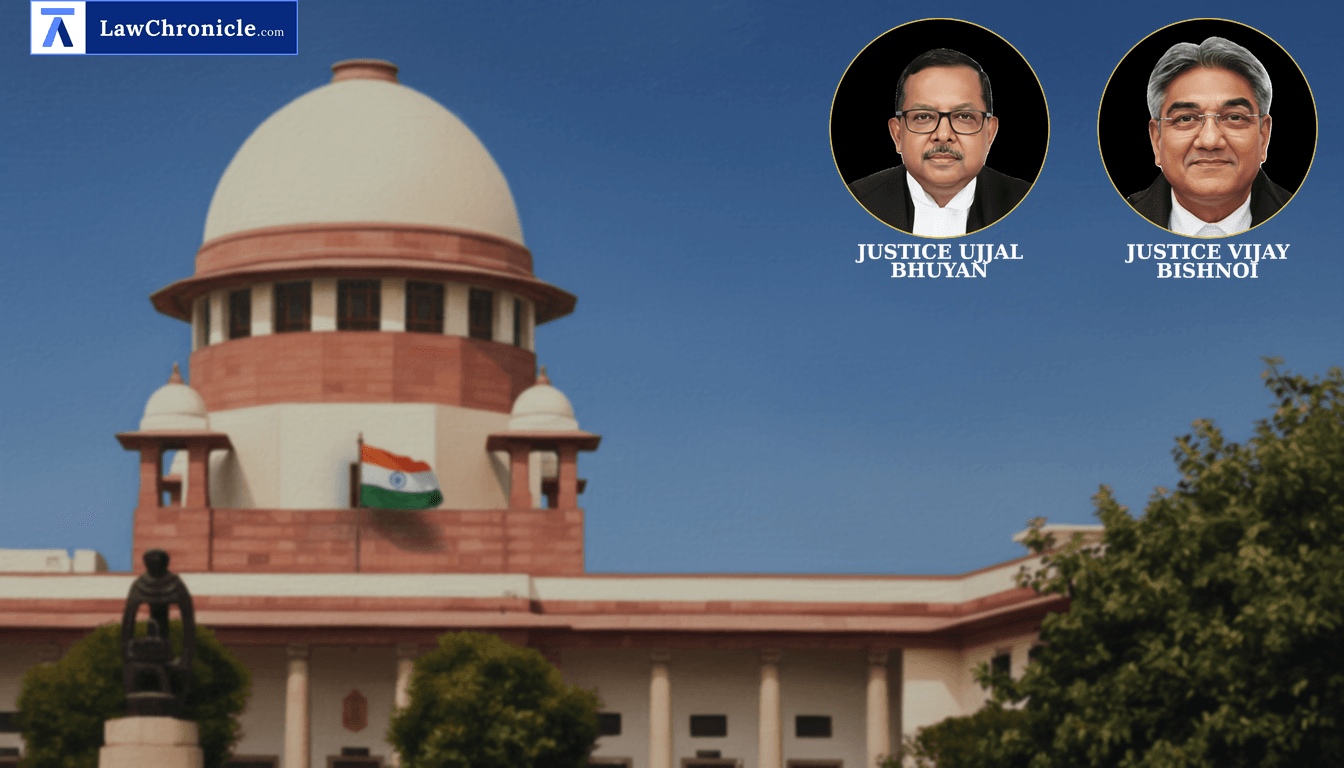
The Supreme Court affirmed that the mere exclusion of natural heirs in a testamentary disposition does not, by itself, constitute a suspicious circumstance sufficient to invalidate a Will, provided the testator’s intention and the due execution of the Will are proved.
A Bench comprising Justice Ujjal Bhuyan and Justice Vijay Bishnoi delivered the judgment while hearing a challenge against the concurrent findings of the Trial Court, the First Appellate Court, and the High Court of Karnataka. The dispute centered on a Will executed by a chartered accountant, B. Sheena Nairi, who bequeathed his properties to his sister to the exclusion of his wife and five children.
Legal Validity of the Will Upheld
In upholding the validity of the document, the Court noted that the execution was duly proven through the testimony of an attesting witness as required under Section 68 of the Indian Evidence Act, 1872. The Court, in its reasoning, observed: "A testator is legally entitled to dispose of his property according to his own wishes, and unless the exclusion is accompanied by suspicious circumstances affecting the genuineness or due execution of a Will, such exclusion alone does not render a Will invalid. Thus, we are of the considered view that the exclusion of the natural heirs cannot be sufficient to vitiate the Will in question, particularly when the Will clearly specifies that the testator has not done any injustice to his wife, children, or other relatives, and that he has given enough to his wife and children who are residing at Bombay."
Court Observations on Mutation and Technicalities
The Court dismissed the appellants' argument regarding the delay in producing the Will and the prior mutation of land in their favor. Relying on Balwant Singh And Another v. Daulat Singh (Dead) By LRs. And Others, the Court reiterated that mutation entries are for fiscal purposes and do not confer title. Furthermore, the Court rejected the contention that the First Appellate Court failed to follow Order XLI Rule 31 of the Code of Civil Procedure, 1908, stating that substantial compliance is sufficient to meet the ends of justice as per G. Amalorpavam And Others v. R. C. Diocese of Madurai and Others ( "(2006) 3 SCC 224": 2006 CaseBase(SC) 976).
The Court has the following directions:
"Therefore, we are of the opinion that the concurrent findings of all the Courts have rightly given a well-reasoned decision upholding the validity of the Will and the same does not warrant interference of this Court. For the aforesaid reasons, we affirm the Impugned Judgment and hence, the present appeal is dismissed."
Background:
The dispute began after the death of B. Sheena Nairi in 1983. His wife and children (Appellants) obtained mutation of his properties under the Karnataka Land Revenue Act, 1964. However, in 1990, his sister (Respondent) filed a suit for declaration of ownership based on a 1983 Will. The Appellants contended the Will was forged and that the signature did not belong to the testator. They also argued that their exclusion from the inheritance was a suspicious circumstance.
The Trial Court compared the signatures using its powers under the Indian Evidence Act, 1872 and, along with the testimony of an attesting witness, found the Will to be genuine. This was upheld by the First Appellate Court and the High Court. The Supreme Court, after analyzing principles from Meena Pradhan and Others v. Kamla Pradhan and Another ( "2023 SCC OnLine SC 1198": 2023 CaseBase(SC) 1053), H. Venkatachala Iyengar v. B.N. Thimmajamma And Others ( "1958 SCC OnLine SC 31": 1958 CaseBase(SC) 175), Bhagwan Kaur v. Kartar Kaur And Others ( "(1994) 5 SCC 135": 1994 CaseBase(SC) 835), Janki Narayan Bhoir v. Narayan Namdeo Kadam ( "(2003) 2 SCC 91": 2002 CaseBase(SC) 53), and Shivakumar And Others v. Sharanabasappa And Others ( "(2021) 11 SCC 277": 2020 CaseBase(SC) 1501), concluded that the propounder had successfully removed all legitimate suspicions regarding the Will's execution.
Case Details:
Case No.: CIVIL APPEAL NO. 6859 OF 2014
NeutralCitation: 2026 INSC 521
Case Title: PARVATHI NAIRTHI (DEAD) AND ORS. v. LAXMI NAIRTHY (DEAD) THROUGH LRS. AND ORS.
Appearances:
For the Petitioner(s): Ms. Meenakshi Arora, Senior Counsel
For the Respondent(s): Mr. Vinay Navare, Senior Counsel
Source: 2026 CaseBase(SC) 446
Similar Articles
 Breaking News


