


Courts cannot substitute Expert Opinions in Answer Key Disputes: Rajasthan HC
 Copy Link
 Share
 Save
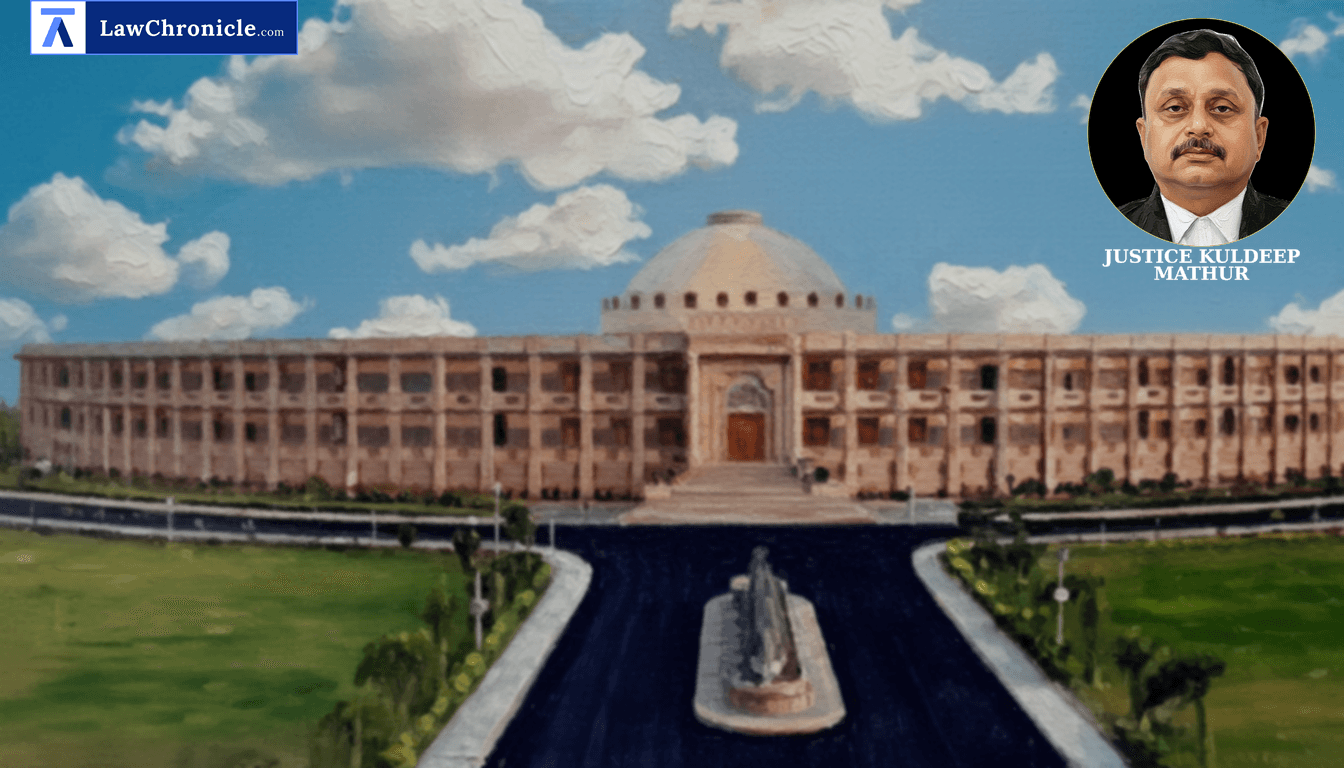
The Rajasthan High Court has slammed the door on candidates seeking judicial re-evaluation of competitive exam results, ruling that courts lack the academic expertise to overrule subject matter specialists unless an answer key is demonstrably erroneous. In a decisive blow to speculative litigation in recruitment processes, the Court affirmed that final answer keys validated by expert committees carry a presumption of correctness that cannot be displaced by competing individual opinions.
Justice Kuldeep Mathur presided over the matter, hearing a batch of writ petitions filed by candidates who participated in the Rajasthan Public Service Commission (RPSC) selection process for the post of School Lecturer. The petitioners challenged their non-selection, alleging discrepancies in the final answer keys for General Awareness, General Studies, and Geography papers.
Key Takeaways
Judicial Restraint in Academic Matters
The Rajasthan High Court reaffirmed that judges are not academic experts and should not assume the role of an examiner by substituting their own views for those of subject specialists.
Burden of Proof on Petitioners
Litigants must provide cogent and authoritative material to prove an answer is so improbable that it cannot be supported by any study material; inferential reasoning is insufficient.
Finality of Expert Committees
Once an expert committee considers objections and provides reasoned justifications supported by textbooks, the resulting final answer key is generally immune from judicial scrutiny.
Preservation of Merit Lists
Candidates cannot seek to reopen the evaluation process merely because the outcome of the examination was unfavorable to them after the results were finalized.
Expert Validation Ousts Judicial Interference
The RPSC defended its process, noting that a model answer key was published and objections were invited through an online portal. These objections were subsequently vetted by an expert committee. The Rajasthan High Court noted that the committee did not merely reject objections but provided detailed justifications supported by relevant textbooks and study materials.
Referring to the legal framework under Constitution of India, the Court emphasized that the scope of judicial review is limited. The Court, in its reasoning, observed: "...the final answer key cannot be subjected to judicial scrutiny merely on the basis of competing opinions expressed by individual candidates. The petitioners cannot, at a subsequent stage, seek to reopen the process of evaluation merely because the outcome of the examination has not been favourable to them. The petitioners are required to demonstrate, on the basis of cogent and authoritative material, that the answers accepted/given in the answer key were so erroneous/improbable that they could not be supported by any study material/textbooks/research material in any circumstances."
The Court further relied on established precedents including Kanpur University and Others v. Samir Gupta and Others ( "(1983) 4 SCC 309": 1983 CaseBase(SC) 66) and Vikesh Kumar Gupta & Anr. v. The State of Rajasthan ( "(2021) 2 SCC 309": 2020 CaseBase(SC) 685) to underscore that the answer key is presumed correct unless proven wrong. The Rajasthan High Court also cited U.P.P.S.C. through its Chairman & Anr. v. Rahul Singh & Anr. ( "(2018) 7 SCC 254": 2018 CaseBase(SC) 401) and Ran Vijay Singh & Ors. v. State of U.P. & Ors. ( "(2018) 2 SCC 357": 2017 CaseBase(SC) 108) to reiterate that where two views are possible, the expert's decision must prevail.
Ratio
In the exercise of jurisdiction under Constitution of India, the High Court shall not act as an appellate authority over the findings of an academic expert committee. An answer key validated by subject experts after considering candidate objections is presumed correct, and judicial interference is warranted only if the key is demonstrably erroneous beyond any doubt, as the court lacks the requisite expertise to substitute its opinion for that of the experts.
Background
The dispute arose following an advertisement dated 25.10.2024 for the recruitment of School Lecturers. Petitioners Smt. Krishna Paliwal, Gosai Ram, and Ramesh Kumar were initially called for document verification but were excluded from the final merit and reserve lists. They challenged specific questions regarding the 'Bhagat Movement', the 1857 War of Independence in Lucknow, the novel 'The Mayor of Casterbridge', and 'Weber's Least Cost Theory'.
Counsel for the petitioners argued that certain questions had multiple correct options or that the RPSC's declared correct options were factually wrong. However, the RPSC produced the expert committee report which included references to textbooks justifying the final key. Finding no perversity or arbitrariness in the Commission's actions, the Rajasthan High Court dismissed the petitions.
Case Details:
Case No.: S.B. Civil Writ Petition No. 9509/2026
Neutral Citation: [2026:RJ-JD:48033]
Case Title: Smt. Krishna Paliwal v. State of Rajasthan and Others (with connected matters)
Appearances:
For the Petitioner(s): Mr. Rajesh Choudhary, Mr. V.L.S. Rajpurohit, Mr. Jamtaram Patel
For the Respondent(s): Mr. Khet Singh Rajpurohit, for RPSC.
Source: 2026 CaseBase(RAJ) 25224
Similar Articles
 Breaking News


