


Delhi HC Upholds Expert's Final Say on UPSC Syllabus
 Copy Link
 Share
 Save
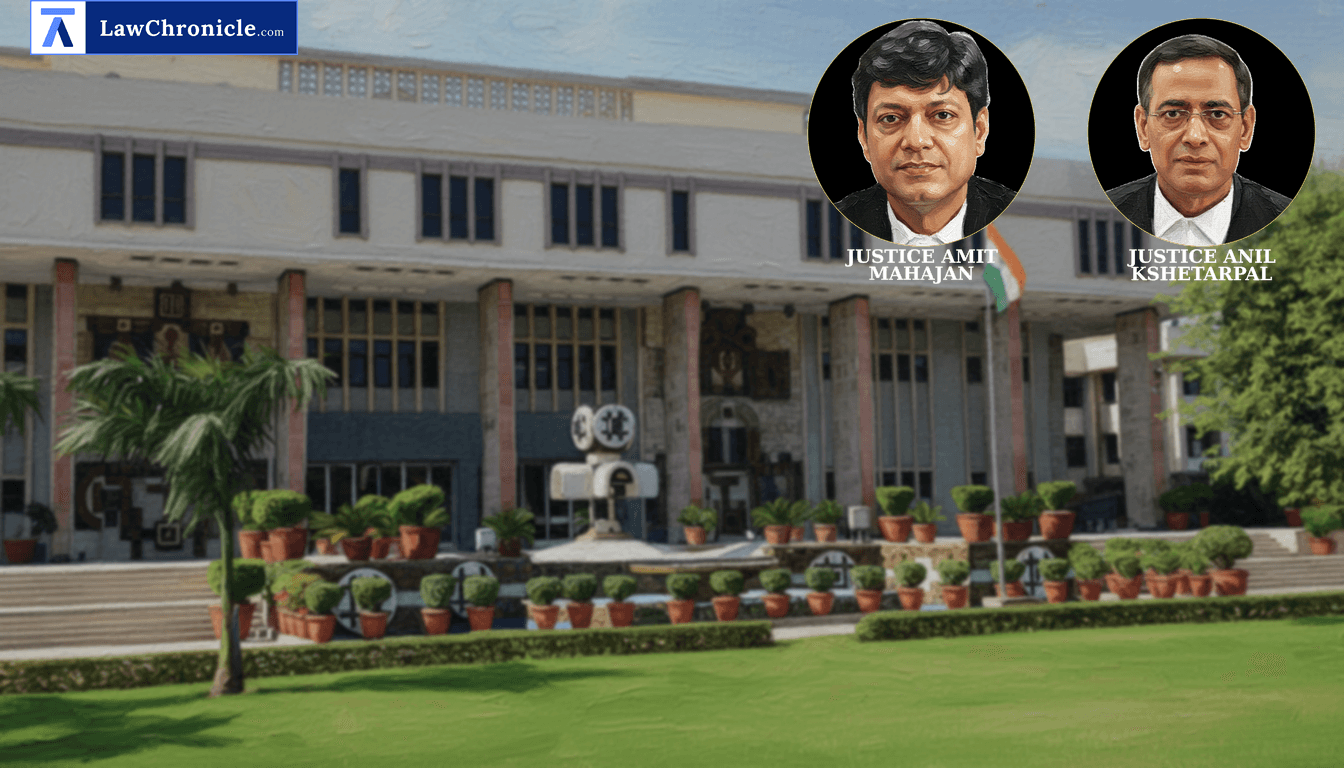
The Delhi High Court has slammed the door on judicial interference in the technical content of competitive examinations, ruling that the determination of whether questions align with a prescribed syllabus remains the exclusive domain of subject experts. In a significant blow to unsuccessful aspirants, the Court affirmed that the judiciary lacks the institutional competence to sit as an appellate body over academic evaluations conducted by the Union Public Service Commission.
A Division Bench comprising Justice Anil Kshetarpal and Justice Amit Mahajan delivered this decisive verdict while hearing a challenge against the Central Administrative Tribunal's refusal to interfere with the Civil Services (Preliminary) Examination, 2023. The Petitioners, aspirants who failed the preliminary stage, alleged that eleven questions in the CSAT Paper-II were derived from Class XI and XII curriculum, violating the statutory rules that restricted mathematical questions to Class X level.
Limited Scope of Judicial Review in Academic Standards
The Court emphasized that its role under the Constitution of India, 1950 is restricted to examining the decision-making process for mala fides or patent illegality. It noted that the UPSC had already constituted an Expert Committee which concluded all questions were within the syllabus. Relying on J.P. Kulshrestha and Ors. vs. Chancellor, Allahabad University, Raj Bhawan and Ors. ( "1980 3 SCC 418": 1980 CaseBase(SC) 469), the Court reiterated that selection is the prerogative of academic bodies and courts should hesitate to dislodge their decisions.
The Court, in its reasoning, observed: "Determination of the nature and standard of questions to be included in a competitive examination lies primarily within the province of subject experts, and courts do not possess the institutional competence to substitute their views for that of duly constituted expert bodies. Even otherwise, mere disagreement with the academic assessment of subject experts by the Petitioners, without demonstrating perversity or manifest error, cannot furnish a ground for judicial interference."
Binding Precedents and the Expert Committee Findings
The Bench pointed out that the Expert Committee report specifically addressed candidates' grievances and found the questions were simply "thought-provoking" and required mental ability expected of aspirants. The Court also cited Siddharth Mishra v. UPSC as a binding precedent, as it involved an identical challenge to the same examination and had already attained finality. Furthermore, the Court highlighted the non-joinder of successful candidates as a fatal procedural flaw, citing Chancellor v. Bijayananda Kar to maintain the sanctity of the selection process.
Court Directions
Given the expert findings and the conclusion of the recruitment cycle, the Court issued no further instructions to the commission. The Court has the following directions:
"The present petition is accordingly dismissed. Pending application(s), if any, also stand disposed of."
Key Takeaways:
Primacy of Expert Opinion
The judiciary will not re-evaluate the difficulty level or syllabus compliance of questions once a competent expert committee has cleared them.
Procedural Finality
Once a selection process is completed and appointments are made, courts are extremely reluctant to grant infructuous reliefs that would disturb the merit list.
Joinder of Necessary Parties
Challenges to competitive examinations are liable to be dismissed if the successful candidates, whose rights might be affected, are not impleaded as parties.
Ratio Decidendi:
The scope of judicial review in academic matters is restricted to examining the legality of the process; courts cannot substitute their opinion for that of subject experts regarding the standard or content of examination questions unless there is proof of manifest arbitrariness or mala fides.
Background:
The dispute originated from the Civil Services (Preliminary) Examination 2023. Candidates challenged 11 questions in Paper-II (CSAT), claiming they exceeded the Class X level syllabus mentioned in the Civil Services Examination Rules, 2023. After their Article 32 petition in the Supreme Court was redirected, they approached the Central Administrative Tribunal (CAT). The CAT dismissed their application, holding that the tribunal cannot define the attributes of a 'good' question paper.
Before the High Court, the UPSC presented a sealed Expert Committee report which confirmed that mathematical questions were confined to Class 10 levels. The High Court also noted that similar challenges in Siddharth Mishra v. UPSC and Pranav Pandey v. UPSC had been rejected previously. Applying principles from Sanchit Bansal & Anr vs Joint Admission Board & Ors, the Court concluded that academic ranking and selection processes are technical matters where courts must keep their 'hands off' unless statutory rules are explicitly violated.
Case Details:
Case No.: W.P.(C) 4354/2025
Case Title: Hanumant Lal Patel & Ors. V. Union Of India & Ors.
Appearances:
For the Petitioner(s): Mr. Ritesh Kumar, Adv.
For the Respondent(s): Mr Balendu Shekhar CGSC with Mr Krishna Chaitanya, Mr Rajkumar Maurya and Mr Divyansh Singh Dev, Advs. for R-1; Mr. Ravinder Agarwal, Mr. Manish Kumar Singh & Mr. Vasu Agarwal Adv. for R-3.
Source: 2026 CaseBase(DEL) 950
Similar Articles
 Breaking News


