


Cutting and Grooving Aluminum Panels Not 'Manufacture' Under Central Excise Act: SC
 Copy Link
 Share
 Save
The Supreme Court has clarified that the process of cutting, routing, and grooving Aluminum Composite Panels (ACPs) to facilitate their installation on buildings does not amount to 'manufacture' as no new distinct commercial product emerges. The Court emphasized that for an activity to be taxable under the Central Excise Act, 1944, it must result in a fundamental transformation of the goods into a marketable product with a new identity.
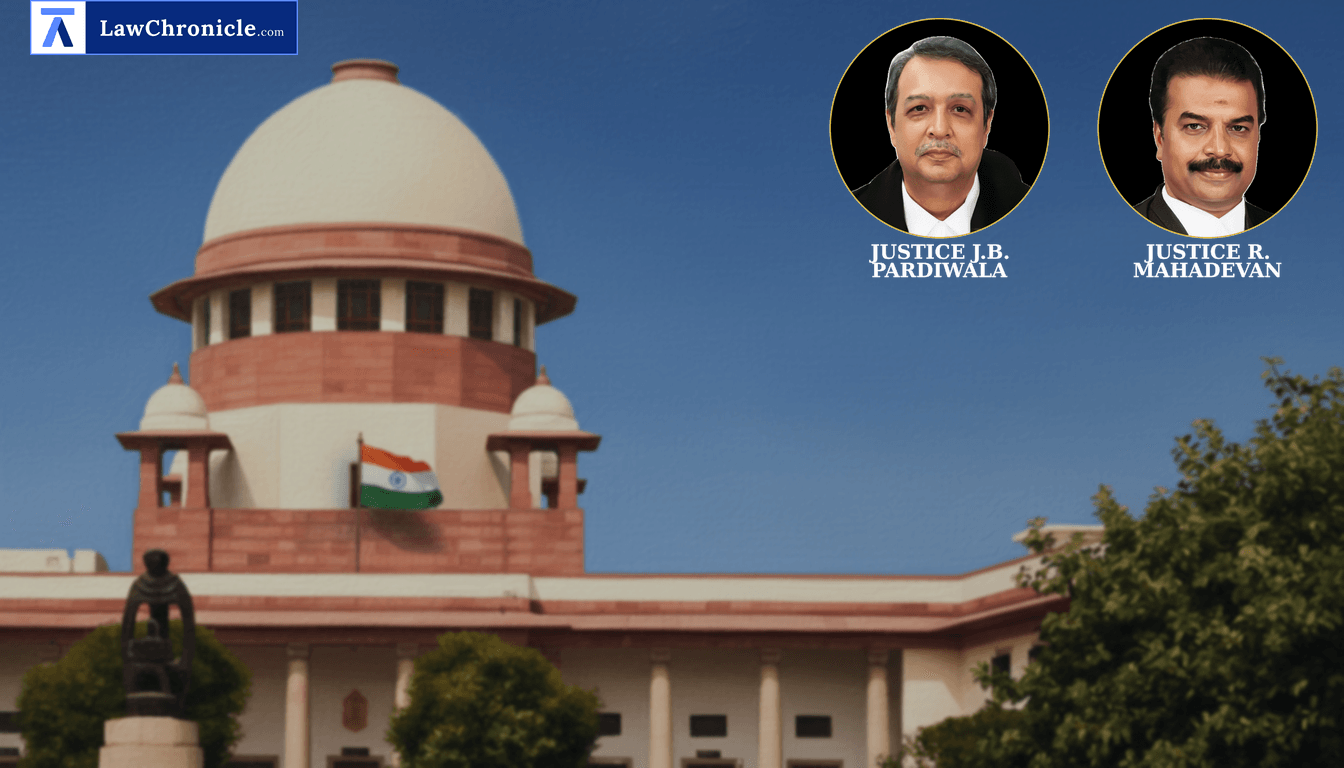
A bench of Justice J.B. Pardiwala and Justice R. Mahadevan set aside a Karnataka High Court judgment that had ruled in favor of the Revenue. The apex court held that the High Court lacked jurisdiction to decide the matter under Section 35G, as disputes relating to the excisability of goods for assessment purposes must be heard by the Supreme Court under Section 35L.
Excisability Disputes and Supreme Court Jurisdiction
The Court observed that the Central Excise Act, 1944 creates a specific appellate scheme where questions relating to the rate of duty or valuation which include the determination of taxability or excisability are excluded from the High Court's jurisdiction. The Bench noted that the Finance (No. 2) Act, 2014 introduced Section 35L(2) to clarify this very point.
The Court, in its reasoning, observed: "The decision on excisability of goods is a precursor to the determination of any question having a relation to the rate of excise duty or to the value of goods for the purpose of assessment. After all, the levy of excise duty presupposes that the goods upon which such assessment is to be made, are downstream consequences of determination of excisability. To hold otherwise would be to sever what is inherently a continuous chain of fiscal adjudication into fragments, which the legislature could never have intended."
The Transformation Test: Processing vs. Manufacture
On the merits, the Court applied the 'transformation test' and the 'marketability test' established in precedents like Union of India v. J.G. Glass Industries Ltd. and Servo-Med Industries (P) Ltd. v. CCE. It found that cutting ACPs into smaller sizes and grooving them merely adapts the panels for specific architectural use without changing their material properties or commercial character.
Referring to Bharat Forge and Press Industries (P) Ltd. v. CCE, the Court noted that turning pipes into pipe fittings through forging or welding does not change their essential character. Similarly, the Court relied on Aman Marble Industries (P) Ltd. v. CCE to highlight that cutting marble blocks into slabs does not constitute manufacture as the end product remains stone.
Background:
The appellant, a construction contractor, imported pre-coated ACPs and performed activities like cutting, routing, and grooving at its premises to fit them onto building facades. Initially, the appellant paid excise duty but later stopped, believing the process did not amount to 'manufacture' under Section 2(f) of the Central Excise Act, 1944. The Revenue issued a show-cause notice demanding duty for the period of April 2002 to December 2003.
While the CESTAT ruled in favor of the assessee, the Karnataka High Court reversed the decision, holding that cutting and grooving created a 'new product' that was commercially identifiable. However, the Supreme Court disagreed, stating that the Revenue failed to prove that the altered panels were marketable as distinct goods. The Court reiterated that the burden of proving marketability lies on the Revenue, and in this case, the ACPs remained ACPs, merely adapted for installation.
Case Details:
Case No.: CIVIL APPEAL NO. 8030 OF 2010
NeutralCitation: 2026 INSC 582
Case Title: M/S ALUPRO BUILDING SYSTEMS PVT. LTD v. COMMISSIONER OF CENTRAL EXCISE BANGALORE-II
Appearances:
For the Petitioner(s): Ms. Charanya Lakshmikumaran, Advocate
For the Respondent(s): Mr. N. Venkataraman, Additional Solicitor General; Mr. G.S. Makker, Advocate; V. Chandrashekara Bharathi, Advocate
Source: 2026 CaseBase(SC) 492
Similar Articles
 Breaking News


