


Delhi HC: International Arbitral Award Not Vitiated by Interpretation of Clauses
 Copy Link
 Share
 Save
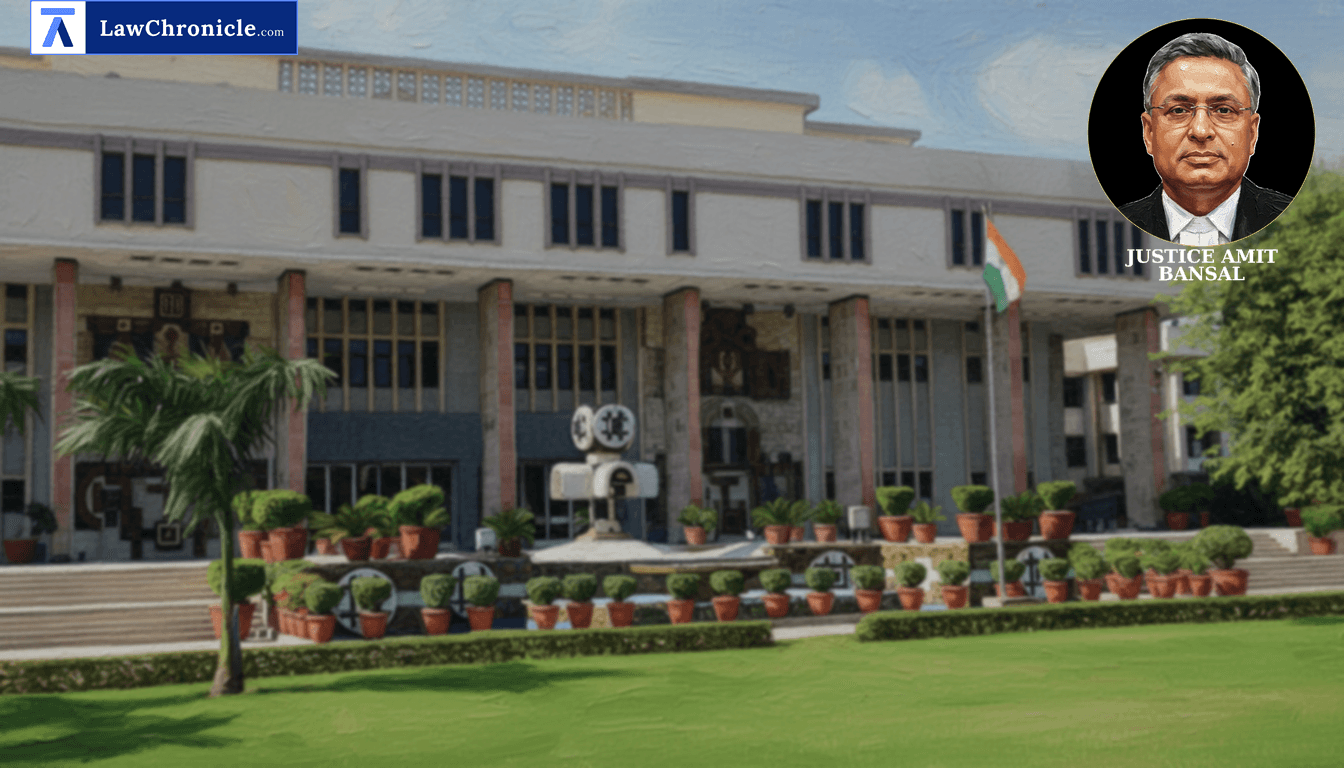
The Delhi High Court has fortified the sanctity of international commercial arbitral awards by ruling that a tribunal’s interpretation of contractual clauses remains final and beyond judicial interference under Section 34 of the Arbitration and Conciliation Act, 1996. The Court held that even if an extension of time is granted conditionally, it necessarily implies that the owner was satisfied that the delay was justified, thereby precluding the imposition of price discounts intended for unexcused delays.
Justice Amit Bansal heard the challenge brought by Indian Oil Corporation Limited against an arbitral award that favored a consortium of Toyo Engineering Corporation and Larsen & Toubro Ltd. The dispute arose from the Naphtha Cracker Project at Panipat, where the petitioner had deducted significant sums as price adjustments for delays and excess utility consumption.
Interpretation of Extension Clauses and Price Discounts
The Court observed that the Arbitral Tribunal’s decision to shift the starting date for discount calculation upon granting an extension of time was a plausible view. The petitioner had argued that the extension was conditional upon a 10% price reduction, but the Court noted that Clause 4.4.2.1 of the General Conditions of Contract (GCC) did not require extensions to be unconditional to trigger a shift in the discount starting date. Relying on Associate Builders v. Delhi Development Authority ( "(2015) 3 SCC 49": 2014 CaseBase(SC) 661) and Ssangyong Engineering and Construction Company Limited v. National Highways Authority of India (NHAI) ( "(2019) 15 SCC 131": 2019 CaseBase(SC) 226), the Court reiterated that in international commercial arbitrations, the ground of patent illegality is unavailable, and courts cannot substitute their own interpretation for that of the tribunal.
The Court, in its reasoning, observed: "The view taken by the Arbitral Tribunal as set out in the paragraphs hereinabove is clearly a plausible view and cannot be subject matter of interference under Section 34 of the Act. It is a settled position of law that the interpretation placed by the Arbitral Tribunal on various clauses of the contract is final and cannot be interfered with under Section 34 of the Act."
The Applicability of Section 74 of the Indian Contract Act
While the Tribunal also found the price discount clause to be a penalty under Section 74 of the Indian Contract Act, 1872, the Court clarified that this was an alternative finding. Since the primary finding that the delay was justified and the discount starting date had shifted was sound, the secondary finding on the penal nature of the clause did not affect the ultimate outcome. The Court noted that even under Indian Contract Act, 1872, the petitioner had failed to prove actual damages, a requirement underscored in precedents like Fateh Chand v. Balakrishnan Dass and Indian Oil Corporation Limited v. Fabtech Works and Constructions.
Adjudication on Arbitrability and Jurisdiction
The petitioner had challenged the jurisdiction of the tribunal, claiming that the respondents failed to satisfy mandatory pre-conditions like notifying claims under Clause 6.6.1.0 of the GCC. However, the Court upheld the tribunal’s interpretation that the disputes fell under the second category of the arbitration clause disputes arising out of amounts claimed by the owner against the contractor which do not require separate notification. In doing so, the Court harmonized various clauses, following principles laid down in Shapoorji Pallonji v. Ratan India Power and Bank of India v. K. Mohandas and Ors. ( "(2009) 5 SCC 313": 2009 CaseBase(SC) 675).
The Court has the following directions:
"The present petition is dismissed. The bank guarantees furnished by the respondents shall stand discharged after a period of four (4) weeks from today."
Key Takeaways:
Tribunal's Finality on Interpretation
Courts will not interfere with a tribunal’s interpretation of a contract under Section 34 of the Arbitration and Conciliation Act, 1996 as long as the view is plausible, particularly in international commercial arbitrations.
Justified Delay Negates Penalty
An owner’s decision to grant an extension of time under clauses requiring 'satisfaction of justified delay' effectively waives the right to claim price discounts for that period.
Narrow Scope of Public Policy
Following Renusagar Power v. General Electric, 'public policy' is construed narrowly and does not permit a review of the merits or the reappreciation of evidence.
Harmonious Construction of Contract
Specific provisions in one part of a contract, such as those in parenthesis in Arbitration and Conciliation Act, 1996 clauses, can be used to interpret similar but less detailed provisions elsewhere in the same agreement to ensure internal harmony.
Ratio Decidendi:
In international commercial arbitrations, the interpretation of contractual clauses and the appreciation of evidence lie within the exclusive domain of the Arbitral Tribunal. Judicial interference is prohibited unless the award is in conflict with the fundamental policy of Indian law or basic notions of justice. A finding that an extension of time renders a price discount clause inapplicable constitutes a plausible contractual interpretation that does not warrant interference.
Background:
The dispute originated from a 2006 contract for a Naphtha Cracker Project at Panipat. The respondent consortium achieved mechanical completion in 2010, after which the petitioner granted an extension of time but simultaneously imposed a 10% price reduction. The respondents challenged this deduction through arbitration. The tribunal ruled in favor of the respondents, holding that the extension shifted the discount starting date and that the discount clause was a penalty under Section 74 of the Indian Contract Act, 1872 without proof of loss. The petitioner moved the High Court seeking to set aside the award, which the High Court ultimately refused, dismissing the petition and discharging the bank guarantees.
Case Details:
Case No.: O.M.P. (COMM) 316/2019
Case Title: Indian Oil Corporation Limited V. Toyo Engineering Corporation & Anr.
Appearances:
For the Petitioner(s): Mr. Rajeev Sharma, Senior Advocate with Mr. Himanshu Gulliya, Ms. Arunima Singh & Mr. Nishant Kandpal, Advocates.
For the Respondent(s): Mr. Sudipto Sarkar, Senior Advocate, Mr. Dayan Krishnan, Senior Advocate, Mr. Rajshekhar Rao, Senior Advocate, along with Mr. Susmit Pushkar, Mr. Sudip Mullick, Mr. Anchit Oswal and Mr. Gaurav Sharma, Advocates.
Source: 2026 CaseBase(DEL) 504
Similar Articles



 Breaking News


