


Delhi HC: Section 37 of Arbitration Act Is Supervisory, Not Corrective
 Copy Link
 Share
 Save
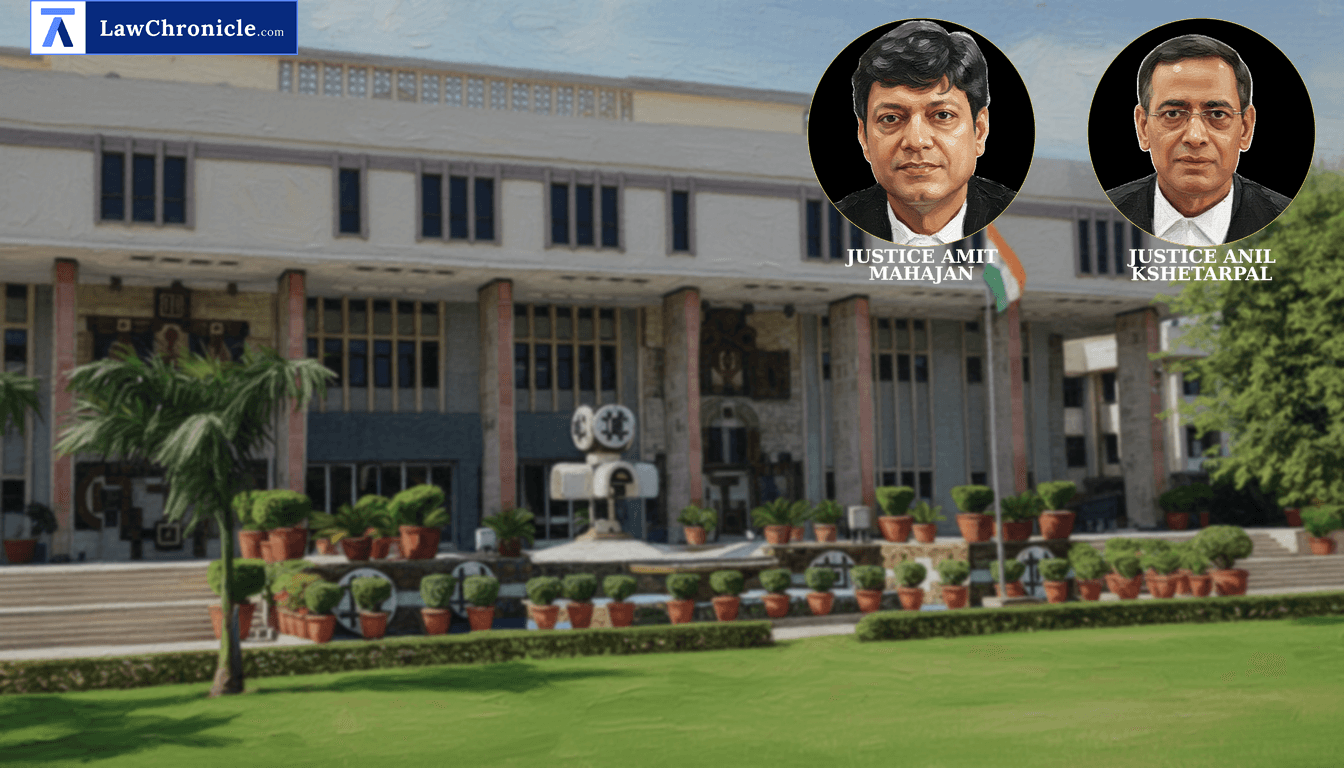
In a decisive ruling reinforcing the sanctity of arbitral autonomy, the Delhi High Court affirmed that appellate jurisdiction under Section 37 of the Arbitration and Conciliation Act, 1996 is strictly confined to ensuring the lower court acted within statutory boundaries and does not permit a merits-based reappraisal of evidence. A Division Bench comprising Justice Anil Kshetarpal and Justice Amit Mahajan delivered this observation while dismissing an appeal by the National Highways Authority of India, emphasizing that judicial restraint is paramount when an arbitral award has already survived scrutiny under Section 34.
The Court, in its reasoning, observed: "The appellate power of Section 37 of the Act is limited within the domain of Section 34 of the Act. It is exercisable only to find out if the court, exercising power under Section 34 of the Act, has acted within its limits as prescribed thereunder or has exceeded or failed to exercise the power so conferred. The Appellate Court has no authority of law to consider the matter in dispute before the arbitral tribunal on merits so as to find out as to whether the decision of the arbitral tribunal is right or wrong upon reappraisal of evidence as if it is sitting in an ordinary court of appeal."
Judicial Restraint and the Supervisory Nature of Section 37
The bench reiterated that the scope of interference under Section 37 of the Arbitration and Conciliation Act, 1996 is even narrower than that contemplated under Section 34. Drawing from MMTC Ltd. v. Vedanta Ltd. ( "(2019) 4 SCC 163": 2019 CaseBase(SC) 3410) and Punjab State Civil Supplies Corpn. Ltd. v. Sanman Rice Mills, the Court noted that once an award is confirmed by a Section 34 court, concurrent findings should not be disturbed unless they suffer from patent illegality or perversity. The Court further relied on UHL Power Co. Limited v. State of Himachal Pradesh ( "(2022) 4 SCC 116": 2022 CaseBase(SC) 1043) to clarify that the jurisdiction of an appellate court in examining an order setting aside or refusing to set aside an award is highly circumscribed. Regarding the appellant's grievance over a delay in pronouncing the judgment, the Court cited M/s Dhir International Pvt. Ltd. v. Karnataka Bank Ltd. to conclude that while undesirable, such delay is not fatal unless it causes demonstrable prejudice.
Findings on Compensation for Fragmented Site Handover
Court's Rationale on Claim No. 3
The dispute primarily concerned additional mobilization costs and idling charges arising from the appellant's failure to hand over project land in a staged manner. The Tribunal had found that the site was released in thirty-six fragments, necessitating extra machinery. The Court upheld this, stating that the use of contemporaneous Monthly Progress Reports and the application of Section 73 of the Indian Contract Act, 1872 provided a sound evidentiary basis. The Court rejected the argument that damages were speculative, noting that the Tribunal had actually used the appellant's own data to arrive at a conservative figure, satisfying the principles laid down in NHAI v. IRB Pathan Kot Amritsar Toll Road Ltd. and Kailash Nath v. DDA.
Entitlement to Bonus as Damages for Breach
Interpretation of Contractual Incentives
A significant legal point addressed was whether a contractor can claim 'bonus' when the contract period is extended. The Court clarified that while Clause 47.3 of the contract might prohibit contractual bonus in extended periods, the Tribunal rightly treated the claim as 'loss of opportunity' damages under the Indian Contract Act, 1872. The court distinguished this from the enforcement of a contractual incentive, viewing it instead as compensation for a breach that deprived the contractor of the chance to earn the bonus. This interpretation remained consistent with Plus 91 Security Solution v. NEC Corporation India Pvt. Ltd. regarding the enforcement of damage-limitation clauses.
Background:
The litigation originated from a 2001 agreement for the widening of National Highway-5 in Andhra Pradesh. Completion was delayed from 2004 to 2005, leading to arbitration where a three-member Tribunal awarded the respondent compensation for additional mobilization, idling, and loss of bonus. NHAI challenged this under Section 34, but the Single Judge of the Delhi High Court declined interference in 2025. NHAI then moved the current appeal under Section 37, contending that the award was based on "deemed idling" and hypothetical calculations without proof of actual loss. The High Court, however, found that the Tribunal’s findings were plausible and grounded in the factual records of the project Engineer.
Case Details:
Case No.: FAO(OS) (COMM) 131/2025
Case Title: NATIONAL HIGHWAYS AUTHORITY OF INDIA v. M/S UNITECH-NCC JV
Appearances:
For the Petitioner(s): Mr. Vikas Goel, Mr. Ritesh Sharma, Mr. Vivek Gupta & Ms. Anisha Dahiya, Advs.
For the Respondent(s): Ms. Priya Kumar, Sr. Adv. with Mr. Rishabh Dheer, Ms. Aishwarya Singh, Mr. Sarthak Bhardwaj, Mr. Prateek Srivastava & Ms. Ekaa Sharma, Advs.
Source: 2026 CaseBase(DEL) 463
Similar Articles
 Breaking News


