


Delhi High Court Grants Bail to Two Accused in NIA Terror Conspiracy Case Citing Prolonged Incarceration and Limited Role
 Copy Link
 Share
 Save

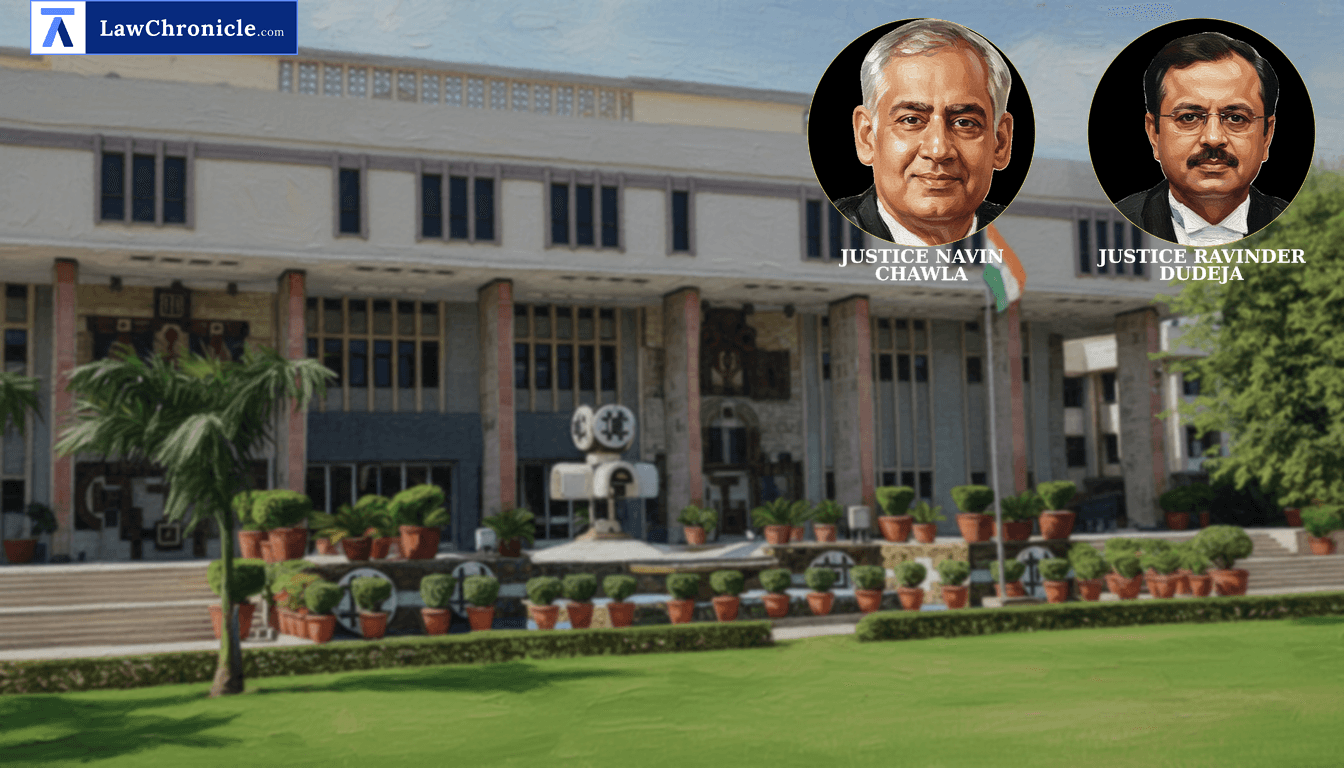
A bench of Justice Navin Chawla and Justice Ravinder Dudeja heard appeals by appellants challenging the trial court's order dated 03.03.2023 which had rejected their bail applications in an NIA-registered case arising out of allegations of a large-scale terrorist conspiracy in Jammu & Kashmir and elsewhere. The appeals were filed under Section 21(4) of the NIA Act read with Section 43-D(5) of the UAPA.
The High Court set aside the trial court's order and granted conditional bail to both appellants, holding that the statutory threshold under Section 43D(5) of the UAPA was not attracted in their cases given the prosecution material and the prolonged period of pre-trial detention. The court relied on the framework recently articulated by the Supreme Court in Gulfisha Fatima and held that the inquiry at the bail stage required an accused-specific assessment of whether the prosecution material, "taken at face value, discloses the essential statutory ingredients of the alleged offence."
The Court, in its reasoning, observed: "Where these requirements are met, the statutory restraint on the grant of bail must operate with full force; where they are not, the embargo stands lifted. This approach preserves the legislative purpose of the Act, and ensures that the exceptional nature of the bail regime under Section 43D(5) is neither diluted by overreach nor distorted by mechanical application."
The court further noted that "continued detention may amount to a violation of their right under Article 21 of the Constitution of India." The appellants were ordered released on bail on furnishing bonds of Rs.50,000 with two sureties of like amount and subject to stringent conditions including surrender of passports, reporting requirements, restrictions on social media activity and communications with witnesses, and regular attendance before the local police.
Background
The prosecution alleged a conspiracy orchestrated by Pakistan-based handlers and proscribed organisations using hybrid cadres and over-ground workers to radicalise and mobilise youth for terrorist activity following the revocation of Article 370. FIR RC-29/2021/NIA/DLI was registered on 10.10.2021 under Sections 120B, 121A, 122, 123 IPC and various provisions of the UAPA. NIA investigation relied on digital device scrutiny, call detail records (CDRs), social media content and witness statements. The charge sheet (first filed 08.04.2022, supplemented 20.03.2023) charged the present appellants under Sections 120B and 121A IPC and Section 18 UAPA; other sections were discharged by the trial court.
Specific allegations against appellant no. 14 included propagating IS/ISJK-related material, membership of online propaganda groups and functioning as an OGW/hybrid cadre; appellant no. 15 was alleged to have operated a YouTube channel that uploaded edited lectures incorporating extremist insignia and to have facilitated dissemination of radical content. Both were arrested in October 2021 and remained in custody for around four years and four months at the time of this order. The trial court had rejected bail on the ground that the allegations prima facie attracted the embargo under Section 43D(5).
At the High Court, defence counsel emphasised delay in trial, the volume and pace of witnesses (prosecution estimated hundreds of witnesses), limited role attributed to the appellants, absence of overt acts, brief CDR contacts, cell-tower proximity explanations, and that one key witness did not identify accused no.14 as having instigated or shared material. The prosecution relied on digital-forensic reports, CDRs, cell location data, and witness statements and argued that Section 18 UAPA extended to planning, coordination or mobilisation and that the prima facie threshold was satisfied.
Applying the Gulfisha Fatima framework and other precedents, the High Court found that the prosecution material, read as a whole, did not establish a prima facie nexus to terrorist activity sufficient to sustain the embargo in the appellants' cases, particularly given their limited attributed roles, the non-creation of alleged content by them, the witness identification issue, the prolonged incarceration and the medical ailment of accused no.15 (cervical spondylosis). The court stated, "The Impugned Order is hereby set aside," and imposed detailed bail conditions to safeguard trial integrity and national security interests. The court clarified that its observations were confined to the bail exercise and were not expressions on the merits; it directed communication of the order to the trial court and jail authorities.
Case Details:
Case No.: CRL.A. 406/2023 & CRL.A. 408/2023
Case Title: HARIS NISAR LANGOO v. NATIONAL INVESTIGATION AGENCY; ZAMIN ADIL BHAT v. NATIONAL INVESTIGATION AGENCY
Appearances:
For the Petitioner(s): Ms. Tara Narula; Ms. Priya Vats; Mr. Jawahar Raja; Ms. Tamana Pankaj; Ms. Sonal Sarda; Ms. Aditi Saraswat; Ms. Nitai Hinduja (Advocates)
For the Respondent(s): Mr. Gautam Narayan, Senior Advocate/SPP; Ms. Asmita Singh; Mr. Shashank Jain; Mr. Geet Kumar; Mr. Prabhat Bajpai (Advocates)
Source: 2026 CaseBase(DEL) 141
Similar Articles

 Breaking News


