


High Courts Must Stop Routine Stay of Trial in Interlocutory Revisions: SC
 Copy Link
 Share
 Save
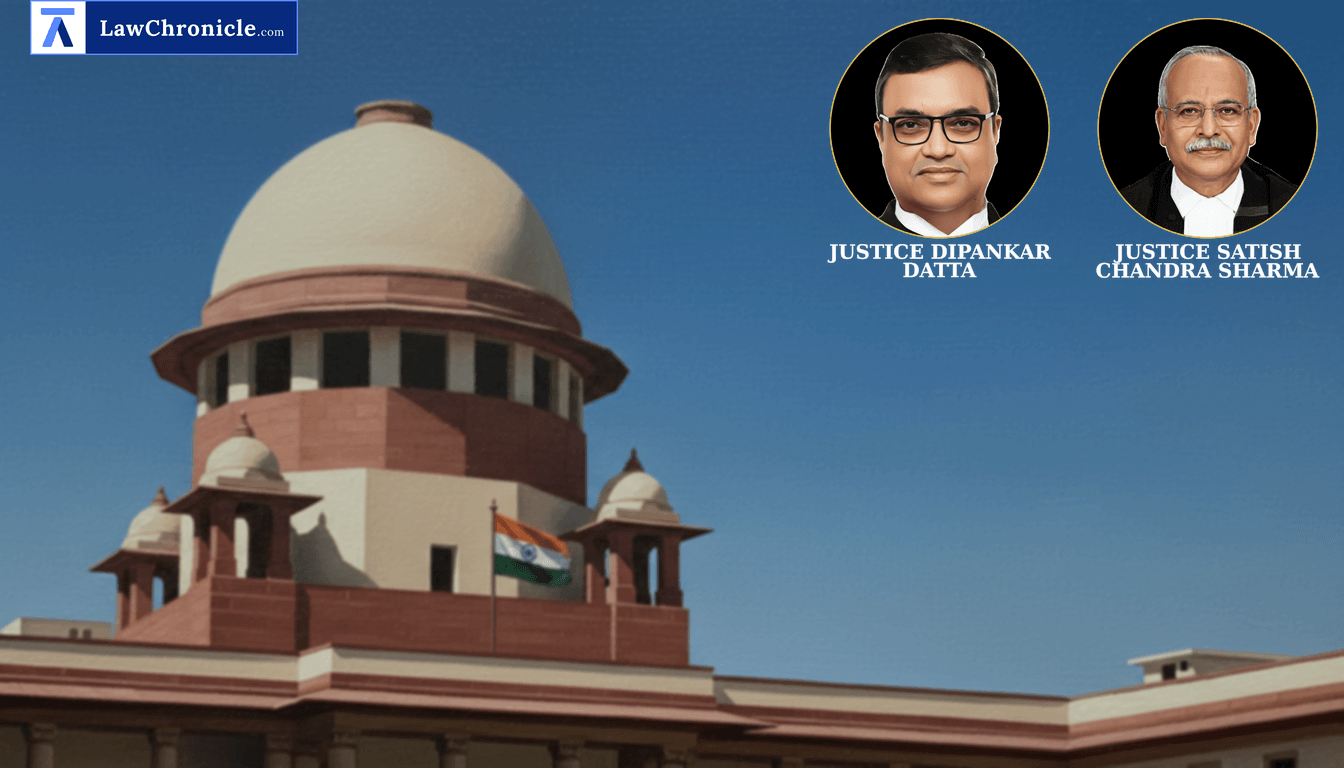
Rebuking High Courts for overstepping revisional limits and routinely paralyzing lower court proceedings, the Supreme Court has ruled that trial stays during interlocutory revisions must be eschewed unless irreparable prejudice is demonstrated. The landmark judgment sternly cautions High Courts against assuming the role of trial courts while dealing with plaint rejection applications, emphasizing that judicial time must be prudently prioritized.
A Division Bench comprising Justice Dipankar Datta and Justice Satish Chandra Sharma set aside a 117-page High Court order that had rejected a suit plaint under Order VII Rule 11 of the Code of Civil Procedure, 1908. Hearing appeals against the High Court's exercise of revisional jurisdiction, the Bench highlighted how the routine grant of stay orders had stalled the civil suit for seven long years without even the written statements being filed.
Key Takeaways
End to Routine Trial Stays
High Courts must refrain from granting routine stay of trial when issuing notice in interlocutory revisions unless deeper scrutiny reveals irreparable prejudice.
Strict Limits on Section 115 Revisions
Revisional jurisdiction under Section 115 of the Code of Civil Procedure, 1908 cannot be treated as a full appellate rehearing or an arena to appreciate extraneous documents.
Order VII Rule 11 Boundary Reaffirmed
Threshold rejection of a plaint must be judged strictly on the basis of averments inside the plaint and annexed documents, not defense claims.
Prudent Use of Judicial Time
High Courts are reminded that expending massive judicial bandwidth authoring lengthy orders on unmeritorious revisional challenges causes institutional disservice.
Decoding the distinct boundaries of High Court powers, the Supreme Court emphasized that revisional jurisdiction under Section 115 of the Code of Civil Procedure, 1908 is strictly supervisory and limited to jurisdictional errors, illegalities, or material irregularities. The Court noted that the High Court completely failed to explain how the Trial Court erred in refusing to reject the plaint.
The Court has following directions:
"The relevant suit, thus, would revive on the file of the Trial Court. In view of stay of the trial since the last 7 (seven) years, we grant liberty to the defendants to file their respective written statements, if not already filed, within 8 (eight) weeks from today. We request the Trial Court, subject to the docket of matters before it, to frame the issues within a further period of 6 (six) weeks of the written statement(s) being filed. Bearing in mind the dicta of this Court in High Court Bar Association Allahabad v. State of Uttar Pradesh, we do not propose to set a timeline for conclusion of the trial; however, it would be eminently desirable for the Trial Court to endeavour to conclude the trial at the earliest without granting unnecessary adjournments."
The Court, in its reasoning, observed: "Unless the high courts, on an examination deeper than prima facie, arrive at a finding that continuation of the trial would seriously and irreparably prejudice the outcome of the revision or adversely affect the parties, stay of the trial ought to be eschewed."
Addressing the improper exercise of Order VII Rule 11 powers, the Supreme Court further noted: "With a deep sense of anguish, we cannot but observe that the very fundamentals of consideration of an application under Order VII Rule 11, CPC seem not to have been present in the mind of the High Court in the present case."
Ratio
Revisional jurisdiction under Section 115 of the Code of Civil Procedure, 1908 is strictly supervisory and confined to jurisdictional errors; High Courts cannot re-appreciate facts or rely on external documents outside the plaint while evaluating an application under Order VII Rule 11 of the Code of Civil Procedure, 1908. Furthermore, routine stays of trial proceedings in interlocutory challenges must be eschewed unless continuation of trial causes serious and irreparable prejudice.
Background
The dispute originated from Special Civil Suit No. 408 of 2017 filed by the appellant and International Asset Reconstruction Company Private Limited seeking declarations to render certain sale deeds null and void, along with possession and monetary damages. Shortly after the suit was instituted, the defendants filed applications under Order VII Rule 11 of the Code of Civil Procedure, 1908 seeking rejection of the plaint, asserting lack of cause of action and legal bars under Section 11 and Section 47 of the Code of Civil Procedure, 1908.
The Trial Court rejected the applications, holding that suppression of documents and issues of res judicata or limitation required examination at trial, relying on the settled principles reaffirmed in T. Arivandandam v. T.V. Satyapal ( "(1977) 4 SCC 467": 1977 CaseBase(SC) 44). Aggrieved, the defendants moved revision petitions under Section 115 of the Code of Civil Procedure, 1908 before the High Court of Judicature at Bombay, Nagpur Bench. The High Court allowed the revisions in a lengthy judgment and rejected the plaint.
Reversing the decision, the Supreme Court highlighted the historical context and recommendations of the 14th Law Commission Report on controlling revisional delays. Relying on Shiv Shakti Coop. Housing Society v. Swaraj Developers, the Supreme Court stressed the fundamental distinction between an appeal and a revision. The Bench noted that the High Court improperly donned the hat of a trial court by examining documents outside the plaint. While restoring the suit, the Supreme Court cited High Court Bar Association Allahabad v. State of Uttar Pradesh ( "(2024) 6 SCC 267": 2024 CaseBase(SC) 453) regarding timelines for trial completion and vacated all interim orders.
Case Details:
Case No.: Civil Appeal No. ... of 2026 [Arising out of SLP (C) No. 14435 of 2024]
Neutral Citation: 2026 INSC 925
Case Title: Madhav Vidarbha Estate Pvt. Ltd. v. Praharsh Corporation Pvt. Ltd. & Ors.
Appearances:
For the Petitioner(s): Dr. Abhishek Manu Singhvi, Senior Advocate; Mr. Pravin Samdani, Senior Advocate
For the Respondent(s): Mr. Ranjit Kumar, Senior Advocate; Mr. Jaydeep Gupta, Senior Advocate
Source: 2026 CaseBase(SC) 918
Similar Articles
 Breaking News


