


Hospital-Bed Execution of Registered Will Fails Proof of Sound Mind: Madras HC
 Copy Link
 Share
 Save
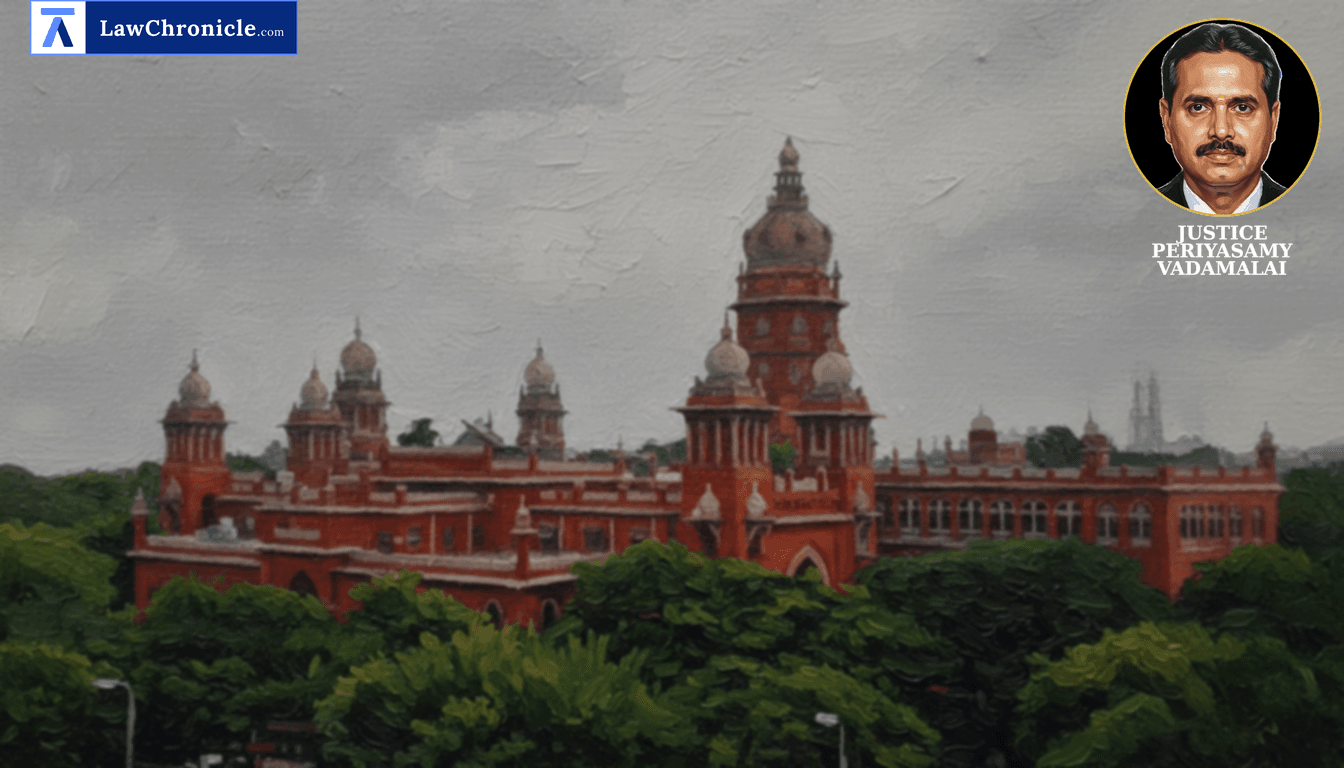
The Madras High Court has reinforced the stringent burden of proof on propounders of Wills executed in medical extremity, ruling that mere registration cannot salvage a testament where the testator's mental capacity is clouded by debilitating illness and imminent death. In a significant clarification of testamentary law, the Court held that when a Will is executed by a patient on their deathbed, the absence of clear medical evidence regarding their rational state of mind renders the document legally unsustainable.
Justice P. Vadamalai, presiding over the Madurai Bench, delivered this decision while hearing an appeal against a partition decree. The Court scrutinized the circumstances surrounding a registered Will executed just nine days before the testator's death, emphasizing that judicial conscience must be satisfied regarding the 'free will' and 'sound state' of the deceased when faced with evidence of severe physical and mental feebleness.
The Requirement of Sound Mind under Indian Law
The Court delved into the statutory requirements for a valid Will, specifically referencing Section 59 of the Indian Succession Act, 1925. It noted that for a testament to be binding, the propounder must demonstrate that the testator was capable of understanding the nature and effect of the dispositions. The Court, in its reasoning, observed: "...the condition of the testator's mind may be very feeble and debilitated at the relevant time... to infer the sound mind of the person, there must be evidence to show his/her capability of understanding the nature of things and being able to make rational judgment about his/her interest."
Suspicious Circumstances and Testamentary Capacity
The Court observed that the Will (Ex.B.7) was executed while the testatrix was an inpatient suffering from severe Aplastic Anemia and Chronic Hepatitis B. Despite being a registered document, the Court found the timing of its execution immediately prior to a discharge 'at request' when her condition was progressively worsening to be highly suspicious. The Court noted that the 2nd Defendant, who stood to benefit, failed to examine the treating physician to dispel doubts about the testatrix's mental state.
Referring to the legal principles established in Bharpur Singh and Ors. v. Shamsher Singh ( "(2009) 3 Supreme Court Cases 687": 2008 CaseBase(SC) 110) and Dr. Prakash Soni Vs. Deepak Kumar and Another, the Court reiterated that if execution is surrounded by suspicious circumstances, the onus shifts heavily to the propounder to remove every legitimate doubt. The Bench also highlighted the importance of Section 12 of the Indian Contract Act, 1872 in assessing what constitutes a 'sound mind' for making a rational judgment.
Failure to Prove Free Will and Rational Judgment
While the 2nd Defendant relied on the testimony of an attesting witness (DW.4) and the presumption of regularity under Section 60 of the Indian Registration Act, citing Irudayam Ammal and Ors. v. Salayath Mary and Senthilkumar v. Dhandapani and Others, the Court found these insufficient. The contradictions regarding where the Will was written the hospital vs. the home coupled with the fact that a thumb impression was used instead of the testatrix's usual signature, further weakened the propounder's case.
The Court has following directions:
"The judgment and decree dated 23.12.2016 passed in O.S.No.165 of 2010 on the file of the learned II Additional District Judge, Tiruchirappalli are confirmed. No costs. Consequently, the connected Civil Miscellaneous Petition is closed."
Background:
The dispute arose between siblings regarding the properties left by their parents, Karuppannan Chettiar and Janakiammal. The plaintiff (1st Respondent) sought partition, claiming the parents died intestate. However, the 2nd defendant (Appellant) produced a registered Will executed by their mother Janakiammal on December 20, 2004, and a settlement deed by their father. The Trial Court had invalidated the mother's Will on the grounds of unsound mind but upheld the father's settlement deed and declared items 22 and 23 as the plaintiff's self-acquired property. The High Court, upon re-evaluating the evidence, particularly the medical records (Ex.X.1 to Ex.X.3) showing the mother was 'deeply icteric' and her condition was 'worsening' at the time of the alleged execution, affirmed the Trial Court's findings. The appeal was dismissed, and the plaintiff was held entitled to his 1/4th share.
Key Takeaways:
Registration Is Not Absolute Proof
The mere fact that a Will is registered does not automatically prove it was executed by a person in a sound state of mind.
Propounder's Heavy Burden in Medical Extremity
When a testator is hospitalized and severely ill, the beneficiary must provide cogent medical evidence or testimony from treating doctors to prove testamentary capacity.
Suspicion Arising from Exclusion of Natural Heirs
While a testator can disinherit heirs, doing so without explanation while in a debilitated state adds to the suspicious circumstances the Court must scrutinize.
Ratio Decidendi:
The binding legal principle is that when the execution of a Will is surrounded by suspicious circumstances such as the testator being in a terminal or extremely feeble medical state the propounder must prove not only the formal execution under Section 68 of the Indian Evidence Act, 1872 but also the sound disposing state of mind and testamentary capacity to the satisfaction of the Court's conscience.
Case Details:
Case No.: A.S(MD)No.110 of 2017
NeutralCitation: 2026:MHC:2533
Case Title: A.K. Kumaravel v. K. Ravi and Others
Appearances:
For the Petitioner(s): Mr.V.Meenakshi Sundaram for Mr.R.Mohana Sundaram
For the Respondent(s): Mr.J.Barathan (for R1), Mr.P.Sesubalan Raja (for R2)
Source: 2026 CaseBase(MAD) 325
Similar Articles

 Breaking News


